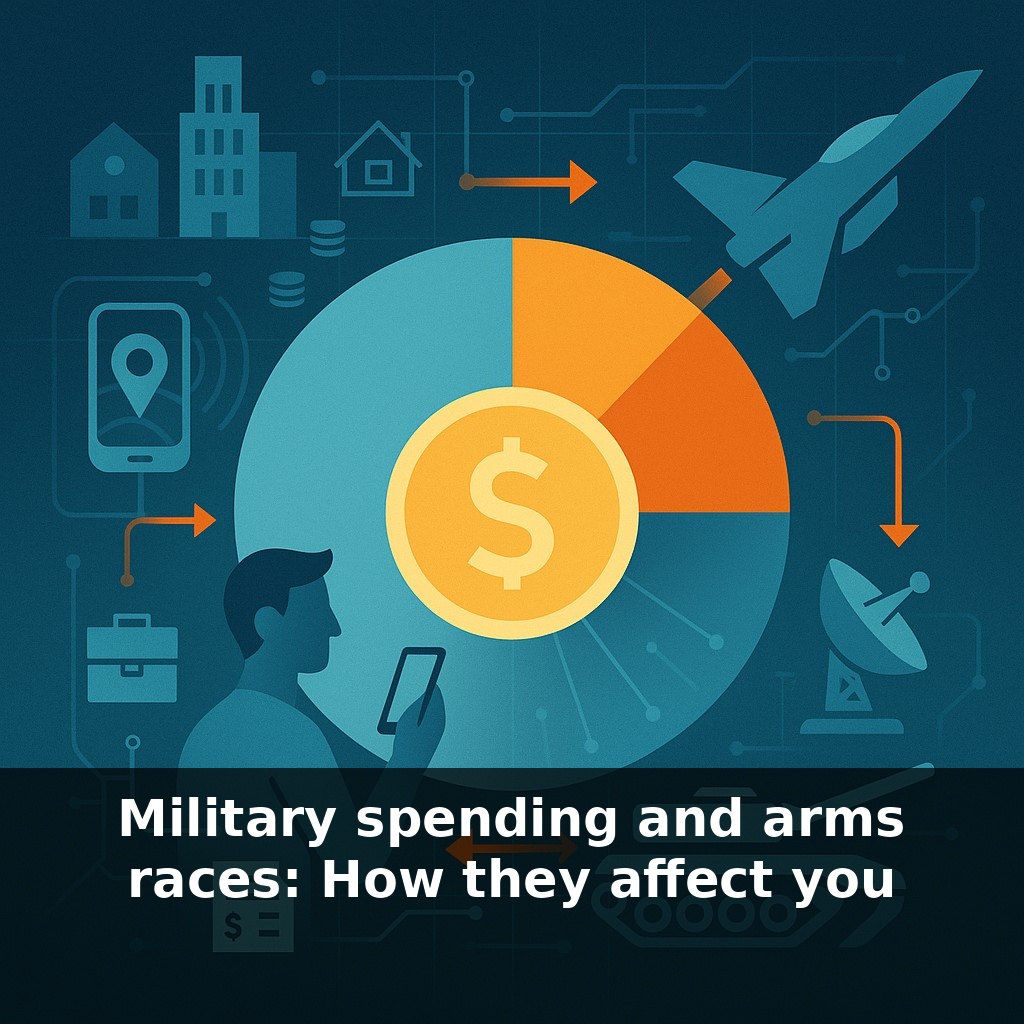
Right now, for every ten dollars created in the world, about one goes to the military. You’re not in a war room, you’re in your car, your kitchen, on a walk—yet your rent, your job prospects, even your phone’s GPS are shaped by decisions in those sealed defence meetings.
That money doesn’t just vanish into distant bases and secret labs; it quietly rewrites your personal budget and your future options. When governments prioritise tanks and jets, they’re also choosing what *not* to fund with the same dollars: cheaper public transport, less student debt, shorter hospital waiting lists. You meet those choices in subtle ways—on your payslip, in overcrowded classrooms, in the time it takes to see a doctor.
But the story isn’t simply “guns versus butter.” Defence spending can mean local jobs, high-tech factories in small towns, and research that later powers civilian breakthroughs. It can also mean higher taxes, or cuts elsewhere, when an arms race forces everyone to keep up. In this episode, we’ll zoom in on that trade-off: how arms races start, why they’re so hard to stop, and the concrete ways they bend prices, careers and public services around you.
When countries enter a spiral of military one‑upmanship, the effects spread far beyond defence ministries. Interest rates, housing demand and even which degrees pay off can shift. Think of how high-tech defence hubs attract engineers and push up local rents, while other regions lose out on investment. Internationally, big buyers can sway currency values and global supply chains—more missiles can mean more pressure on rare minerals, metals, even skilled welders. And because rivals often buy from different suppliers, whole trade blocs and alliances can quietly reorganise around these flows of money and hardware.
Listen to budget debates or headlines and you’ll hear a simple story: spend more on defence to be safe, cut it to fund everything else. Reality is messier. The core puzzle is *how much is enough*—and what happens when countries overshoot that “enough” point because they’re watching each other rather than their citizens.
Strategists sometimes talk about a “minimum credible deterrent”: the level where a rival knows attacking you would be too costly, so they don’t. Beyond that, every extra dollar buys less real safety. In a rivalry, though, leaders rarely admit they’ve hit “enough.” If the other side adds new drones or expands a naval fleet, matching it can feel politically unavoidable, even when generals privately say the core balance hasn’t changed much.
You feel that dynamic not just through taxes but through *what gets prestigious*. If your country is locked in a technological arms race, engineering degrees, cybersecurity and aerospace suddenly look like golden tickets; arts funding, social work or basic science can stagnate. Over a decade, that reshapes whole cohorts’ skills—and what kinds of companies your city attracts.
Then there’s where the money physically lands. Defence contracts often cluster in swing regions or areas with powerful politicians. Two towns with similar unemployment can get wildly different futures depending on whether they host a shipyard, a satellite plant, or nothing at all. For workers, that can mean high-paid, specialised jobs that don’t easily transfer if a program is cancelled. The same welders or software engineers might have built bridges or medical devices instead—work less vulnerable to a single parliamentary vote.
On the household level, timing matters. A surge in spending during a crisis can feel almost invisible if it’s financed by debt. The real squeeze may show up years later as austerity: frozen wages for teachers, higher fees at public universities, slower upgrades to public transit—just as interest payments on past military splurges lock in.
Your challenge this week: pick one recent military purchase your government has announced—a jet, a ship, a cyber unit—and trace it as far as you can. Who builds it? Which town gains jobs? Which line in the budget quietly shrank to make room?
Think about more concrete price tags. A single advanced air-defence battery can cost close to what a mid‑sized city needs to modernise its water system. When that order goes through, steel mills, chip fabs and logistics firms light up with business; civil engineering firms that specialise in flood barriers or metro lines might watch their tenders stall. The same pattern shows up in education: specialised scholarships suddenly appear for AI, cryptography and aerospace materials, while grants for early‑childhood care or geriatric medicine stay flat.
On your grocery receipt, you may see indirect ripples. Heightened tensions often trigger “risk premia” on shipping routes and insurance, nudging up the cost of traded food and fuel. University career fairs tilt too: defence contractors sponsor hackathons and labs, while local clinics or NGOs can’t match the starting salaries. It’s a bit like a music scene where one genre suddenly grabs all the festival slots—other styles don’t vanish, but they get pushed to the smaller, harder stages.
Arms races increasingly spill into domains you touch every day: phone apps hardened for cyber‑conflict, satellites routing your map data, AI models trained with defence grants. As borders blur between “military” and “civilian” tech, your privacy, job options and even which startups get funded are shaped by security planners you’ll never meet. Voting, investing and career choices quietly nudge this system—like tiny course corrections on a long flight that eventually change which continent you land on.
In the end, the numbers on defence line‑items are less like a distant scoreboard and more like a thermostat: nudge them up or down and the temperature in classrooms, hospitals and startups subtly shifts. Staying curious—who profits, who waits, who gets heard—turns you from a passive bill‑payer into someone quietly editing the script of tomorrow’s crises.
Before next week, ask yourself: How much of my country’s budget actually goes to the military compared to healthcare, education, or climate programs—and if I looked up one recent budget breakdown today, would it change how I feel about our priorities? When I hear about an “arms race” (like hypersonic missiles, AI-driven weapons, or nuclear modernization), do I instinctively feel safer or less safe—and why might that be, based on what I learned in the episode? If my tax money helps fund these systems, what’s one specific way I could respond this week—such as emailing my representative about a particular weapons program mentioned, or supporting a peace or veteran-support organization that aligns better with my values?