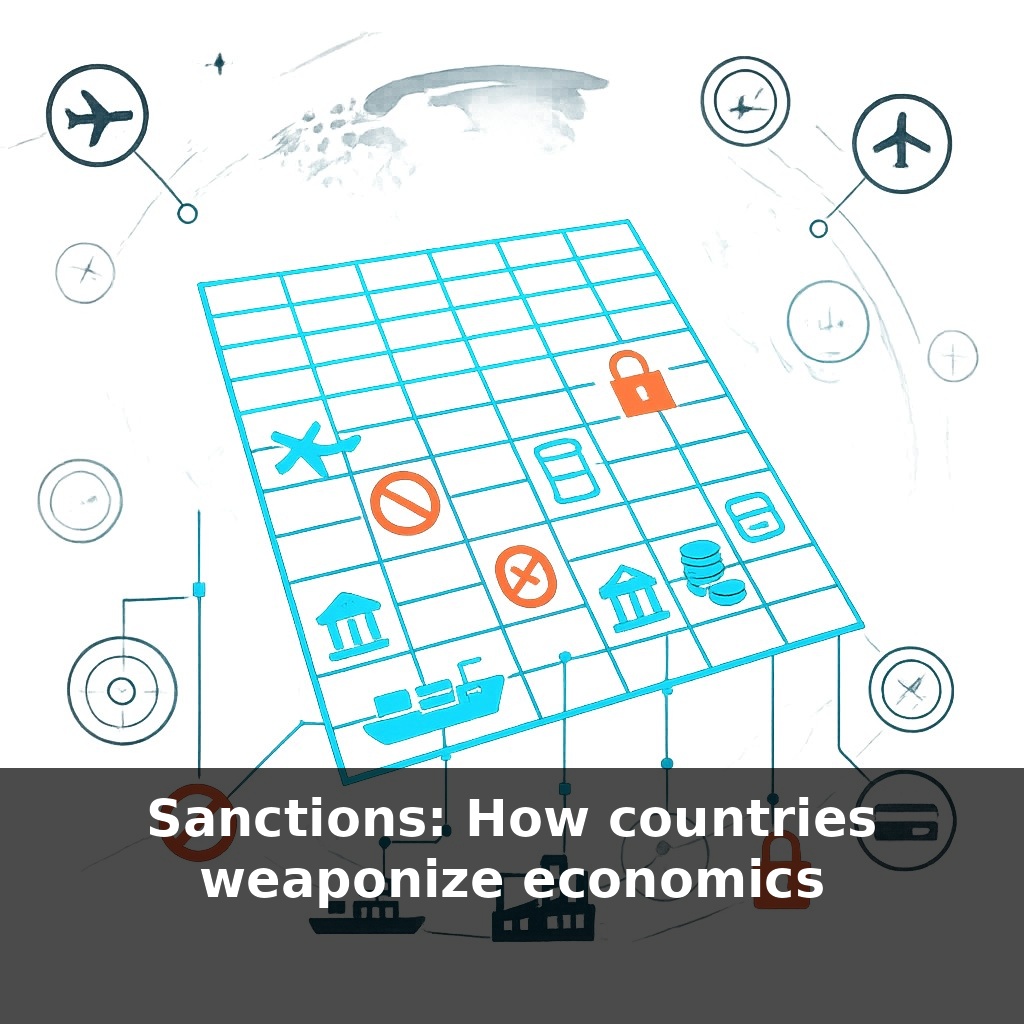
A single spreadsheet in Washington quietly decides who can’t buy planes, sell oil, or even move money across borders. Tonight, we step inside that hidden system—where no bullets fly, yet entire economies shudder, blacklists move markets, and allies suddenly feel like targets.
Sanctions look clean on paper: no soldiers, no airstrikes, just rules and rows in that spreadsheet. But behind each entry sits a chain reaction that can reach from a Moscow bank to a South African port to a small factory in Italy that suddenly can’t get paid. A ship loaded with fertilizer is turned away; a semiconductor order is quietly cancelled; a construction project stalls because a single sanctioned lender sits in the financing stack, like one broken instrument throwing off an entire orchestra. Policymakers call this “pressure.” For trading houses, insurers, and logistics firms, it’s a daily puzzle: which counterparties are safe, which currencies are still usable, which contracts just became radioactive? And for governments, sanctions are no longer rare tools—they’re becoming the default response to almost every geopolitical crisis.
Behind those rules lie hard numbers and political bets. In 2022, sanctions launched by G7 economies touched nearly a third of global GDP, and more than 30 countries now sit under some form of U.S. restriction. These aren’t just labels; they decide which pipelines get finished, whose satellites can access Western components, and which shipping routes suddenly reroute overnight. A refinery upgrade in Asia stalls because a sanctioned supplier is in the blueprint; a fintech startup in Nairobi loses access to dollar clearing when its back-end bank appears on a list. Each entry quietly redraws the world’s trade map.
Sanctions work by exploiting chokepoints: places in the global system where a handful of actors control something everyone needs—dollars, shipping insurance, advanced chips, aircraft parts, key software. Instead of blocking every transaction, governments lean on these bottlenecks so that pressure radiates outward with minimal direct action.
Three levers matter most.
First, finance. Most large cross‑border deals touch a Western bank or pass through a major currency. Once a bank fears penalties, it often “over‑complies,” cutting ties not just with listed entities but with anyone remotely risky. That’s why a small business in Turkey or Kenya can suddenly see payments rejected after a rule change aimed at a conflict thousands of kilometers away.
Second, trade in critical goods. Not all exports are equal. Crude oil is fungible and can be rerouted or discounted; precision machine tools, aviation software, and 5‑nanometer chips are not. When those are restricted, entire industrial plans stall. Russia’s aerospace sector, Iran’s automotive industry, and North Korea’s missile program all show how missing components can slow—but rarely halt—strategic projects as targets invest in substitutes, smuggling, or new suppliers.
Third, reputation. Sanctions signal who is “risky” to do business with. Credit rating downgrades, frozen foreign investment, and canceled joint ventures often follow. Sometimes the fear of future measures bites harder than the current ones, pushing firms to exit before they are forced.
The results are uneven. Coordinated measures, like the financial squeeze that helped bring apartheid‑era South Africa to negotiations, can reshape incentives. Others entrench hardliners, who blame outside hostility for economic pain and clamp down at home. Meanwhile, neighbors may profit as trade diverts to new hubs, accelerating the rise of alternative payment systems and regional blocs.
Your challenge this week: pick one sanctioned country—past or present—and trace a specific sector (energy, aviation, banking, or tech) across five years. Look for three things: which foreign firms left, which new partners arrived, and which work‑arounds emerged. By the end, ask: did pressure change behavior, or just change which flag was on the ships and whose logo was on the software?
Think of how a single missing violin can force a symphony to rewrite an entire passage. When advanced lithography tools were cut off from certain chipmakers, it wasn’t just one factory that paused; product launch timelines slipped, phone designs were redrawn, and procurement teams scrambled for second‑tier suppliers in places they’d barely mapped. Or look at shipping: when insurers refused to touch particular crude cargoes, older tankers were bought up, flags were swapped, and a “shadow fleet” started taking longer, riskier routes—changing port traffic patterns and even refinery maintenance schedules.
There’s also the quiet software angle. A sanctioned bank losing access to a core vendor doesn’t just switch apps; it might rebuild whole IT stacks in a hurry, spawning local tech firms that suddenly specialize in replacement code and integration. Over a few years, that scramble can seed parallel ecosystems: new data centers, different messaging protocols, alternative credit networks. The original measure targets one node, but the rerouting gradually redraws the map of who connects to whom—and on whose terms.
Sanctions are quietly rewriting the “rules of the game.” As states hedge, they’re testing new routes: local‑currency trade, regional payment rails, and digital tools that trace flows with near‑real‑time granularity. The result could be a patchwork world where firms juggle multiple playbooks, switching tactics with each border crossed. Some see more resilience and choice; others see rising friction, legal risk, and a creeping expectation that every transaction might soon carry a political score.
Sanctions are also feedback loops: each new measure teaches firms, courts, and engineers how to route around the next one. Compliance teams swell like extra goalkeepers on a field, regional lenders learn to play without the dollar’s whistle, and code replaces phone calls. The open question is whose rules will script the next upgrade of this system.
Before next week, ask yourself: 1) “If my country suddenly faced Iran- or Russia-style financial sanctions, which everyday things I rely on (banking apps, imported food, fuel, medicines, foreign-made tech) would be disrupted first, and what’s one concrete step I could take this week to be less fragile to that?” 2) “Thinking about how U.S. dollar dominance lets Washington ‘flip the switch’ on SWIFT and foreign reserves, how might my own savings, investments, or business contracts be exposed to decisions made in another capital—and what’s one specific question I should ask my bank or employer to better understand that risk?” 3) “When I hear that sanctions can both pressure regimes and hurt ordinary people (like in Iraq or Venezuela), which current sanctions regime do I feel most unsure about morally, and what is one credible source (e.g., UN reports, independent economists, or local journalists) I will read this week to challenge my assumptions about who is actually paying the price?”