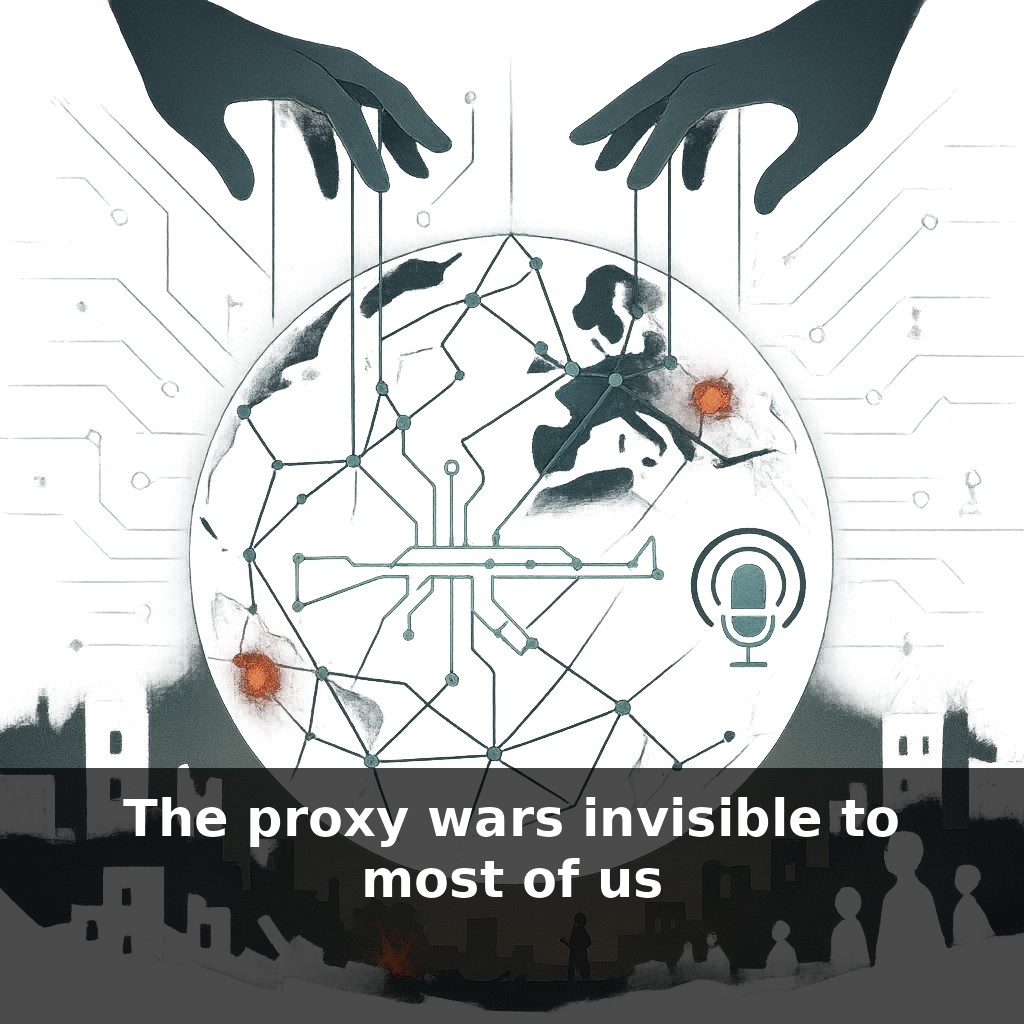
A war can reshape a region without a single foreign soldier officially “at war” there. A local fighter gets a new rifle, a fresh batch of ammo, and a quiet promise of support. Somewhere far away, a politician gains influence—while the people under the bombs never learn their names.
On paper, proxy wars sound efficient: big powers trade resources instead of lives, “manage” risks at a distance, and keep their own casualties near zero. But step closer and the logic breaks down. Money and weapons flow in faster than trust or accountability. Local actors start answering less to their own communities and more to distant sponsors whose priorities can shift overnight—like a band suddenly forced to play to a producer’s taste instead of the crowd in front of them.
These conflicts are also strangely invisible to many of the taxpayers funding them. Budgets are buried in line items, operations are classified, and media attention spikes only during spectacular atrocities. Meanwhile, the fighting grinds on in slow motion, bleeding towns, economies, and futures years after the headlines move on. To understand modern power, you have to look where the cameras rarely stay: at the quiet mechanics of who arms whom, and why.
So how do these distant players actually show up on the ground? Often it starts with “security cooperation” or “counterterrorism assistance” that looks technical and modest: training a special forces unit, sharing satellite imagery, extending credit for weapons purchases. Contracts get signed in quiet conference rooms, but the effects ripple outward—militias swell, black markets reorganize, and weak governments lean harder on foreign backers than on their own citizens. Over time, battle lines harden into supply chains, and battlefield gains depend less on local consent than on whose cargo planes keep landing.
Follow the money and the metal and the pattern becomes clearer. External backers rarely announce, “We’re running a proxy war now.” It starts as a drip: a few trainers deployed under a cooperation agreement, a shipment of “defensive” weapons, intelligence shared through a new coordination cell. Then rival states notice the opening. One backs the government, another backs an opposition faction, a third quietly backs a spoiler group just strong enough to ruin any peace deal that doesn’t include its interests.
Different patrons play different roles. Some are paymasters, wiring cash that keeps salaries flowing and commanders loyal. Others are armourers, moving drones, artillery, or anti‑tank missiles through convoluted routes and cut‑outs. A few specialize in political cover—blocking UN resolutions, hosting “peace talks” designed more to freeze a favorable balance of power than to actually end the fight.
On the ground, that support reshapes incentives. Leaders who once needed broad local coalitions can survive with narrower bases, as long as the external pipeline stays open. Splinter factions discover they can gain leverage simply by threatening to defect to a rival sponsor. Ceasefires become less about who is tired of fighting and more about whose warehouse is low.
Crucially, the proxies are not just extensions of foreign will. They bargain, mislead, and selectively implement advice. A faction might accept weapons earmarked for “counterterrorism” and then redeploy them in a local feud. Another might stage an offensive precisely to force a wavering patron to recommit.
Technology deepens these dynamics. Cheap armed drones, encrypted messaging apps, and satellite bandwidth let sponsors influence tactics in near real time, while keeping formal distance. Arms brokers and private military companies blur lines further, offering deniability in exchange for contracts, mining rights, or port access.
From afar, the conflict can look like a single war. Up close, it’s a crowded marketplace of patrons and clients, each trading risk, legitimacy, and blood for very different kinds of power.
In Syria, Iran’s backing of militias, Turkey’s support to opposition groups, Russia’s airpower, and Western training programs created overlapping “projects” on the same battlefield—each with its own budget, media narrative, and preferred outcome. Yemen layered a Saudi‑led coalition, Emirati‑aligned forces, and Iranian assistance to the Houthis onto long‑standing local rivalries, turning a national power struggle into a regional contest that outlived initial objectives.
Libya shows how quickly these networks mutate: Qatar and Turkey favored one camp, Egypt, the UAE, and later Russia backed another, while European states quietly prioritized migration deals and energy ties over a unified peace push. The Sahel offers a different pattern again: French counterterrorism missions, Russian Wagner deployments, and Gulf funding for religious and political projects often intersect in the same fragile towns. Instead of a single “front line,” you get overlapping projects that keep shifting, like musicians in a jam session all playing different songs through the same speakers.
Roughly 40% of today’s internal conflicts already pull in outside patrons; the next decade could turn that into a dense web of “remote‑control” battlefields. Cheap drones, rented mercenaries, and freelance hackers make it easier to dial violence up or down like streaming a show. Add climate stress and great‑power rivalry, and more fragile regions risk becoming unmarked arenas. The hardest part won’t be stopping one war, but untangling overlapping campaigns no one fully owns.
For most of us, the only visible trace of these struggles is a bump in fuel prices, a refugee headline, a missing product on a shelf—like faint ripples from a shipwreck we never saw. Following those ripples back means watching trade routes, election donors, even which crises vanish from news feeds. The more you trace them, the less “far away” these battles really are.
Before next week, ask yourself: “Where in my daily information diet (news sources, social feeds, podcasts) might I be unknowingly absorbing narratives that serve someone else’s ‘proxy war’—a political party, a foreign government, a corporate interest—and how could I deliberately cross-check one of those stories today using a source with an opposing incentive?” “Thinking about the examples from the episode (like foreign influence campaigns, think tanks pushing particular ‘expert’ takes, or astroturfed grassroots groups), which one feels most present in my own country, and what’s one concrete clue I could look for this week—funding trails, repeated talking points, coordinated hashtags—to spot it in the wild?” “If I had to explain to a friend, in 2–3 sentences, how a hidden proxy battle might be shaping one current event we’re both following, what specific event would I pick, and what’s one question I’d encourage them to ask that could shift how they see it?”