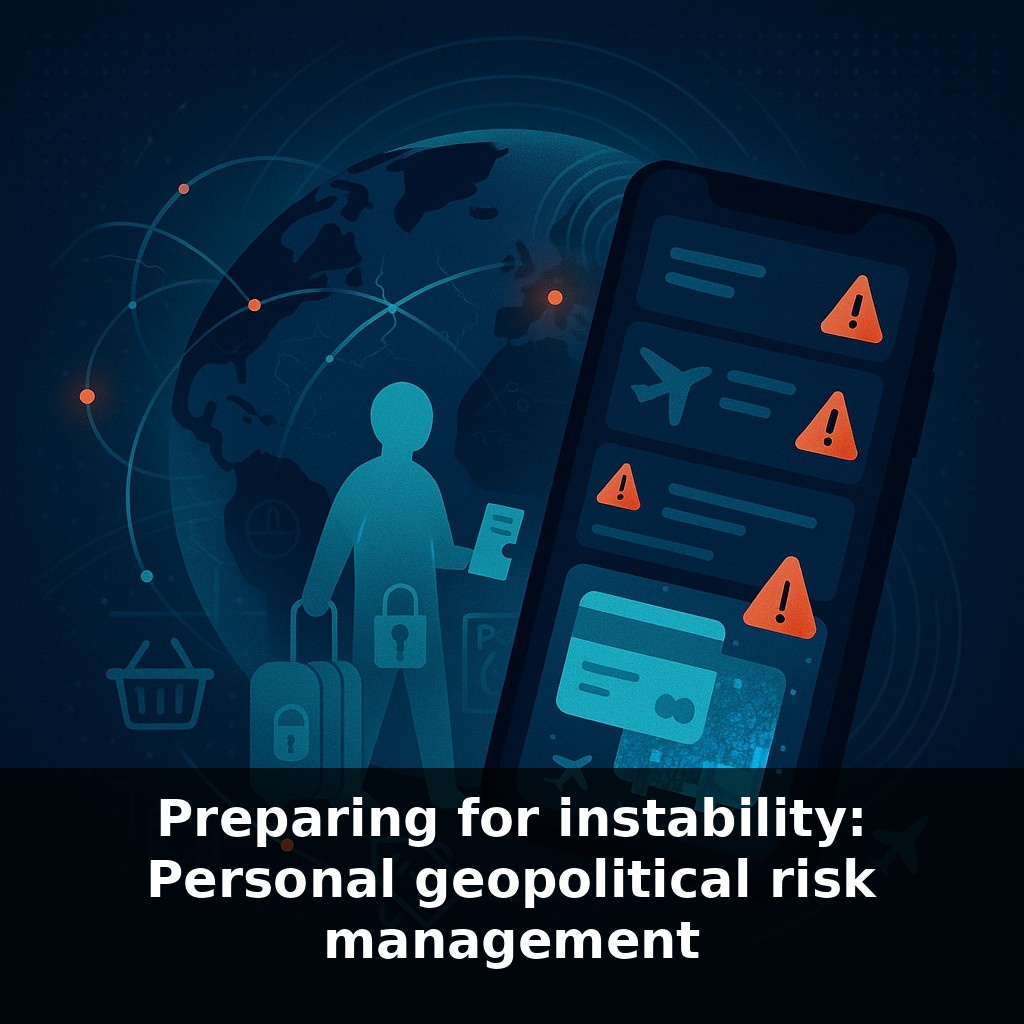
About one in seventy people on Earth has already fled their home because of conflict. Now, you’re boarding a flight, tapping your banking app, posting online—while decisions made in distant capitals could quietly freeze your card, reroute your trip, or silence your feed.
A border skirmish 5,000 miles away can now change the price of your groceries within days, your job prospects within months, and your ability to move money or cross borders within hours. In 2022 alone, food prices jumped double digits globally, and cyber insurance costs rose by half as digital attacks and disruptions spiked. Yet at the personal level, many people are exposed: one in four Americans has zero emergency savings, and more than half couldn’t handle a $1,000 shock. Fewer than half even hold a passport—making rapid relocation or evacuation difficult if things deteriorate quickly. In this episode, we’ll treat instability the way professionals do: as a set of scenarios you can map, prioritize, and prepare for. You’ll learn how to scan for early signals, stress‑test your lifestyle, and build backup options for safety, money, and mobility.
Professionals start by asking: “Instability where, and for whom?” Your answers will differ from a diplomat’s. Maybe 80% of your income depends on one country’s market, or 90% of your social ties sit on a single platform that can be banned overnight. Perhaps you live within 20 km of critical infrastructure or in a city that imports 70% of its food. In this episode, we’ll translate those abstract exposures into a personal risk map: specific places, accounts, tools, and relationships you rely on, and how to rank which failures would actually hurt you most.
Start by separating emotion from exposure. Professionals don’t ask “Is the world getting worse?” They ask: “Which specific shocks could hit this specific person, in this specific place, through which channels?” You can do the same with three lenses: impact, probability, and time.
First, impact. List five parts of your life where a disruption above 30 days would be severe, not just annoying: income, housing, food/water, digital access, and legal/identity documents. For each, be concrete: “Salary from one employer in X country,” “Rental contract in Y city,” “Cloud account with Z provider.” Then rate personal damage on a 1–5 scale if that item vanished for a month: 1 = trivial, 5 = life‑altering. A single point of failure that scores 4 or 5 deserves immediate attention.
Second, probability. Instead of guessing, anchor to data that updates at least yearly. Examples: - How concentrated is your income? If 80–100% comes from one employer, your “job concentration” risk is high by corporate standards. - How exposed is your location? Check metrics like homicide rate per 100,000, inflation rate, or debt‑to‑GDP. A move from 3% to 15% annual inflation changes everyday risk far more than most headlines. - How digitized is your access? If 90%+ of your money is in one country’s banking system and 100% of your authentication uses one email account or one phone number, your “platform” risk is elevated.
Third, time. Some shocks are “fast”—airport closed in 6 hours, app blocked overnight. Others are “slow”—currency erosion over 3–5 years, creeping censorship, shrinking job sector. Tag each big exposure as fast, slow, or mixed. Fast risks need pre‑built decisions: where you’d go, how you’d pay, who you’d call within 24 hours. Slow risks need staged moves: shifting 10–20% of savings per year, adding one new market or skill every 6–12 months.
Layer on geographic diversification. Count how many jurisdictions really govern your life: where you live, where your employer is registered, where your main bank is licensed, where your key cloud services are based, where your citizenship sits. If that number is one or two, you’re not diversified; you’re concentrated. A basic long‑term goal is 3–5 jurisdictions across your residence, money, work, and data—even if you never leave your home city.
Run one concrete scenario all the way through. Example: you depend on a single city for work and logistics. Say you live in City A, rent there, earn $4,000/month from a local employer, and keep $20,000 in a local bank. That’s 100% housing, 100% salary, and 100% liquid savings tied to a single jurisdiction. Now layer a “moderate but plausible” disruption: a 4‑week power shortage plus 20% inflation in a year.
Trace the effects with numbers: - Income: 1 missed paycheck = $4,000 gap - Expenses: rent rises from $1,200 to $1,440 at renewal - Savings: real value of $20,000 drops to $16,000 in 12 months
Counter‑moves can also be numeric and specific: - Shift $5,000 into a second bank in another country (25% diversification) - Add one remote client paying $800/month from a different region (20% of income) - Store 30 days of nonperishable food and 40 liters of water at home
Your goal isn’t perfection; it’s turning big single points of failure into 3–4 smaller, survivable ones.
110 million people were forced from home in 2023; most didn’t think “it could be me” the year before. The next step is to turn abstract risk into specific, trackable moves. Think in thresholds: at 8% inflation, you might move 10% of savings abroad; at 15%, 30%. If flights jump above 2× normal price, you pre‑book an exit. Your challenge this week: define 3 numeric triggers—one for moving money, one for relocating temporarily, one for switching employers or sectors.
As you refine triggers, pre‑commit specific actions. Example: if unemployment in your field hits 9%, you apply for 5 remote roles abroad. If your rent‑to‑income ratio tops 40%, you downshift to a cheaper area within 60 days. If card outages exceed 6 hours twice in a quarter, you fund 2 backup payment methods within 72 hours.
To go deeper, here are 3 next steps: 1) Run your country and city through the free Global Peace Index and Fragile States Index dashboards, then plug your home location into the climate-risk layer on RiskFactor.com to get a quick “stability snapshot” of where you live. 2) Download and start filling out an emergency documentation kit (e.g., FEMA’s Emergency Financial First Aid Kit PDF), then back it up to an encrypted cloud service like Proton Drive so you can access critical records if you need to leave quickly. 3) Order one solid, field-tested reference—either *Emergency War Surgery Handbook* (for advanced first-aid minded folks) or *When Technology Fails* by Matthew Stein—and pick one chapter tonight to turn into a checklist for supplies you’ll actually buy this week.