Decoding Global Conflicts
📝 Transcript
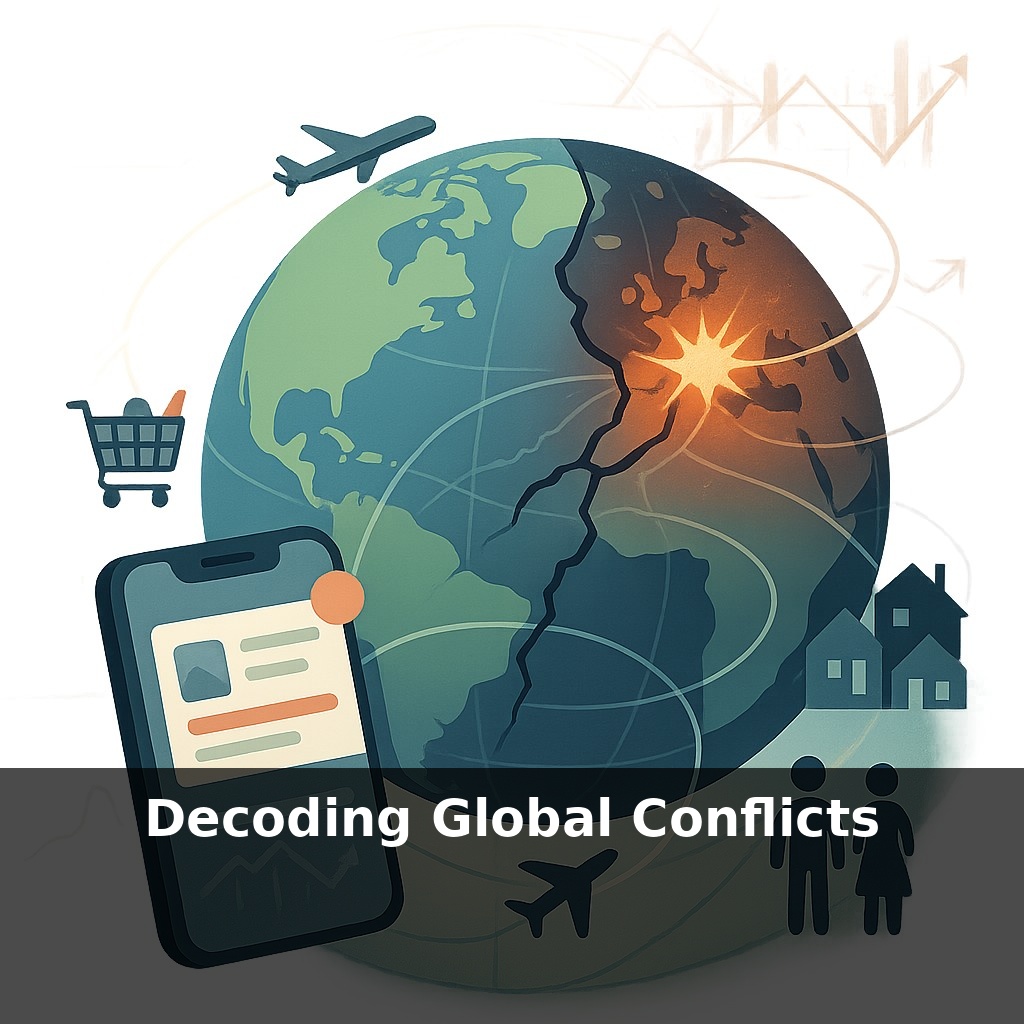
A war you’ll never see up close might still change the price of your groceries, the route of your vacation flight, and who shows up in your neighborhood. One frontline clash can quietly redraw maps of money, people, and power—without most of us realizing it’s happening.
A headline about distant clashes pops up on your phone, squeezed between a sports score and a friend’s new post. It’s tempting to swipe past, treating it like background noise to your “real” life. Yet behind that notification are chains of decisions, fears, and bargains that quietly set the conditions of your future—who your country trades with, which technologies you can access, even what your taxes fund.
To decode that headline, we need to step outside the frame it gives us: “good guys vs. bad guys,” “ancient hatreds,” or “pure chaos.” Conflicts usually grow from overlapping layers: leaders hedging against loss of power, communities reacting to humiliation, elites betting on profit, and outside states nudging the board.
In this series, we’ll treat each conflict like a complex software bug: not random, not inevitable, and not fixed by a single patch—but traceable, understandable, and sometimes preventable.
Global conflicts also run on “hidden code”: doctrines, unwritten rules, and quiet red lines that most people never see. Generals read them in satellite images; traders feel them in freight prices; border guards hear them in new orders. When those signals shift, they ripple into your reality—maybe as a delayed package, a denied visa, or a news alert about a suddenly “strategic” metal. In this series, we’ll practice reading those signals the way a doctor reads vital signs, spotting when the global system is running a fever long before the headlines shout “crisis.”
When you strip away the slogans, most large-scale violence grows from a collision between big structural forces and small, often-overlooked sparks.
Start with the wide-angle view. International politics runs on shifting power balances: who has missiles, who controls sea lanes, who supplies critical minerals or energy. When one state rises fast or another declines, others feel exposed. They stockpile weapons, lock in alliances, or try to reorder their neighborhood before it’s “too late.” That’s the classic security dilemma: each step taken to feel safer can look like a threat to someone else, creating a feedback loop of fear.
Layer onto that the fight over resources. It’s not only oil and gas anymore. Fresh water in transboundary rivers, lithium for batteries, cobalt for electronics, even fertile land and fishing grounds—all are part of a tightening competition. Climate stress intensifies this: drought, floods, and heat waves push farmers off land, swell cities, and harden zero-sum thinking—“if they gain, we lose”—around basic survival.
Then narrow the lens. Those structural pressures only become wars when they intersect with raw, lived grievances. Long-term unemployment among young people in one city, a minority shut out of government jobs in another, a region feeling robbed of its tax revenue—these are not yet battle plans, but they are flammable material. Militia leaders and politicians with something to gain scan this landscape for recruits, fears, and resentments they can weaponize.
Technology adds a new layer of volatility. Drone strikes, online disinformation, and deniable cyber operations lower the up‑front cost of taking risks. A state can disrupt a rival’s power grid, banking system, or media space without crossing a physical border. That blurs lines between war and peace and pulls civilians directly into the battlefield, not as bystanders but as targets whose data, savings, and attention can be seized or scrambled.
Seen this way, a conflict is less a sudden explosion and more a slow architectural failure: stress accumulating in beams and joints—economic systems, social contracts, ecosystems—until one more load-bearing lie or shock brings part of the structure down.
Think of three levels of conflict like layers in a strategy game you’re forced to play, whether you like it or not.
At the top layer, great powers adjust trade rules, tariffs, and sanctions. You might notice this only when a favorite app stops working in your country, or a gadget suddenly needs a pricey “import fee.” Those aren’t random glitches; they’re quiet moves in a larger contest.
At the middle layer, firms and cities adapt. A port town that once shipped grain might rapidly pivot to exporting weapons parts; a logistics company may abandon one shipping route and overuse another, driving up insurance costs. The map of “safe to invest” shrinks and stretches in ways your pension fund quietly tracks.
At the bottom layer, families modify everyday risk calculations. Parents decide which language their kids should learn “for safety,” students switch majors toward “crisis‑proof” skills, migrants pick routes based not just on distance but on which borders are about to harden.
Your challenge this week: whenever you see a conflict headline, ask: what might be shifting at each of these three layers—and where, concretely, would that touch your own life?
Conflict’s next wave may feel less like a distant battle and more like a glitchy operating system around you. Borders can stay quiet while passports, visas and data flows get constantly “patched,” rewriting who can move, study, bank or speak freely. Blackouts or platform bans may arrive like surprise software updates: suddenly, a tool you rely on is gone. Your challenge this week: each time a service fails or policy shifts, ask, “Whose risk calculation just changed—and why now?”
As you start noticing these patterns, resist rushing toward simple stories or sides. Curiosity is your best tool here: treat each headline like a clue in a much larger puzzle. Over time, you’ll see recurring shapes—who is protected, who is exposed, who gets silenced. That pattern‑recognition is the first quiet step from passive spectator to thoughtful actor.
Here’s your challenge this week: Pick one current conflict mentioned in the episode, then spend 30 minutes comparing how it’s covered on three different non‑US news sites (for example: Al Jazeera English, BBC World, and DW or France24). Create a simple 3‑column comparison (one column per outlet) listing: (1) the headline wording, (2) which actors are centered, and (3) what causes/solutions are emphasized. Then, in one short paragraph (5–7 sentences), explain how those differences might shape a citizen’s view of “who’s right” and “what should be done” in that conflict, and decide which framing you find most credible—and why.
From this course
Geopolitics for Personal Transformation
5 episodesUnlock all episodes
Full access to 5 episodes and everything on OwlUp.
Subscribe — $1.99/monthLess than a coffee ☕ · Cancel anytime