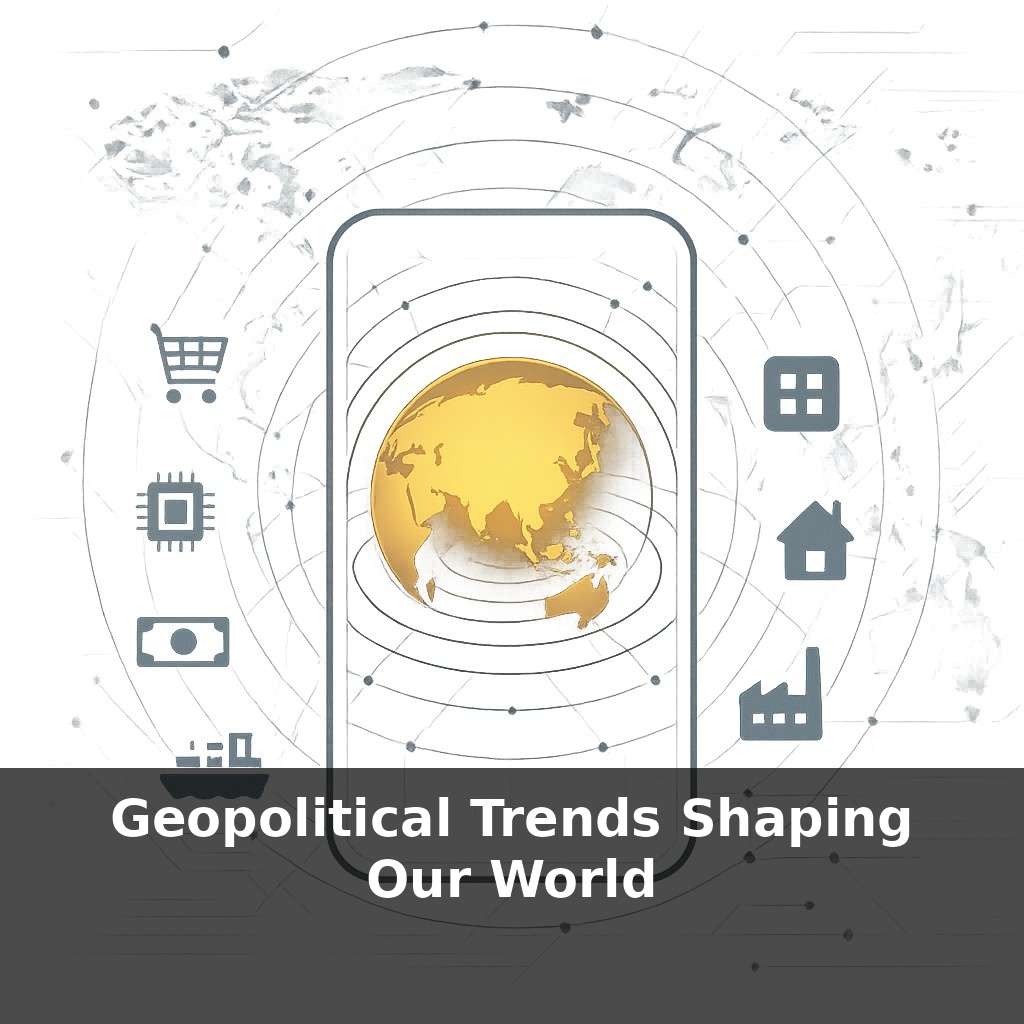
Asia is on track to generate most of the world’s economic output within a decade—yet your phone, your paycheck, and even your news feed are already reacting to that shift. Today we drop into the middle of that quiet earthquake and ask: what does great‑power rivalry feel like in everyday life?
Your grocery bill, your job options, even which apps vanish from your phone—these are now shaped by decisions made in distant capitals you’ll never visit. Supply chains are being redrawn like subway maps after a major outage: routes that once felt automatic are suddenly detouring through new partners, new ports, new rules. Countries are racing to secure energy, chips, and critical minerals, while also bracing for climate shocks that can wipe out factories, farms, and coastal cities in a single season. At the same time, data is being locked behind national borders, and governments are quietly deciding which technologies you can trust, use, or even see. This episode isn’t about abstract geopolitics; it’s about how those forces are rewiring the background settings of your life—and how paying attention can become a personal advantage rather than a source of quiet anxiety.
Politicians call this a “multipolar world,” but you’ll feel it less like a headline and more like a series of quiet nudges: a delayed package here, a new “export control” error message there, a sudden spike in insurance for a house near the water. Defense budgets are swelling, not just for distant wars, but to guard fiber‑optic cables, satellites, chip plants, and ports. Meanwhile, climate pressure is turning Arctic routes, desert solar farms, and deep‑sea minerals into prized real estate. These shifts don’t ask your permission; they simply update the rules of the game you’re already playing.
The quiet earthquake becomes easier to see when you realize it has four main fault lines: security, technology, resources, and climate. They overlap, but each one changes a different part of your daily environment.
First, security is no longer only about tanks and missiles. Those record‑high global defense budgets are swelling because governments now treat ports, chip fabs, submarine cables, satellites, and even app stores as “strategic terrain.” A cyberattack that freezes a hospital system, a drone incident that shuts an airport, or a blockade that slows a single shipping lane can cost more than a skirmish on a distant border. Security planners have moved from defending lines on a map to defending systems that keep economies alive.
Second, technology is turning into a regulated substance. When countries argue over who sells which chips, cloud services, or 5G gear, they’re really deciding who sets the standards everyone else must quietly follow. These standards have a long half‑life: once a country builds its networks, payment rails, or AI infrastructure around a given ecosystem, switching is like trying to rewrite your body’s DNA while you’re still walking around. So every “technical” rule—on encryption, app stores, digital taxes—becomes a geopolitical choice.
Third, resources are being reclassified from “cheap inputs” to “strategic leverage.” Control over rare earths, lithium, advanced batteries, and green‑tech supply chains now acts like a pressure valve in negotiations. Countries and firms are racing to secure multiple sources, not just at the mine, but in the refining, processing, and recycling stages where real choke points live. This is where industrial policy—once a dry topic—reappears as a frontline tool of statecraft.
Fourth, climate takes all of this and scrambles the map again. Coastal cities that anchor a tenth of global GDP sit on physical risk that can suddenly reprice mortgages, insurance, and municipal finances. At the same time, regions rich in sun, wind, or clean water discover they hold the “prime real estate” of the energy transition. Climate diplomacy isn’t just about emissions targets; it’s also about who finances resilient ports, who owns green shipping corridors, and who controls the data from new sensor networks tracking all of it.
Business leaders, mayors, and even university administrators are starting to think like junior foreign ministers. The decisions they make about where to build, which standards to adopt, and whose rules to comply with quietly align your daily life with one geopolitical orbit or another—even if you never read a single policy paper.
Open your banking app during a “routine” outage and you’re touching these trends. A cyber incident in a data center thousands of miles away can now lock you out of your money, not because systems failed randomly, but because financial networks are increasingly treated like strategic assets and are probed, tested, and sometimes sanctioned like oil fields once were.
Or look at a coastal startup hub that suddenly faces higher insurance premiums and stricter building codes. The founders aren’t just battling market risk; they’re negotiating with shifting climate models, municipal balance sheets, and investors who quietly prefer inland servers and warehouses.
Even your streaming queue is part of this landscape: one show disappears after a content dispute tied to a foreign regulator; another is promoted because it helps a platform comply with local cultural rules that secure market access.
Think of the world as a professional sports league: the rules committee keeps tweaking regulations mid‑season, and your favorite teams scramble to rewrite playbooks while the game is already underway.
You’ll feel these shifts less like a single shock and more like a series of nudges. Border checks may grow tighter even as digital visas and remote work hubs expand. Universities might add “sanctions risk” and “AI governance” to standard business curricula. Employers could weigh your second language or cross‑border project experience the way they once treated MBAs. Local elections may hinge on chip factories or drone rules the way they used to on taxes and schools, pulling “foreign policy” onto your doorstep.
You don’t need to become a diplomat; you need to become a better pattern‑reader. The same way you once checked the weather before planning a trip, you’ll increasingly scan headlines on chips, minerals, or coastal risks before choosing careers, cities, or investments. Geopolitics is turning from background noise into a dashboard—if you’re willing to read it.
Here's your challenge this week: Pick one geopolitical flashpoint mentioned in the episode (like the South China Sea, Ukraine, or the Taiwan Strait) and spend 20 focused minutes mapping how it could affect your daily life—your job, costs of things you buy, or your digital privacy. Then, choose one concrete “resilience move” tied to that trend—such as diversifying where you buy a key product, tightening your digital security in response to cyber risk, or starting a small emergency savings buffer against economic shocks—and put it into motion today. Finally, share a 3–4 sentence summary of what you did and why with one friend or colleague, to start a real-world conversation about the trend rather than just passively consuming the news.