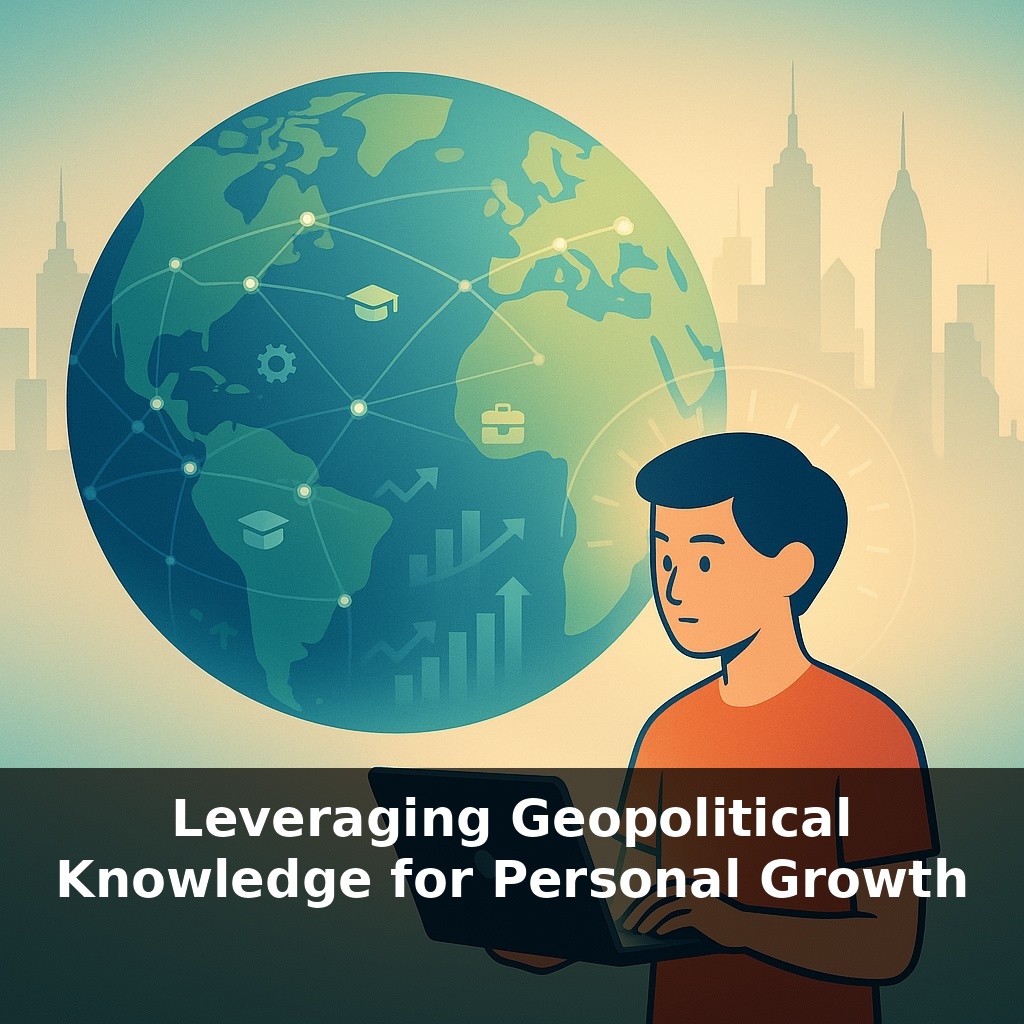
About half of the world’s teenagers never get formal education on global issues—yet those same global forces quietly decide which jobs grow, which skills pay, and which cities boom. You’re already living inside geopolitics… long before you ever choose to “care” about it.
Millennials already rank geopolitical conflict as the top risk to their future—but most people still treat it like background noise. That gap is your advantage. When you start paying attention to global power shifts, trade spats, sanctions, and alliances, you’re not “being political”; you’re upgrading the operating system behind your daily choices.
This isn’t about memorizing headlines. It’s about noticing how a semiconductor dispute in East Asia reshapes which tech skills are scarce, or how a new trade corridor redirects investment—and your job market—toward certain regions. You begin to see patterns: which countries bet on renewables, which double down on fossil fuels, which invest in AI or biotech. Each pattern quietly nudges the value of your skills, savings, and even your passport.
The turning point is when world events stop feeling random and start looking like data you can use to grow.
Most people meet world events as scattered headlines: a crisis here, an election there, a new treaty somewhere else. The growth unlock happens when you start treating those headlines like clues instead of noise. You notice who keeps showing up together, who keeps clashing, which regions attract talent, and which quietly lose it. Over time, a mental map forms: not just of countries, but of incentives, fears, and ambitions. That map doesn’t just help you “understand the news”; it quietly reshapes how you judge risk, whose stories you believe, and where you choose to bet your time and attention.
Look closely at how you already move through the world and you’ll notice a pattern: your brain is constantly doing “micro‑geopolitics” without calling it that. You scan for power (who really decides things in this meeting?), resources (who has the budget, the time, the connections?), and alliances (who tends to back whom when there’s disagreement?). You’re mapping incentives and influence in miniature.
Now stretch that same habit outward.
When you learn how a country secures energy or water, you’re training the same muscles you use to think about how your company secures customers or data. When you study why two states cooperate despite rivalry, you’re rehearsing how to negotiate with someone you mistrust but still need. The vocabulary changes, but the underlying logic travels well.
Consider three specific “transfers”:
1. Power literacy → career navigation Reading shifts in regional clout trains you to notice subtle power shifts at work: a new executive sponsor, a rising team, a declining product line. You stop treating org charts as reality and start watching where decisions actually originate.
2. Interdependence → smarter money and skills bets Seeing how supply chains ripple across borders teaches you to trace knock‑on effects in your own life: if a city leans into green tech, what certifications will compound in value? If a region is exposed to food or energy shocks, what does that say about housing, salaries, or remote‑work resilience?
3. Narrative awareness → emotional regulation States use stories—about threat, pride, destiny—to mobilize citizens. Once you notice this at the national level, it becomes easier to catch when fear‑laden or glory‑laden stories are steering your own reactions, online and offline. That pause is the beginning of emotional self‑governance.
Think of yourself less as a news consumer and more as an analyst of systems you happen to live inside. Instead of asking, “Do I agree with this?” start with, “What incentives would make this outcome logical for each player involved?” Over time, that question bleeds into everything: tense family conversations, salary negotiations, even how you interpret viral posts.
And as your mental map of the world grows denser, something subtle happens: you feel less like events are “happening to you” and more like you’re choosing where to stand, what to build, and which kinds of future you’re quietly training yourself to survive—and shape.
Think about how a single policy decision can cascade into your day. When the EU tightened data rules with GDPR, it didn’t just affect lawyers in Brussels; startups worldwide rewrote code, marketers relearned consent, and “privacy officer” became a serious career path. When Russia’s invasion of Ukraine jolted energy markets, electricians, solar installers, and efficiency experts suddenly found their skills in higher demand across Europe.
Personal growth hides in these ripples. A student who notices how migration flows shift after a regional conflict might choose to study urban planning or counseling instead of a more crowded field. A freelancer who sees a country doubling down on AI safety standards might position themselves early in compliance or auditing, before it feels “hot.”
Here’s where the “systems lens” compounds: the more you practice connecting distant decisions to local consequences, the more naturally you start designing your own life with the same rigor executives use for five‑year strategies.
53 % of students may never be taught how the world fits together, but you don’t have to wait for a curriculum to catch up. As tools evolve—from AI briefings to real‑time “geo‑alerts” baked into shopping and travel apps—the edge will belong to people who can question those prompts instead of obeying them. Like an architect reading a city skyline, you’ll see hidden load‑bearing structures: who funds what, whose risks are ignored, where quiet opportunities are opening for you to step into.
Your growth, then, isn’t just about reacting faster to headlines; it’s about quietly redesigning how you notice cause and effect in your own life. Like a coder profiling a slow program, you start spotting hidden bottlenecks and unexpected accelerators—in your habits, networks, and choices—and can iteratively refactor the way you learn, earn, and contribute.
Start with this tiny habit: When you unlock your phone in the morning, read the *first* headline from an international news section (not domestic) and ask yourself one question: “How could this event impact ordinary people’s daily lives?” Then, as you brush your teeth at night, quickly imagine how *you* would adapt if that same event happened in your country—one small change you’d have to make (like a commute reroute, a price change, or a shift in job security). This keeps geopolitics tied to real human experience, not just abstract headlines.