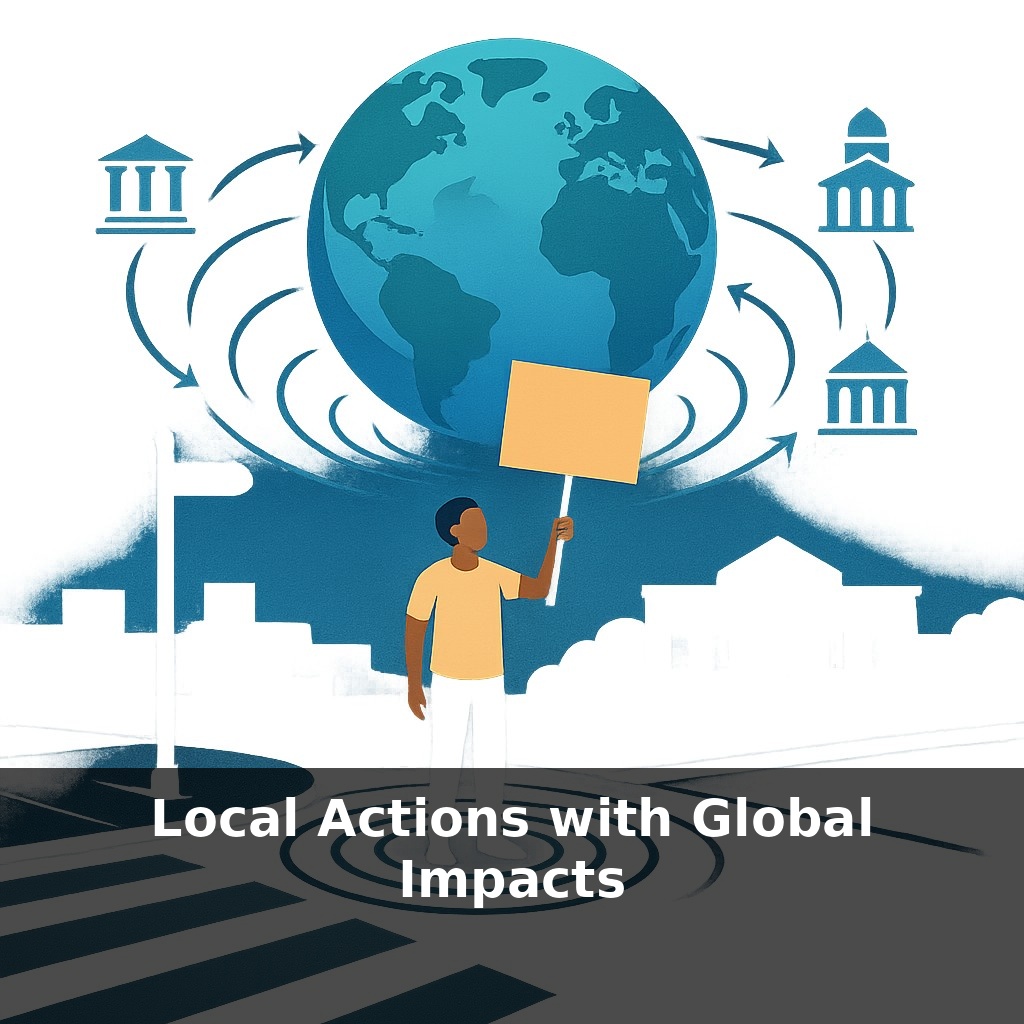
A protest on a single street corner can reshape laws on the other side of the planet. Today, we’re stepping into those small, local moments—a city council vote, a campus petition, a neighborhood experiment—and asking: how do these tiny ripples become geopolitical waves?
Those street-corner actions don’t float in a vacuum—they plug into huge hidden systems. A student campaign at one university leans on alumni pressure, which nudges an investment committee, which shifts a pension fund, which quietly changes what gets financed worldwide. A city’s building code update forces construction firms to adapt, and suddenly an “experiment” in one jurisdiction becomes the new industry standard. Think of it like updating the software on one server in a giant network: once it proves faster and safer, other nodes copy it, often just to stay competitive. In this episode, we’ll track how seemingly modest initiatives—city climate targets, campus divestment drives, local housing pilots—leap across borders through supply chains, investor expectations, and global media, and how those pathways give your own choices more leverage than they appear to have at first glance.
Sometimes the most disruptive “global strategies” start as side projects no one is paid to care about: a librarian reorganizing energy use in one building, a farmers’ co‑op experimenting with new seeds, a coder launching a transparency tool after work. These don’t look like geopolitics, yet they plug into supply chains, data flows, and reputation games that governments and corporations quietly track. When results show up—lower costs, fewer outages, better headlines—larger players copy and scale them, often without ever crediting the obscure pilot that proved what was possible.
Here’s where the “local to global” pattern gets concrete.
Start with movements. Research on over a century of social change shows that more than half of major transformative movements began as something small and specific: a sit‑in at one lunch counter, a pilot childcare program in one district, a test case in one courtroom. These weren’t designed as global campaigns. They were attempts to solve a problem that was immediate and close‑up. But once a tactic works in one place, others copy it—sometimes out of solidarity, sometimes out of pure pragmatism. That replication is what turns a single node of action into a network.
Policy works similarly. National governments often borrow “off‑the‑shelf” solutions that have already been stress‑tested locally. A congestion charge in one city becomes a template. A low‑emission transport corridor elsewhere. Over time, these scattered experiments add up. When international climate reports say that city‑level policies are doing a large share of the work, they’re pointing to this quiet accumulation of small, specific rule changes that together bend the curve of emissions, investment, and technology standards.
Money moves along these channels too. Take divestment. A campaign at one university or municipality seems tiny next to global finance. But when enough local institutions change where they park their savings, asset managers notice. Models get updated. Risk assumptions about fossil fuels shift. At a certain point, funds start exiting those assets not for moral reasons, but because the spreadsheet now says “too risky, too slow‑growing.” Moral pressure and market logic suddenly point in the same direction.
Your daily choices plug into these dynamics. Consumer data is constantly mined by companies and investors: what you *don’t* buy, which services you switch to, which apps you delete. When thousands or millions of people quietly make similar moves, product lines disappear, labeling becomes stricter, entire sectors pivot toward new standards of safety or sustainability. A single city pilot, a campus campaign, a shift in neighborhood habits—each can become an early indicator that larger players treat as a signal, not a footnote.
A single coastal town decides to track where every piece of plastic on its beaches comes from. They publish the data online, tag the brands, and within months a mid‑size packaging company quietly redesigns its bottles to avoid being named. A trade journal covers the shift as a “cost‑saving innovation,” another firm copies it, and soon a regional industry standard has moved—none of which shows up in the town’s local newspaper.
Or consider a small farmers’ market that starts requiring QR codes showing supply‑chain emissions. At first, it’s nerdy and niche. But a regional grocery chain pilots the same labels to compete. When sales data shows customers use the info, a national retailer adopts a version. Regulators notice that the public can handle more transparency than expected, and a few years later, disclosure rules tighten across an entire bloc.
Like a clever new play tested in a single sports team’s practice, a local experiment that reliably “wins” tends to be copied until it reshapes the whole league’s strategy.
55% of major movements starting small hints at a deeper shift: “local” is no longer local. A single tool, dataset, or story can now leap borders faster than laws can catch up. When one town prototypes flood‑resistant housing or neighborhood solar, satellite data, open‑source plans, and investor dashboards quietly turn that into a reference point for engineers, insurers, and mayors on other continents. Your street becomes less like an endpoint and more like an early‑access test server for the future.
Your life sits at a crossroads of these vast systems: family chats, workplace norms, neighborhood habits, online communities. Each choice is a tiny “patch” you’re pushing to the shared codebase of society. The real question becomes less “Does this matter?” and more “Which future am I quietly beta‑testing every time I act, spend, speak, or stay silent?”
Here's your challenge this week: pick **one product you regularly buy** (like coffee, chocolate, or clothing) and, within the next 24 hours, switch to a version that’s **certified fair trade, locally produced, or from a worker-owned co-op**—and actually make the purchase. Then, before the week ends, **tell three people** (in person, text, or social) exactly what you switched, why (e.g., better wages, smaller carbon footprint), and where they can get it too. Track how many of them say they’ll try it, and aim for at least **one person** to commit to making the same swap.