About half of freelancers hit an invisible ceiling: their calendar is crammed, income is stuck, and raising rates barely helps. One keeps saying “I just need more hours.” Another asks, “How do I replace myself?” Same workload, same skills—totally different future.
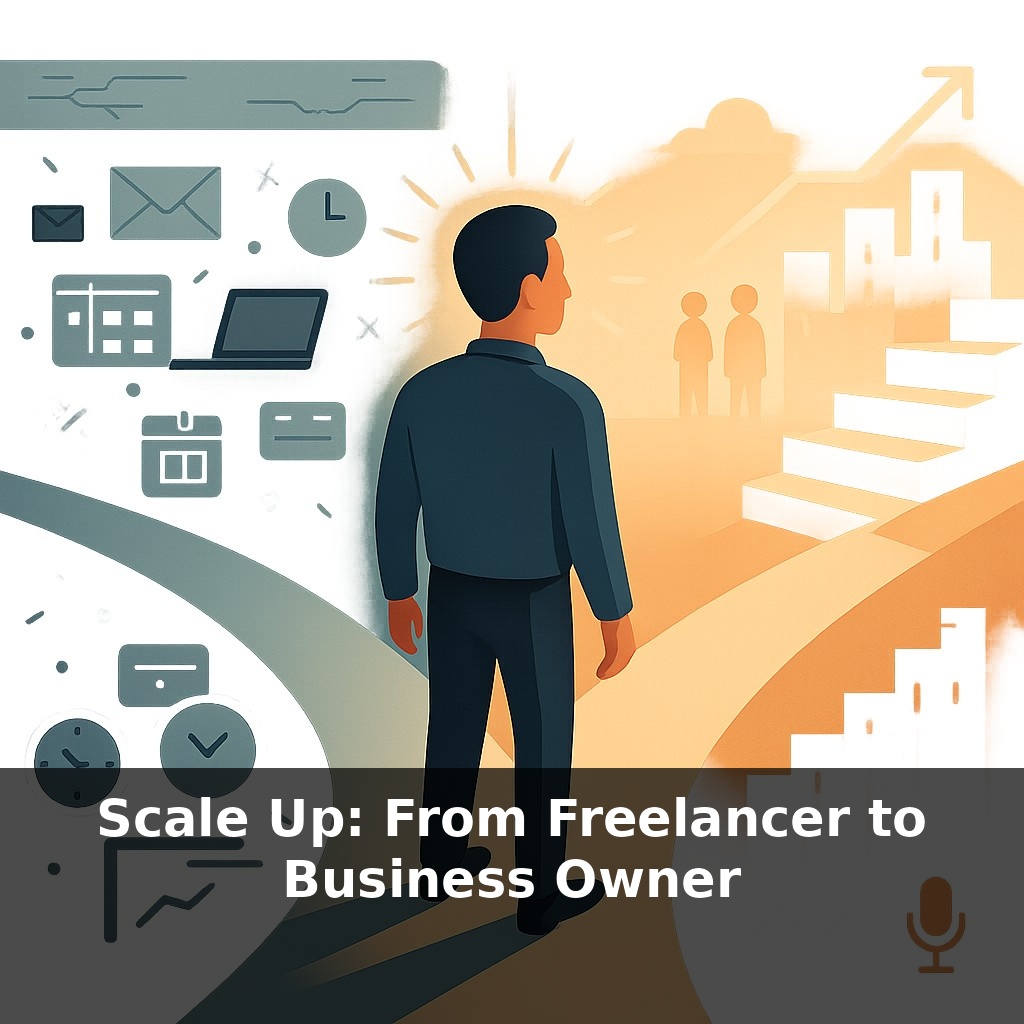
Most people assume the next step after a packed schedule is “more clients” or “higher prices.” That’s how you move up, right? But there’s a hidden fork in the road: either you keep squeezing more out of *you*, or you start building something that can work *without* you doing everything.
This is where the shift from freelancer to business owner quietly begins.
At first, it doesn’t look dramatic. It’s in small choices: you stop saying “my work” and start saying “our process,” even if “we” is just you and a part‑time VA. You notice which parts of your service feel like custom artwork every time, and which parts feel like following a checklist. You start to see that the real asset isn’t your latest project—it’s the way you consistently deliver results.
In this episode, we’ll map that transition: the mindset, systems, and structure that turn a busy solo act into a scalable business.
Most people don’t “decide” to scale; they drift into it. One month you bring on a VA “just to help with email.” Then you test a contractor on overflow work. Then you realize clients are asking for add‑ons you could offer if you weren’t the only one doing the core delivery. The question quietly shifts from “Can I handle this?” to “How would *we* handle this every time?” Think of it like weather patterns: a few random clouds (one‑off help) aren’t climate, but as patterns repeat, you can start to forecast—and design—what happens next.
Here’s where things quietly get real: the numbers stop caring how “talented” you are.
If you max out around 30 billable hours a week over 46 weeks, you’re capped near 1,380 hours a year. Even at strong rates, there’s a hard limit. The only variables left are: what happens in those hours, and who’s actually doing the work.
Start with a blunt audit: in a typical week, how many hours are true expert work versus scheduling, invoicing, chasing content, fixing scope creep, or re‑explaining the same steps to every client? Bench found that solo owners lose roughly 8 hours weekly to admin. That’s not just annoyance—that’s about 20% of your potential revenue or 20% of your future hiring budget.
So the first practical move isn’t “hire a team.” It’s: treat your current service like a product you’re preparing to hand off.
Document the *minimum viable version* of what you already do well: the steps you always follow, the checkpoints that catch most mistakes, the templates that speed things up. Not a giant operations manual—just enough that another competent person could follow along. SCORE’s data shows that people who do this before hiring keep employees longer for a reason: new folks know what “good” looks like.
Next, design the flow of work, not just the work itself. How does a stranger become a lead, then a client, then a repeat buyer or referrer? Where do they wait? Where do they get confused? A basic CRM and project board aren’t “nice software” at this stage; they’re how you see bottlenecks early instead of feeling them as 2 a.m. panic.
On the money side, the game changes from “Can I afford this month?” to “Can the business survive three bad months?” With 82% of small service businesses sinking from cash‑flow gaps, building a three‑month buffer stops every decision from being a crisis. It also lets you reinvest on purpose—into people, tools, or assets—instead of grabbing every dollar as owner income.
Notice how this played out for companies like Design Pickle: they didn’t scale by working heroic hours; they narrowed the offer, standardized delivery, and then added humans into a machine that was already humming.
Think of your work like a lab experiment: you’re not just trying to get a reaction once—you’re trying to set it up so anyone can follow the protocol and get the same outcome. Start by spotting the “signature moves” in your service: the way you onboard tricky clients, the questions you ask that always unlock clarity, the check you run before delivery that catches issues early. Those are your reagents; they’re what make your results different from a random provider’s.
Now zoom out to the rest of the lab. Who preps the slides—gathering assets, setting up folders, confirming details—so you’re not doing it with gloves already on? That might be your first hire. Where do samples “sit on the bench” too long—waiting for feedback, approvals, or missing info? A simple rule there (like time‑boxed reminders or a standard fallback decision) can remove days of delay.
As you tweak this setup, don’t chase perfection. Treat each improvement as a test: change one variable, watch what happens, keep what works, discard what doesn’t. Over time, your “lab” becomes the real asset.
Regulation and AI are quietly tilting the playing field. As tools handle more “button‑click” work, buyers start paying more for orchestration: who designs the offer, assembles people and software, and guarantees outcomes. New rules in places like the U.S. and EU may also nudge solo operators into small companies by default, like weather fronts pushing streams into rivers. Expect more 5–25 person, niche shops that look tiny on paper but operate with global reach and client lists.
Your challenge this week: Design a tiny “handoff experiment.” Take one recurring slice of your work—client onboarding emails, file organization, draft QA, or meeting notes—and turn it into a short, step‑by‑step checklist that *someone else* could follow. Then either: - Give it to a real human (VA, collaborator, or even a trusted peer) **once**, or - Run through it yourself as if you were new.
Notice where they—or you—get stuck or ask, “Wait, what does this mean?” Those friction points are signals: either the step is unclear, or the process is too fragile. Refine it until a competent stranger could get 80% of the result without your help.
Growth often starts where you feel least “necessary.” When a checklist or tool handles something you used to guard, you’re reclaiming attention for choices only you can make—like which clients to pursue or what offer to launch next. It’s less like cloning yourself and more like tuning an orchestra so the music holds, even when you step offstage.
Start with this tiny habit: When you open your laptop to start work, add just ONE line to a simple “Products, Not Hours” list with a concrete offer you could sell (e.g., “Podcast editing package: 4 episodes/month for $600”). Don’t shape it, price it perfectly, or design a sales page—just one line, once a day. This keeps you shifting from “freelancer doing tasks” to “owner building packages” without feeling overwhelming.