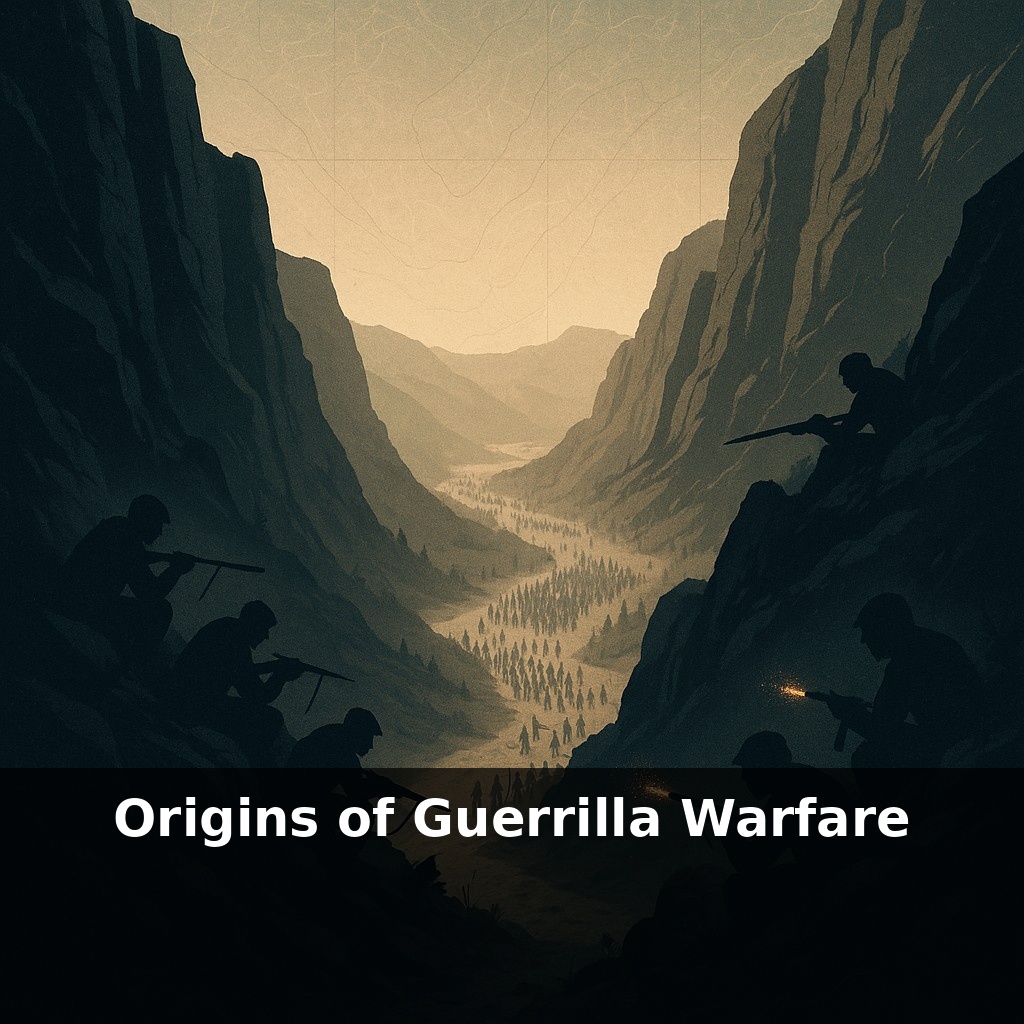
Gunfire echoes down a narrow mountain pass. A few dozen fighters melt into the rocks, while an army thousands strong is left confused and bleeding. History’s turning points often start like this—not with grand battles, but with small, sharp cuts that huge empires never see coming.
Long before anyone wrote manuals on “irregular warfare,” people with almost no armor, few weapons, and no formal ranks were already testing one simple idea: if you can’t outmuscle an enemy, out-think and out-move them. Farmers who knew every hidden trail, herders who read the weather like a calendar, and traders who slipped between villages became, in crisis, the scouts, saboteurs, and snipers of their age. Their strength wasn’t in what they carried, but in who they knew and what they understood about the land. Like a river quietly carving a canyon, these small forces reshaped campaigns over years rather than days, forcing mighty invaders to guard every road, fear every shadow, and spend more and more just to stand still. As we trace guerrilla warfare back to its origins, we’re really tracing how humans turned local knowledge into a weapon.
To see where this story really starts, we have to step far outside the age of uniforms and gunpowder. Early records from Egypt, Mesopotamia, and China already hint at smaller bands refusing to fight on the empire’s terms—striking supply lines, guiding enemies into bad ground, vanishing into forests or hills. Often, these people weren’t “soldiers” at all but border clans, displaced villagers, or rival nobles using proxies. Their actions left few monuments, but they left fingerprints in complaints carved on tablets and reports to distant kings, like faint drumbeats behind the official music of victory.
If we follow those faint drumbeats forward, certain patterns start to stand out. One of the earliest is simple: when a center of power grows, its edges start to bite back. In the hills of ancient Greece, for example, city-states found that chasing raiders into rough country cost more lives than the theft itself. A few stolen goats or burned fields could trigger an expedition; that expedition, strung out along tracks and ravines, offered targets at every bend. Officials recorded “bandits” and “brigands,” but their enemies were often politically connected clans using raiding as leverage, not random criminals.
In ancient China, Warring States rulers complained about enemies who refused to stand and fight. Some chronicles describe forces lying hidden along forest paths, striking the baggage train instead of the vanguard, or setting fires to block retreat. Legalist thinkers urged harsh crackdowns on any group that knew the backcountry too well, recognizing that the same guides who led tax collectors could, in the right moment, lead ambushers. The first lesson: control of territory on a map is not the same as control of movement through it.
Rome ran into this gap repeatedly. In Spain, Numidia, and later in Judea, Roman legions could win set-piece clashes yet still bleed slowly from attacks on scouts, couriers, and foragers. Celtiberian fighters in Iberia used high ground and broken terrain to force Romans to march in long, vulnerable columns. Each march became a gamble: would water sources be poisoned, bridges cut, or allies switch sides overnight? Official victory reports hid the anxiety of commanders who never felt safe outside their fortified camps.
Across these regions, three threads wove together. First, social networks: kinship ties and local loyalties that could mobilize a dozen messengers faster than any imperial decree. Second, flexible leadership: chiefs, nobles, or charismatic figures who could raise a band for one raid and dissolve it before retaliation arrived. Third, an ability to blur categories—farmer by day, fighter at dawn, trader by dusk—confusing any bureaucratic attempt to separate “civilian” from “enemy.”
Over centuries, states responded with roads, watchtowers, informant systems, and mass deportations. Yet every new control measure created fresh grievances and new spaces to hide, like a forest thickening in the shadow of an axe.
Think of an occupied valley where the official army controls the main road but not the side paths. A miller lets resistance fighters store food under flour sacks; a shepherd times his grazing so his flock briefly blocks a convoy; a potter makes extra jars, knowing some will carry messages baked into double walls. None of these people wear uniforms, yet each nudges the balance. Historical fragments hint at similar micro-alliances: merchants in caravan towns misdirecting patrols by “misremembering” distances, priests ringing bells in patterns that quietly signaled danger, or boatmen along riverfronts agreeing that one overturned lamp meant “ambush ahead.” These everyday roles formed living maps that no conqueror fully read. Over time, such informal pacts could stretch into wide networks, where a warning shout in one village translated into a closed gate three hills away—like a gust of wind rippling through tall grass, invisible at its source but obvious in its effects far down the slope.
As tools like cheap drones and encrypted apps spread, those old hillside ambushes morph into networked swarms. A few people with laptops and quadcopters can now shape events far from any front line, nudging traffic, panicking markets, or blinding sensors. Power still flows outward from capitals, but resistance can form in tiny, shifting pockets—more like sudden summer storms than fixed fronts—forcing states to defend their influence as much as their borders.
These patterns hint at a deeper rule: wherever rules feel distant or unfair, inventive resistance sprouts in the gaps, adapting like hardy plants in sidewalk cracks. Your challenge this week: pick any modern conflict and map one “crack”—a grievance, a blind spot, a new tool—that lets small groups quietly bend events out of proportion to their size.