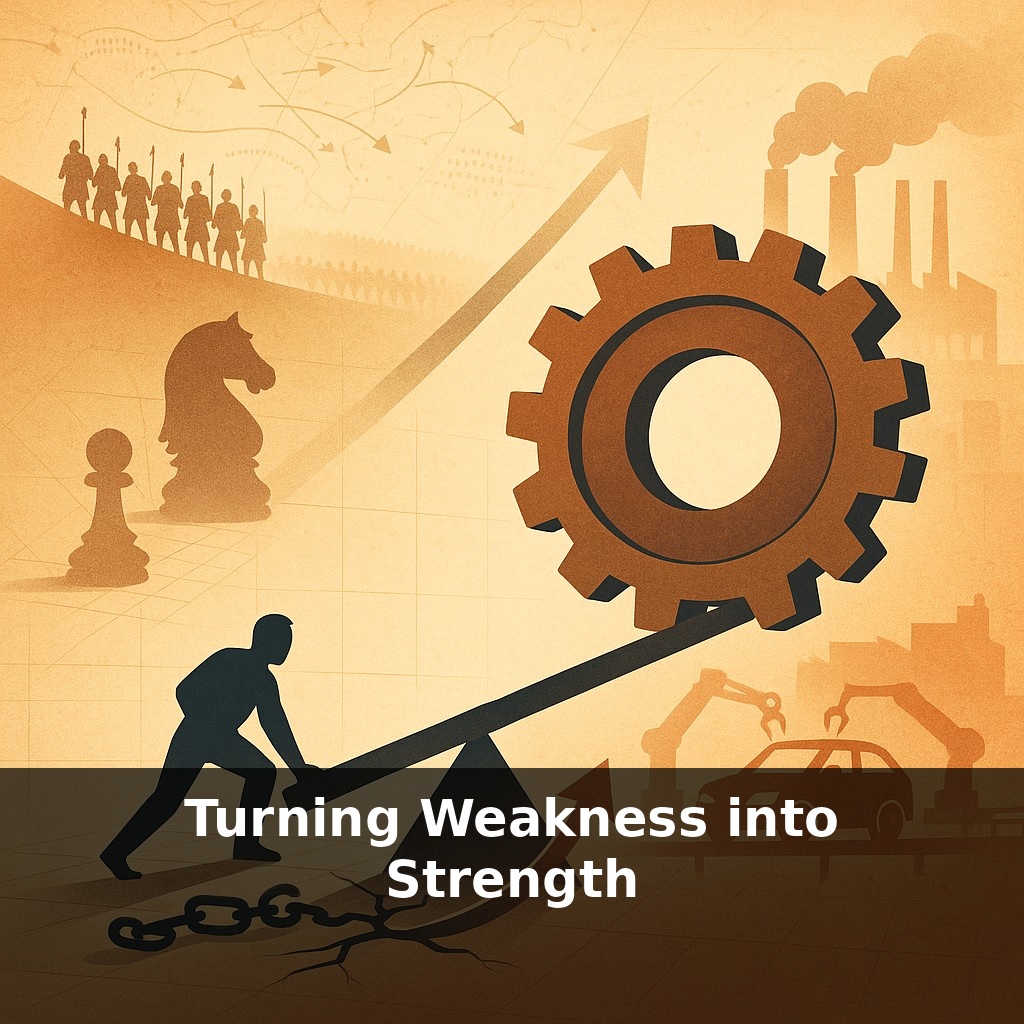
A tiny army with a fraction of its enemy’s firepower wins a battle. A small carmaker, starved for cash, invents a way to build vehicles faster than industrial giants. Weakness, on paper. Advantage, in practice. How does that flip happen—and could your biggest liability be your hidden edge?
Here’s where this gets practical. Most people treat a weakness like a leaky roof: patch it just enough to stop the drip, then pretend the storm isn’t getting worse. But the actors who consistently win under pressure do something stranger: they redesign the whole house around the leak. They change where they live, how they store things, what they build with—until the “problem” becomes part of a smarter structure.
In business, that might mean a tiny team that can’t match a giant’s feature list, so they deliberately strip their product to one thing customers rave about, then design every hiring, meeting, and metric around defending that focus. In your own life, a lack of time can push you to build ruthless filters: fewer goals, tighter commitments, sharper criteria for “yes.”
This episode, we’ll unpack how to do that on purpose—systematically, not by accident.
History shows this flip often starts with an uncomfortable admission: “We can’t win their game.” Toyota couldn’t outspend Detroit, so it built a system obsessed with flow, not stockpiles—eventually shrinking lead times so much that inventory became a disadvantage. Netflix couldn’t make DVDs arrive faster by mail, so it stopped treating the mailbox as the battlefield and moved the whole fight online. In both cases, the constraint didn’t just shape tactics; it dictated what “winning” even meant. That’s the mental pivot we’re after: changing the scoreboard, not just training harder for the old one.
Start with the uncomfortable part: most people stop at naming a limitation. “We’re underfunded.” “We’re late to the market.” “Our tech stack is outdated.” That’s a label, not a constraint. A constraint is precise and operational: “We can only release once a quarter,” or “We can only support one customer segment deeply.” You can engineer around a specific constraint; you can only complain about a vague one.
So the first move is to sharpen the weakness until it’s almost painfully specific. Toyota didn’t say “we’re small”; they confronted very concrete limits in warehouse space, cash, and defect tolerance. Netflix wasn’t “worse at delivery”; it was bound by shipping cycles and physical inventory. The precision forced creativity.
Second, you look for an arena where that sharpened constraint becomes an anchor, not a handicap. This is where most competitors are lazy: they copy dominant players’ scorecards. If you’re capped at quarterly releases, maybe you become the company whose updates never break anything—security, regulatory, and enterprise buyers suddenly care more about your rhythm than your rivals’ speed. If your team is tiny, perhaps every engineer pairs weekly with actual customers, building a reputation for uncanny fit in one niche.
Here’s a practical test: ask, “Where would this constraint actually be attractive?” Limited budget can be compelling in markets that distrust excess—education, nonprofits, or customers burned by bloated solutions. Slower growth can appeal in categories that value stability—financial services, medical tools, infrastructure. Your job is to find the environment where your supposed flaw is someone else’s proof of seriousness.
Then comes the hard part: codifying that into systems so it’s not a one‑off trick. Guerrilla forces don’t just use fewer people; they train, plan, and measure as if “small and mobile” is sacred. In business, that might mean targets that reward depth over breadth, processes that block distractions, and hiring screens that favor people who like constraint.
Like a jazz trio working with fewer instruments, the point isn’t to imitate an orchestra; it’s to lean so hard into minimalism that listeners stop comparing—and start preferring the clarity you produce.
A solo developer who can’t compete on features might turn a “slow roadmap” into a promise: every release ships with a migration guide, a rollback plan, and live office hours. Over time, users stop asking “What’s next?” and start trusting “What breaks if I adopt this?” The constraint becomes a reliability brand.
A small café with only four tables can’t chase volume, so it offers fixed‑time seatings and pre‑order menus. That limitation lets them learn regulars’ patterns, test new dishes nightly, and run near‑zero waste. The tiny space, framed correctly, becomes an intimacy engine.
On a personal level, someone who struggles with context switching can formalize it: no more than two active projects, strict themed days, and short, scheduled “inbox windows.” Instead of fighting distraction case‑by‑case, they embed a pattern that turns narrow focus into a predictable asset.
Your litmus test: if an outsider copied your “solution” without sharing your constraint, would it actually make them better—or just slower and heavier?
Volatile decades ahead mean constraints won’t be rare accidents; they’ll be the default weather. Teams that practice “constraint drills” now—simulating budget cuts, data loss, or sudden demand spikes—will spot patterns faster when real storms hit. AI will help by stress‑testing plans against thousands of futures, flagging where you’re brittle. Expect careers to shift too: leaders who can narrate a clear “we bent, then rebuilt stronger” story will shape which projects get funded—and which even survive.
Constraints won’t wait for permission; they arrive like sudden fog on a highway. The skill is learning to drive by instruments: what you measure, who you listen to, how fast you’re willing to turn. As you experiment, notice which frictions keep repeating—those are often signals, not glitches, pointing toward a design only you are forced to discover.
Here’s your challenge this week: Pick one “weakness” you’ve been hiding at work (for example, being slow with numbers, getting flustered in meetings, or overexplaining your ideas) and publicly reframe it as a strength in a real situation. Before your next workday ends, tell a colleague or your manager something like, “Because I’m [e.g., more reflective than fast-reacting], I’m going to handle [specific task] this way instead,” and then follow through on that approach. At the end of the day, grade yourself from 1–10 on how fully you leaned into that reframed strength instead of apologizing for it, and aim to beat that score once more before the week is over.