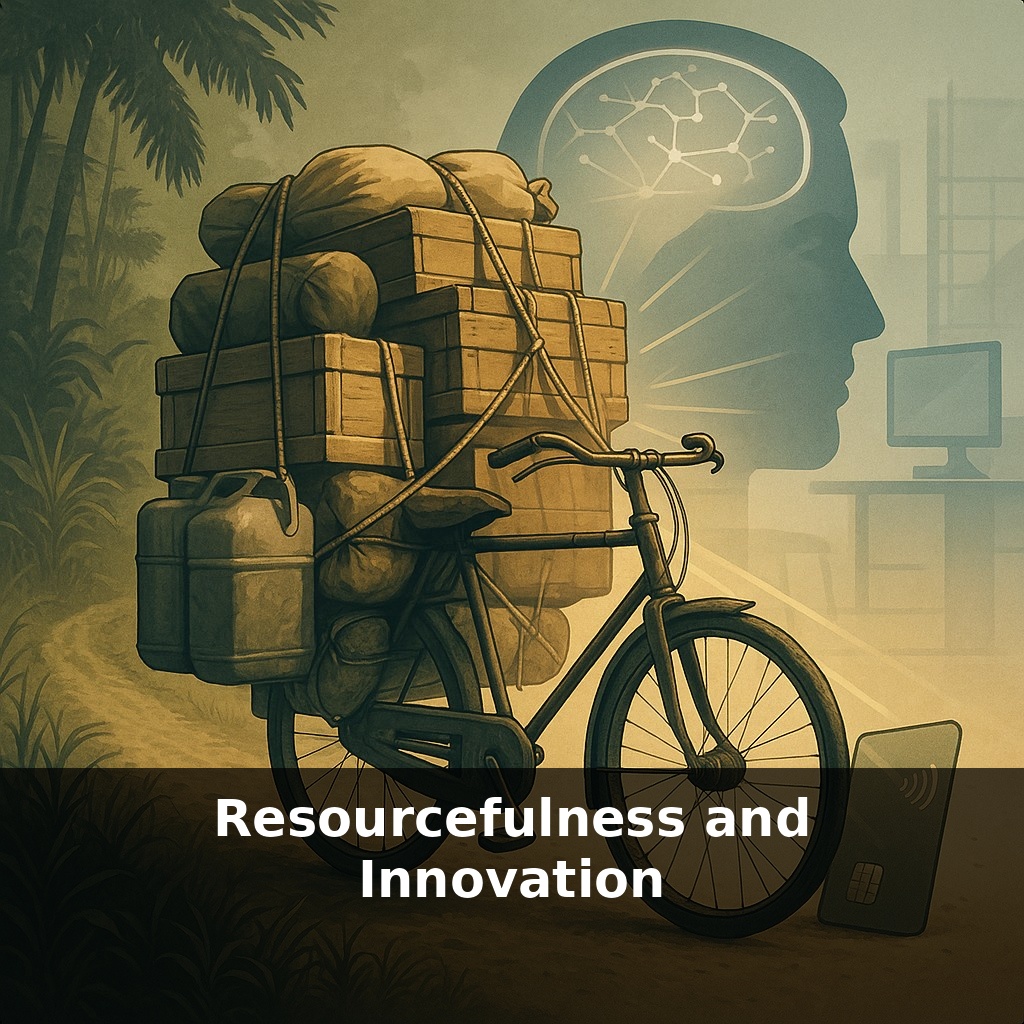
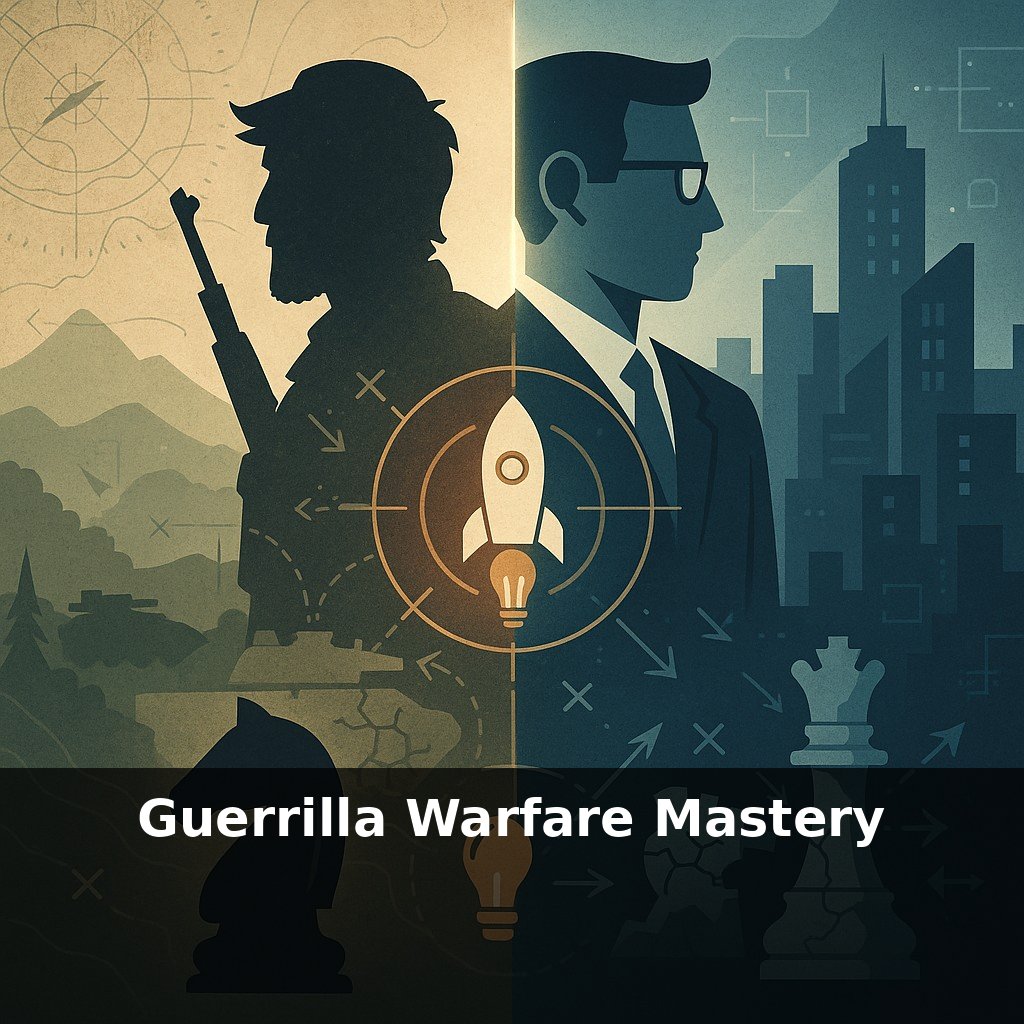
A single bicycle in the Vietnam War sometimes carried the same load as a small truck. Now jump to a modern office: an employee gets a prepaid card and permission to break the rules. Which one is the real weapon—the gear, or the mindset that squeezes magic from almost nothing?
Resourcefulness isn’t just “doing more with less”; it’s deciding *where* to be lavish and *where* to be ruthless. Guerrillas spend almost nothing on status, everything on leverage: a hidden trail that bypasses a highway, a trick that turns a common tool into a force multiplier. Modern innovators face a similar trade-off. They may lack budget, headcount, or brand power—but they can overspend on experimentation speed, customer insight, or unconventional partnerships.
Think of three levers: improvisation (using tools off-label), speed (shortening the time between idea and test), and psychological advantage (shaping how others perceive risk or value). Those Viet Cong porters and those intrapreneurs with a small card share one quiet superpower: they reassign value. What looks minor on paper becomes decisive in practice. In a volatile market, that shift in what you treat as “strategic” is often the real asymmetric weapon.
In war zones, scarcity exposes what actually matters. Ammunition, food, local trust—each is constantly re-ranked as conditions shift. The same ruthless prioritization is now visible in boardrooms. When 38% of startups die from running out of cash, the constraint isn’t just money; it’s the ability to continually reassign it to what’s working *this week*. That’s why programs like Adobe’s Kickbox don’t just hand out funds; they normalize small, fast bets. In unstable markets, the winners behave less like architects executing a fixed blueprint and more like field engineers, reinforcing whatever section is holding under fire.
In guerrilla campaigns, three often-overlooked mechanics show up again and again: recombination, opportunistic timing, and narrative pressure. Each has a clear business twin.
**1. Recombination: turning “non-assets” into assets** Guerrillas rarely wait for ideal tools; they stitch together whatever is at hand. In business, this looks like combining stale assets in ways your competitors don’t bother to try: pairing old datasets with a new API, repurposing a dormant email list as a beta-tester community, turning a support team into a source of product insight. The constraint forces you to ask: “What do we already have that could be rearranged into something valuable by next month?”
**2. Opportunistic timing: striking between the beats** Under-equipped forces avoid head-on battles and exploit gaps—bad weather, shift changes, festival days. Companies can work the calendar the same way. Launch when incumbents are distracted by earnings, regulation changes, or peak season firefighting. Test pricing during low-visibility periods. Push bold experiments when internal bureaucracy is slow to react—weekends, end-of-quarter, or in “ignored” product lines where scrutiny is lower. The aim is not recklessness, but slipping tests into moments when resistance is weakest and learning is fastest.
**3. Narrative pressure: weaponizing perception** A smaller force survives by shaping stories: exaggerating strength, hinting at hidden allies, or broadcasting minor wins to demoralize opponents. Businesses can apply a cleaner version of this by deliberately curating signals that change how customers, partners, and even competitors interpret your moves. Publishing scrappy case studies early, open-sourcing a small tool, or showcasing a niche but passionate user group can create the sense that “something is happening here,” attracting talent and collaboration disproportionate to your actual size.
Your challenge this week: pick one project and apply all three mechanics. Recombine at least two underused assets, time a small experiment for a “low-resistance” moment on your calendar, and share one visible signal that amplifies the project’s perceived momentum.
A jazz quartet on a tight budget books a tiny club on a rainy Tuesday, inviting a local poet and a student filmmaker. None of them are famous, but together they create a one-night “festival” that feels bigger than the sum of its parts. That’s recombination in practice: instruments, words, and visuals colliding into something novel.
In business, think of a small analytics startup partnering with a niche newsletter and a regional meetup group. On their own, each channel is modest; combined, they become a focused launch pad into a very specific community executives can’t easily reach.
Guerrilla movements often lean on unlikely allies the same way—radio hobbyists, smugglers, village elders—each offering a narrow but crucial capability. Scrappy teams can mirror this by looking beyond typical “business” partners: local makerspaces, alumni groups, or even disgruntled users can become agile extensions of your reach, if you design experiments that let them plug in fast.
Guerrilla-style creativity will only get more important as tools become cheap and universal. When anyone can spin up cloud servers and AI models, the edge shifts to *how* you combine them and *how fast* you learn. Think of it less like owning rare instruments and more like being the band that can improvise a new song onstage. Teams that practice tiny, reversible bets—using no-code, open data, and lightweight alliances—will navigate shocks better than those waiting for perfect plans or big budgets.
Treat constraints like shifting weather: not obstacles, but changing wind you can tack against. The teams that win aren’t those with perfect forecasts, but those who’ve practiced trimming sails quickly—cancelling dead projects, redeploying talent overnight, reusing “failed” components in new bets—until adaptation itself becomes a quiet, compounding advantage.
Try this experiment: Pick one constraint you’re facing right now (like “no budget for tools” or “only 30 minutes a day to work on this idea”) and, for the next 24 hours, treat it as a *non‑negotiable design rule* instead of a problem. Using only resources you already have—your existing network, free software, and what’s physically around you—build a scrappy “version 0.1” of a solution (a rough prototype, a simple workflow, or a tiny pilot with one real user). Then, before you go to bed, ask one person you trust to use or react to that version 0.1 and tell you what surprised them most—good or bad.