The Anatomy of Damage: Understanding What Broke
📝 Transcript
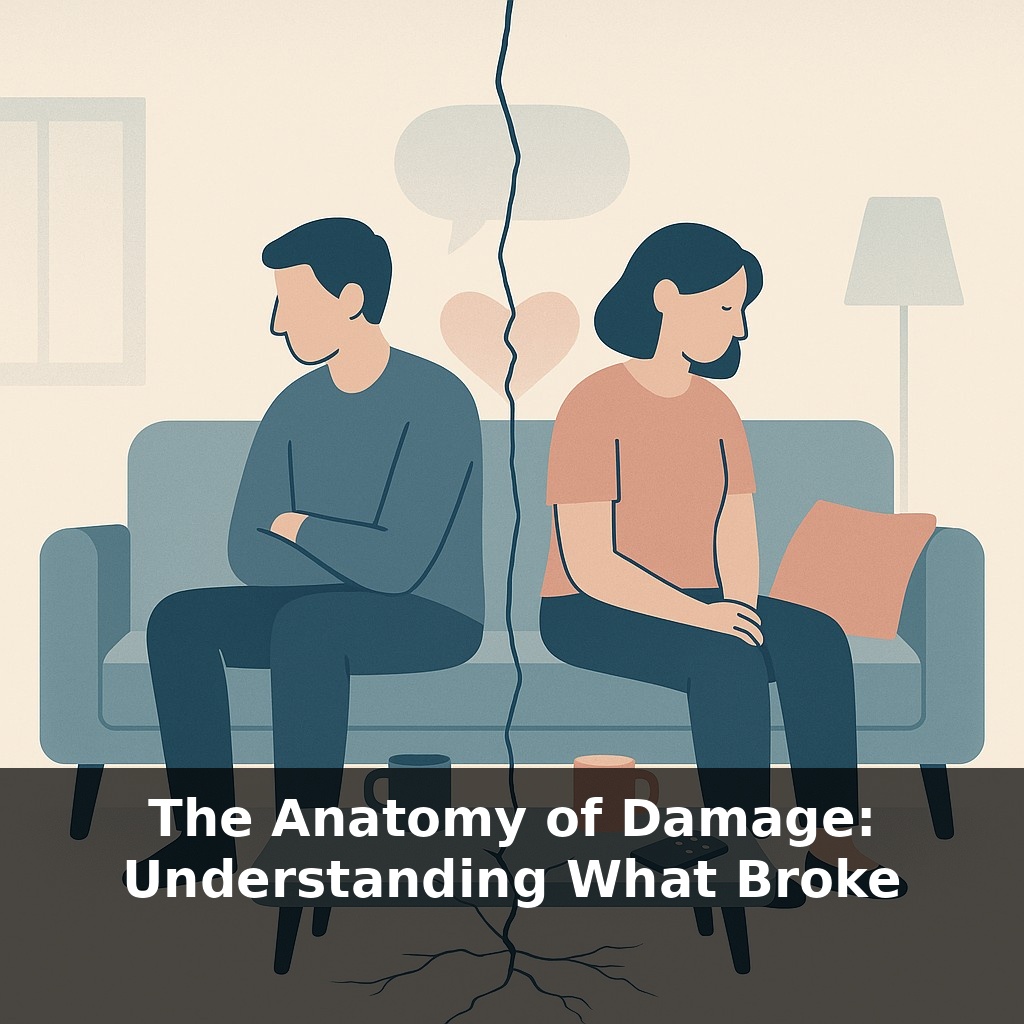
“Most relationships don’t explode—they slowly suffocate.”
One person stops sharing good news. The other stops asking real questions. Days feel “fine,” but strangely cold.
Here’s the twist: by the time a breakup feels sudden, the damage has usually been quietly building for years.
A strange thing happens when we talk about “a relationship breaking.” We jump straight to the headline event: “They cheated.” “She left.” “He just changed.”
But beneath that headline there’s a quieter story: *what, exactly, stopped working long before the ending?*
Modern relationship research doesn’t just look at big betrayals; it tracks tiny, observable behaviours that predict whether a couple will stay together years later. Not vague “communication issues,” but specific moves—eye-rolls during conflict, turning away when your partner speaks, the jokes that land like little slaps instead of shared laughter.
These moments seem harmless in isolation, the way a single skipped oil change feels trivial. Yet over time, patterns form: needs that never get voiced, hurts that never get named, repairs that never quite happen.
This episode is about zooming in on those patterns so “what broke” stops feeling like a mystery.
Sometimes the clearest clues of what’s broken show up in ordinary moments: how you say “hi” after work, whether you still reach for each other on the couch, the tone you use when you’re both tired and something small goes wrong. Relationship science gives these moments names—contempt, stonewalling, failed repair attempts—but in daily life they feel like tiny shifts: less warmth, shorter answers, more sighs. Over months or years, the emotional climate changes. You still share a house or a bed, yet it feels like you’re living in separate weather systems that rarely touch.
There’s a reason so many people feel blindsided by a breakup even when the signs were there. We’re wired to normalize slow changes. What would have felt shocking three years ago (“We haven’t had a real conversation in weeks”) can, over time, come to feel like “just how we are.”
To understand what actually broke, it helps to look at three layers of damage that often stack on top of each other.
**Layer 1: Unmet core needs (that no one is naming).** Most people need some version of: “Are you there for me?” “Do I matter to you?” “Can I be myself with you?” When these go unmet, we rarely say, “My attachment needs feel threatened.” We say: “You’re always on your phone.” “You never help.” “We never do anything fun.” The surface argument is about chores or schedules; the underground story is about mattering, safety, and being chosen.
**Layer 2: Repeated negative cycles.** Over time, couples tend to fall into familiar dances: - One pursues, the other withdraws. - One criticizes, the other defends. - One shuts down, the other explodes.
These aren’t random. They’re protective strategies that accidentally make things worse. You raise your voice to show urgency; your partner hears attack and pulls away; their distance confirms your fear that you don’t matter, so you push harder. The content of the fight changes, but the choreography stays the same.
**Layer 3: Unrepaired injuries and betrayals.** Not just affairs or lies—also all the “small” events where you felt abandoned or mocked and nothing meaningful happened afterward. Each incident on its own might be survivable. But when apologies are shallow or missing, the nervous system starts treating your partner less like “home base” and more like “potential threat.” That’s when emotional withdrawal starts to feel safer than reaching.
These layers interact. Persistent unmet needs make negative cycles more likely; negative cycles make real repair harder; failed repair turns into a story about who your partner *is*: “You’re selfish.” “You’re impossible.” “We’re just incompatible.”
Understanding what broke means tracing those layers, not to assign blame, but to see where change is actually possible: at the level of needs, cycles, and stories—not just at the level of one dramatic event.
Think of everyday moments as diagnostic tests rather than verdicts about the whole relationship. You snap, “Why are you always late?” but beneath it might be: *Can I rely on you when it matters?* Your partner mutters, “Forget it,” and walks away; under that might be: *It never feels safe to get it wrong with you.*
Notice how each person’s move makes emotional sense in isolation, yet together they form a loop that hurts both. The late partner might be juggling too much and already ashamed; the one complaining might have a long history of being let down. Neither is “the problem.” The real issue is how their protective moves collide.
Another clue: the stories you each silently tell. When plans fall through, do you think, “They’re careless,” or “They’re overwhelmed”? The first story fuels distance; the second makes curiosity possible. Mapping what broke is less about dissecting who failed, and more about tracing how your meanings, reactions, and protections started working against you.
Damage rarely stays confined to the couple. As those small misattunements stack up, they can start leaking into sleep, work focus, even how patient you are with friends or kids. The nervous system doesn’t keep tidy folders labeled “relationship stress” and “everything else”; it’s more like dye in water—once poured in, it tints the whole glass. The implication: caring for the bond isn’t just about “us,” it’s quiet preventative care for your future energy, health, and capacity to love at all.
Seeing the anatomy of the damage is only step one. The next is gently testing what still responds. Tiny experiments—asking one more curious question, pausing before a familiar jab, admitting “that stung more than I said”—are like pressing keys on a dusty piano to find which notes still ring true. You’re not fixing everything yet; you’re learning where repair is even possible.
Try this experiment: for the next 24 hours, every time you feel a spike of shame, defensiveness, or “I’m the problem,” pause and quickly label which layer of damage is getting activated—story damage (“what I believe about what happened”), attachment damage (“what I fear people will do if I’m honest”), or identity damage (“what I think this says about who I am”). Then, out loud, respond to yourself with one sentence that directly challenges that specific layer—for example, “This story might not be accurate,” “Even if some people leave, that doesn’t mean I’m unlovable,” or “This mistake is not the whole truth about me.” Notice which layer shows up most often today and how your body responds when you name it and answer it back.
From this course
Healing Relationships: From Broken to Whole
8 episodesUnlock all episodes
Full access to 8 episodes and everything on OwlUp.
Subscribe — $1.99/monthLess than a coffee ☕ · Cancel anytime