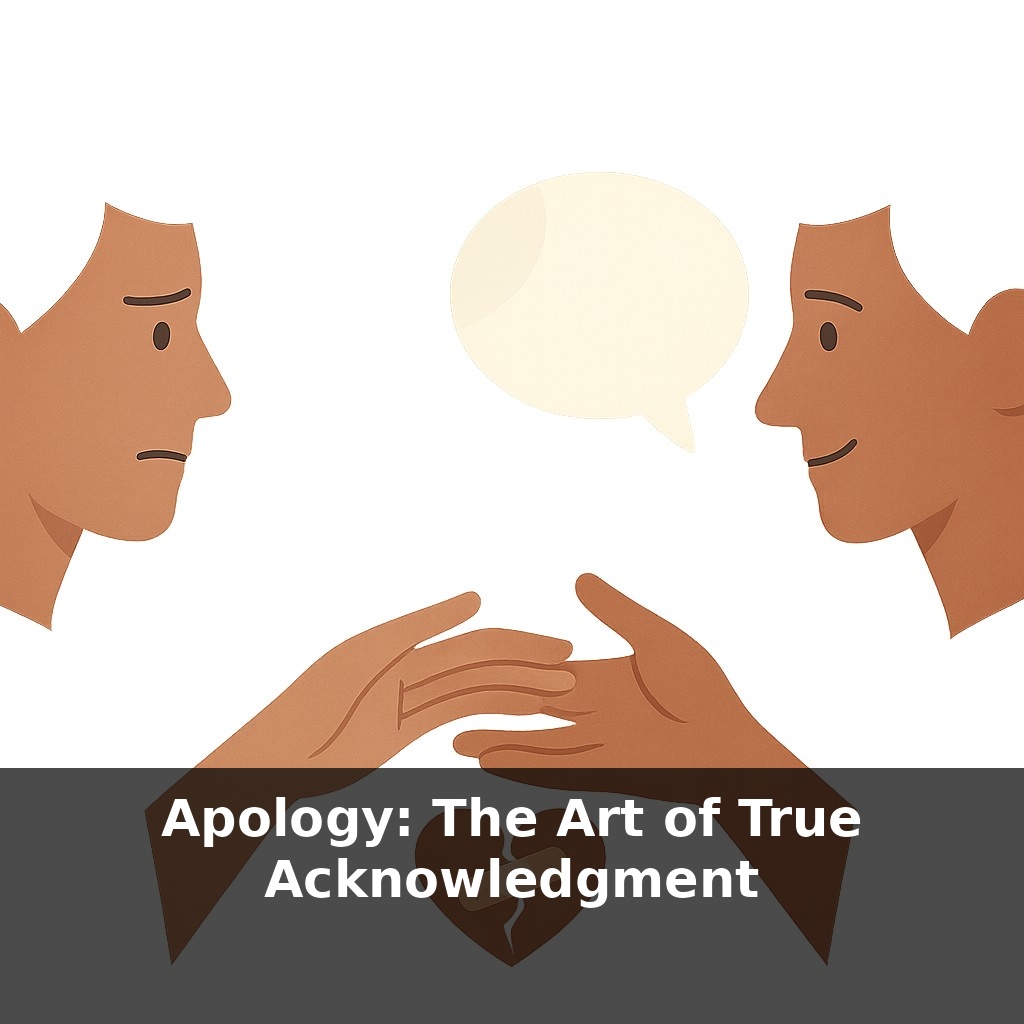
“I’m sorry” can lower someone’s stress hormones almost as much as deep breathing—when it’s done right. A slammed door, a curt email, a partner going silent at dinner: same two words, totally different impact. Why do some apologies heal instantly while others quietly make things worse?
You’ve probably felt that odd whiplash of hearing “sorry” and feeling…nothing. Or worse, feeling slightly more irritated than before. That’s not because you’re unforgiving; it’s because your brain is exquisitely tuned to the difference between a quick escape hatch and a real attempt to make things right. Research on conflict shows that we don’t just listen to the words—we scan for whether the other person truly *gets* what they did, why it mattered, and what they’ll do differently next time. Miss one of those pieces, and the whole thing rings hollow. That’s why a tossed-off “I’m sorry you feel that way” can sting more than silence: it names your reaction but sidesteps their role in causing it. In close relationships, these near-miss apologies quietly pile up, like unwashed dishes in the sink—each one small, but together heavy and hard to ignore.
So where does that leave you when you *want* to make things right but aren’t sure how? Most of us grew up with “Say you’re sorry” as a social reflex, not as a skill. We learned the verbal equivalent of a quick handshake, not the slow, steady work of repair. That’s why, in the heat of conflict, your mind grabs for shortcuts: explain your intention, minimize the damage, move on fast. Meanwhile, the other person is quietly running a different checklist: Do you see what hurt? Do you see *your* part? Will this happen again? When those internal scorecards don’t match, even well-meant apologies land with a dull thud instead of real relief.
Think of this as learning a new language: you’ve been using one catch‑all word—“sorry”—for years, but the person across from you is actually fluent in six different dialects of repair. Miss the one they’re listening for, and the message scrambles.
Those six “dialects” show up clearly in Lewicki’s meta‑analysis: regret, explanation, responsibility, repentance, repair, and request for forgiveness. Most people lean on one or two and skip the rest. Some of us are over‑explainers (“Here’s why it happened…”), others over‑repenters (“I feel terrible”), and some are fixers (“I’ll pay for the damage”). When your default style doesn’t match what the other person needs, the apology feels slanted, even if your heart is in it.
This is why intent so often clashes with impact. You might feel you’ve poured yourself into an apology because you agonized over how bad you feel. But if you never clearly say, “I did this, and it hurt you in these ways,” the other person’s nervous system stays braced. Social psychology research repeatedly finds that people forgive based more on how well you recognize the *effects* of your actions than on how nobly you describe your motives.
Culture and context shape this, too. In Japan, for instance, phrases like “moushiwake arimasen” flag total ownership; without that signal, even extensive explanations can sound slippery. In many Western workplaces, by contrast, lawyers and PR teams often strip apologies of responsibility to avoid liability—ironically creating the very mistrust that fuels lawsuits and market‑cap losses.
Relationships aren’t courts, but the same dynamic applies. A partner who keeps emphasizing how accidental something was can feel, over time, oddly unsafe: not because they’re malicious, but because they never squarely say, “I did that, and I see the ripple it had on you.” Without that, promises to “do better” have nothing solid to stand on.
So the art is less about eloquent wording and more about coverage: Did you touch the specific points their nervous system is scanning for? The more precisely you can match what *they* need to hear to relax and re‑engage, the more your apologies stop being performances and start being turning points.
You can start noticing this in tiny, ordinary moments. You snap at your partner while rushing out the door and later mumble, “Sorry, I was stressed.” That covers “explanation,” but not much else. Contrast that with: “I snapped at you. That was unfair and probably made you feel small. I don’t want to talk to you that way. Tonight I’ll handle the dishes so we’re not both rushed tomorrow. Can you forgive me?” Same event, different architecture.
Or think of a manager who misses a deadline that leaves their team scrambling. “Stuff came up” softens their own discomfort but leaves everyone wary. “I misjudged my time and dropped this. You had to stay late because of me. Next sprint, I’ll build in a buffer and check mid‑week so this doesn’t repeat. Are you open to that plan?” Now the team has something solid to stand on.
Notice how, in both cases, the focus shifts from *defending why it happened* to *naming what happened and how you’ll carry it differently next time*.
Public and political life will likely test this “art of acknowledgment” at scale. As deepfakes and scripted statements blur sincerity, people may start treating apologies like they do ingredient labels—checking for what’s missing, not just what’s advertised. Workplaces could train teams to offer repairs as routinely as they track KPIs. Even families might adopt shared “reset rituals,” small but formal, the way households already agree on who cooks or cleans.
You won’t nail this every time, and that’s the point. Treat each repair attempt like adjusting a recipe: a bit more ownership here, clearer naming of harm there, a concrete offer to make things right. Over time, people start to relax around you—not because you never misstep, but because they can trust how you come back when you do.
Before next week, ask yourself: 1) “Whose hurt or disappointment from the past keeps resurfacing in my mind, and if I had to name the exact moment I broke trust (the comment I made, the promise I broke, the thing I dismissed), what would it be?” 2) “If I stripped my apology of every explanation and ‘but,’ what simple, specific sentence could I say that would make them feel fully seen and acknowledged for what I actually did?” 3) “If I imagine their body language and tone after hearing that clean apology, what am I most afraid they’ll say or not say—and what does that fear reveal about what I’m still trying to protect in myself?”