About half of what you do each day runs on autopilot. Now place that inside a tense conversation: one sigh, one eye-roll, and both of you are already following a script you didn’t choose. The puzzle is this: how do you rewrite a script you only notice after it’s already running?
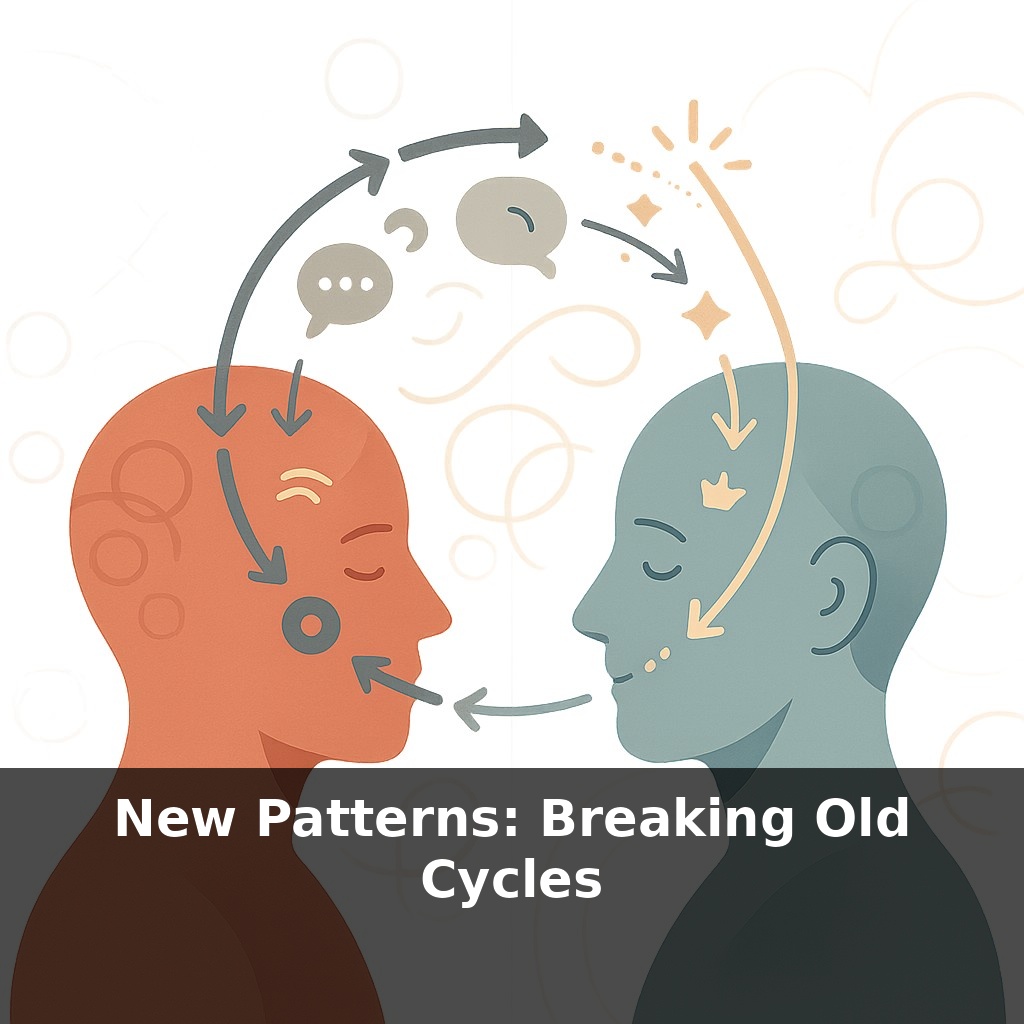
Conflict in most relationships doesn’t start with shouting; it starts with tiny, predictable sparks: the late reply, the unfinished chore, the tone that “sounds just like last time.” Your brain quietly tags these as cues and, before you’re fully aware, the familiar cycle is already spinning: tension → defensiveness → shutdown or attack → distance. What research adds here is crucial: it’s not enough to just “stop” the old pattern. You have to give your nervous system something better to do in that same moment. Therapies like CBT, EFT, and Gottman’s work all agree on this point: lasting change happens when you pair a new response with a new emotional payoff—relief, understanding, safety—over and over. That means we’re not just trying to avoid the next fight; we’re training your body and mind to recognize, “Oh, this is the part where we do something different now.”
You don’t have to wait for a huge argument to work with these patterns; they’re being rehearsed in much smaller, quieter moments all day long. Passing each other in the kitchen, reading a text, hearing the front door close—your brain is quietly sorting these into “safe,” “neutral,” or “uh oh.” Over time, those tiny judgments start steering your tone of voice, your posture, even the topics you avoid. New patterns begin by noticing these micro-moments and gently tweaking them: a different greeting, a softer facial expression, a curious question where a complaint would normally appear.
Research shows that most negative cycles follow a simple structure: cue → meaning → reaction → aftermath. The cue is external (a look, a sentence, a delay), but the meaning you attach to it is internal—and that’s where you have the most leverage.
The cue might be your partner checking their phone while you talk. One person’s brain quietly fills in: “I’m boring. They don’t care.” Another person’s: “They’re stressed from work.” Same cue, different meaning, completely different reaction. CBT targets this exact link between cue and meaning, asking: “What story did my brain just tell, and is it the only possible story?”
EFT zooms in on what happens underneath that story. Instead of staying at “You never listen,” it slows down enough to find the softer layer: “I’m scared that I don’t matter to you.” When that deeper emotion is shared clearly and received with some empathy, the old reaction—criticism, sarcasm, shutdown—has less fuel.
Gottman’s research adds another piece: the way you *start* a difficult moment heavily predicts where it ends. A “harsh startup” (“You always…”, “Why are you so…”) almost guarantees defensiveness. A “soft startup” (“I feel X about Y, and I need Z”) drastically changes the odds, even when you’re upset. This isn’t about being polite; it’s about not triggering the same well-worn path.
Think of it like cooking on a high flame: if the heat is always on maximum, even good ingredients burn. Lowering the flame—speaking a bit slower, dropping your volume, pausing before the comeback—creates enough space for a different outcome. That’s where mindfulness comes in. Those mindfulness-based communication studies weren’t about being “Zen” in general; they trained couples to notice rising tension *in the moment* and make small adjustments: unclenching the jaw, uncrossing arms, taking one breath before responding.
Breaking cycles, then, isn’t heroic or dramatic. It’s often one tiny shift at a single link: questioning a story instead of believing it, naming a softer feeling instead of attacking, starting the hard talk 10% gentler, or taking a 60-second pause *before* voices spike. Each small deviation is a vote for a new pattern your brain can eventually learn to trust.
One couple I worked with kept looping through the same Sunday-night argument about money. Instead of tackling “the whole problem,” we zoomed in on just the *first* 90 seconds. Their cue was always the same: partner A opening the banking app with a sigh. Normally, partner B would brace, cross their arms, and fire back, “Here we go again.” Their experiment for two weeks was tiny: when the sigh happened, partner A had to name one specific fact (“I’m worried about the credit card, not everything”), and partner B had to ask one curious question before responding (“What part feels most stressful right now?”). They still disagreed, but the arguments got shorter and less vicious, because the first link in the chain was different.
In medicine, this is like treating the infection *early* instead of waiting for a full-blown fever. You don’t need a personality transplant; you need to intervene at the smallest, earliest signs your old cycle is starting.
69% of couple issues never fully resolve, yet how partners *handle* them can transform a family’s emotional climate for decades. As old loops weaken, kids witness apologies, repair, and calm problem-solving as normal. That becomes their template with friends, coworkers, and their own partners. It’s similar to slowly changing a city’s zoning laws—at first, only a few new buildings appear, but over time the entire skyline reflects those earlier, quiet decisions.
Change rarely arrives with a drumroll; it shows up as that quiet second where you choose not to send the sharp text, or you reach for your partner’s hand instead of your phone. Over time, those tiny pivots can feel less like effort and more like muscle memory—like finally learning the rhythm of a song you’ve been humming for years.
Here’s your challenge this week: Choose one recurring pattern you heard described in the episode (like overcommitting, shutting down during conflict, or procrastinating on hard conversations) and, for the next three days, interrupt it in the exact first 60 seconds it usually shows up. When you notice it starting, pause and say out loud the new script they modeled on the show (for example: “I’m feeling overwhelmed, so I’m going to choose one thing and let the rest wait” or “I want to stay in this conversation, but I need a 10-minute breather”). Track each interruption by putting a simple tally mark on your phone’s notes app or a sticky note, and aim for at least three successful interruptions by the end of the week.