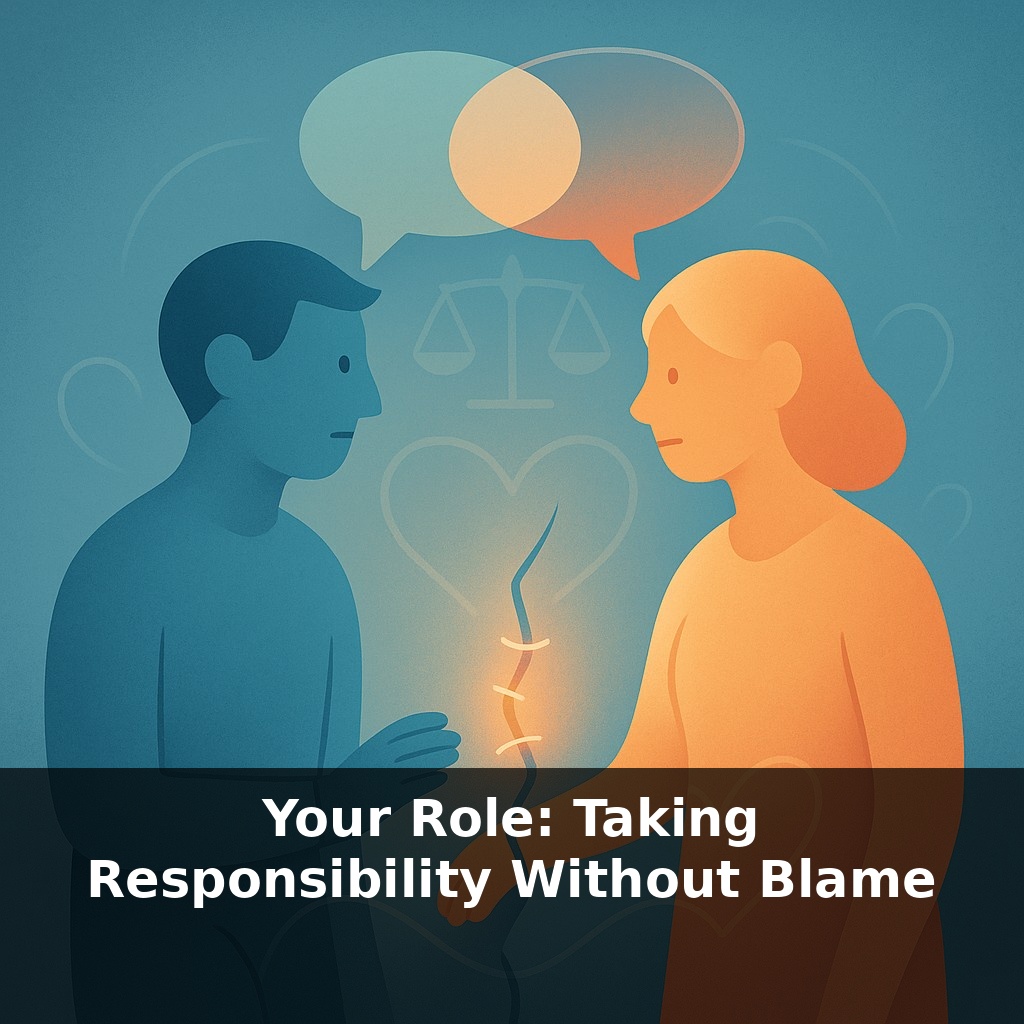
A couple in Gottman’s Love Lab starts arguing. Within minutes, one partner quietly says, “You’re right, I did snap at you earlier.” Conflict drops, repair succeeds. Here’s the twist: they took responsibility—without blaming themselves or their partner. How do you do that?
You’ve probably had moments where you thought, “This is partly on me,” and instantly felt your stomach drop. That inner flinch is why taking responsibility so often turns into self-attack or counterattack. Today, we’re going to separate responsibility from worth: what you did from who you are. Instead of asking, “Whose fault is this?” we’ll zoom in on a sharper question: “What was my actual impact here?”
Think of it like adjusting seasoning in a stew: you’re not judging the entire meal as a failure; you’re noticing, “Ah, a bit too much salt there,” and correcting course. In relationships, that means learning to notice your contribution with the same calm precision—no drama, no character assassination. We’ll unpack how to use that kind of clear seeing in real conversations, especially when emotions are high and your defenses want to take over.
Most of us were trained in one of two modes: defend yourself at all costs, or collapse into “you’re right, it’s all my fault.” Both are like using only “too hot” or “too cold” on the stove, with no in‑between. In this episode, we’ll work in that missing middle. We’ll look at how your brain explains events to itself, why it so quickly jumps to self‑criticism or blame, and what actually changes in your body when you respond with accountability plus kindness. You’ll start to see conflicts less as verdicts on your character and more as data you can learn from together.
When researchers talk about “blameless accountability,” they’re really describing a specific mental sequence your brain can learn to run under stress. It has three parts: how you see what happened, how you treat yourself about it, and how you talk about it with others.
First is accurate self‑assessment. In conflict, your mind tends to sprint toward two biased stories: “I’m the villain” or “I’m the innocent victim.” Both feel strangely certain. What’s missing is curiosity. Metacognition—the ability to notice your own thinking—lets you hit pause and ask, “What am I assuming right now about why this happened?” Attribution research shows we usually over‑explain others’ behavior with character (“they’re so selfish”) and our own with circumstance (“I was just tired”). Blameless accountability asks you to flip on a brighter light: “What were the specific actions, signals or silences on my side that plausibly affected this?”
Second is self‑compassion. That’s not letting yourself off the hook; it’s how you stay in the room with your own mistakes long enough to learn from them. Across studies, people who respond to errors with warmth instead of abuse don’t avoid responsibility—they actually show more motivation to repair. Anxiety drops, problem‑solving rises. Your nervous system hears, “You messed up, and you’re still basically safe,” so it doesn’t have to waste energy on shame or defense. That freed‑up energy is what you then have available for change.
Third is solution‑focused communication. This is where your private clarity turns into shared progress. It sounds like: “Here’s the part I see I played,” followed by, “Here’s what I’d like to try instead,” not, “So I guess I’m just terrible,” and not, “But you were worse.” Etsy’s shift to blameless postmortems is a good example: engineers describe exactly what they did, what the system did, and what they’ll alter next time—no character judgments, yet very real consequences and fixes.
These three pieces reinforce each other. The more accurately you can map your role, the easier it is to be kind to yourself without denial. The kinder you are, the more data you can tolerate seeing. And the more you bring that data into conversations in a forward‑looking way, the safer everyone feels naming their own part—without anybody having to be the designated villain.
In a team setting, this mindset can look surprisingly ordinary. Say a project deadline is missed. One person could say, “I screwed everything up, I’m just disorganized,” and another might insist, “If marketing had done their part, we’d be fine.” A third response sounds different: “I underestimated how long my piece would take and didn’t flag it early. Next sprint I’ll set a midpoint check‑in so we can adjust sooner.” No drama, but very specific. Over time, teammates start mirroring that language, and status meetings shift from “Who dropped the ball?” to “What signals did we miss?”
In a couple, it might sound like: “When I checked my phone while you were talking, I imagine it felt dismissive. Next time I’ll finish the message before we start, or put my phone away.” That kind of micro‑adjustment, done consistently, often matters more than occasional big apologies. You’re not just fixing incidents; you’re teaching each other that it’s safe to be imperfect and still stay engaged.
83% of couples in repair studies, faster tech incidents, lower anxiety in individuals—over time, this mindset scales into culture. Classrooms using it start to treat conflicts like group projects in emotional problem‑solving. In families, kids watch adults own missteps calmly and copy that script with siblings. Policy‑wise, it nudges systems toward “What would prevent this next time?” instead of “Who deserves punishment?”—more like tending a garden each season than hunting for the worst weed.
As you practice this, notice how small shifts ripple outward. Conversations may feel less like courtroom trials and more like joint problem-solving at a cluttered workbench: both of you sorting through tools, asking, “What could we try next?” Over time, that shared curiosity can become the quiet backbone of trust in even your toughest relationships.
Start with this tiny habit: When you catch yourself thinking “This isn’t my fault,” pause and quietly add the words “but it is my responsibility for what I do next.” Don’t analyze it, don’t argue with it—just add that one sentence in your head. If you’re in a conflict, do the same thing right after the other person finishes talking. This micro-shift trains your brain to separate blame from responsibility, without needing the other person to change first.