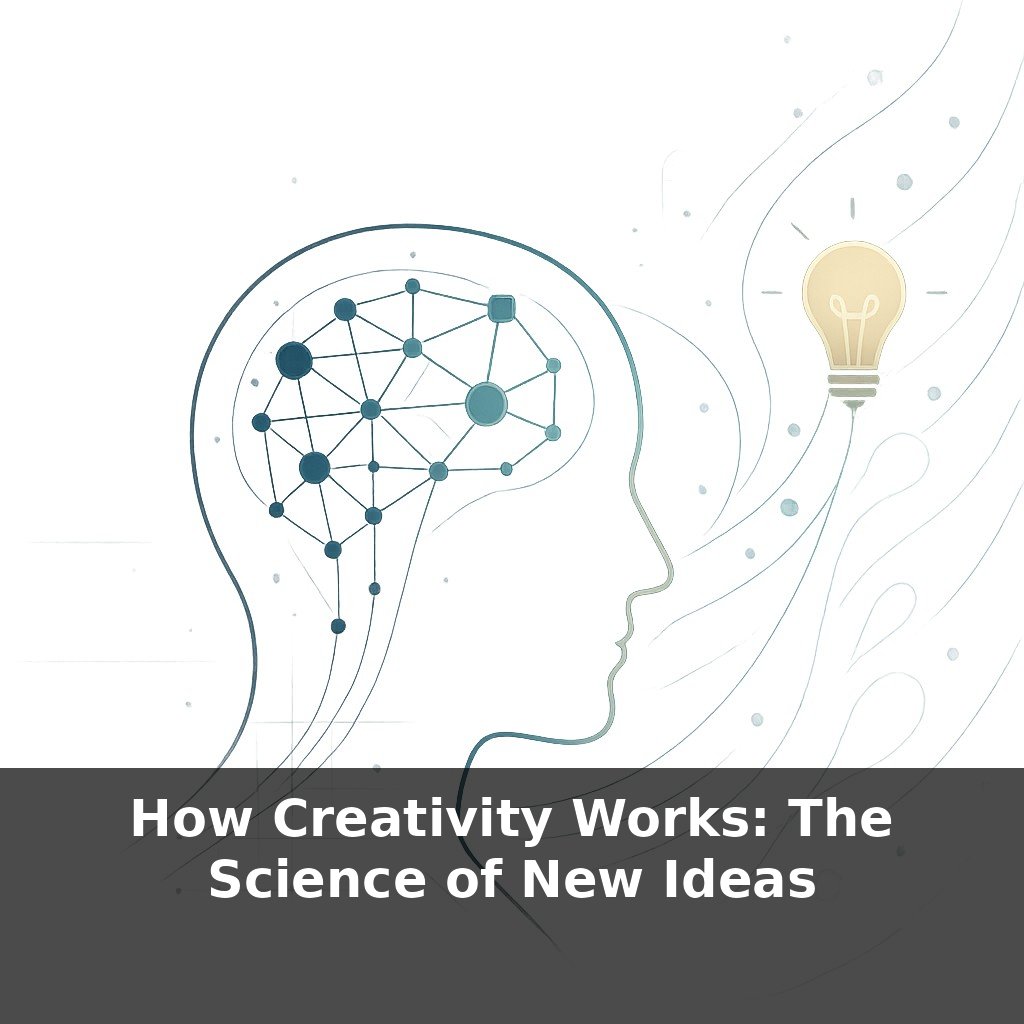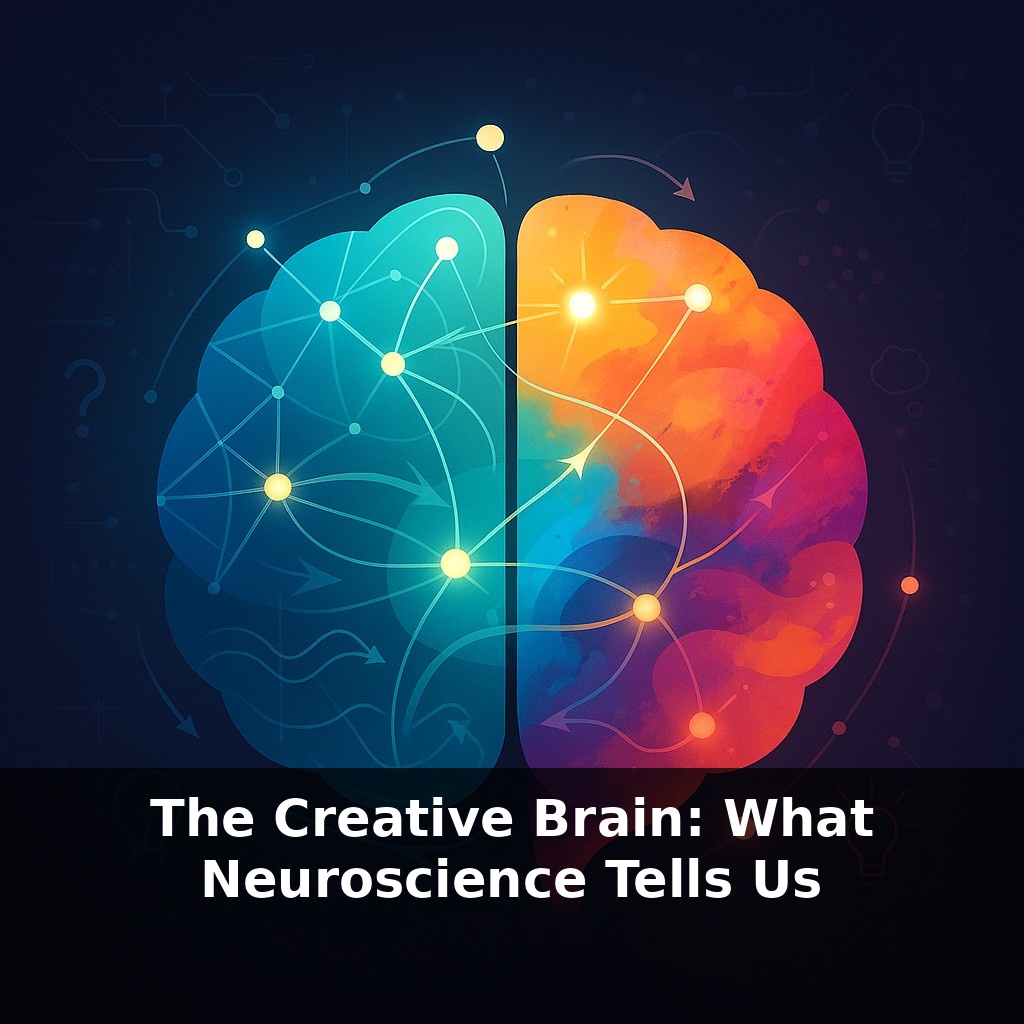
A Nobel-winning scientist once joked that creativity is “intelligence having fun” — but your brain disagrees. Right now, as you’re listening, three huge neural networks are quietly arguing over every idea you have. The surprise? Their “fights” may be the secret to original thinking.
So when an idea “pops into your head,” it’s not magic—it’s negotiation. Those same networks that argued over your last good idea are constantly weighing comfort against risk, habit against curiosity. Most of this happens below awareness, which is why your best thoughts can feel random, like finding a $20 bill in a jacket you forgot you owned. In practice, your brain is running a quiet cost–benefit analysis: Is this new connection worth my energy? Is it safe to deviate from the usual path? That’s why creativity so often shows up when stakes feel low—during a walk, a shower, or while cooking something simple. The pressure dips, your internal “accountant” relaxes, and suddenly unusual combinations become acceptable. Today, we’ll look at how to nudge that invisible negotiation in your favor, on purpose.
Today’s twist is that this “quiet negotiation” isn’t fixed—your brain’s rules of engagement can be tilted, and faster than you’d expect. Neurochemicals like dopamine work a bit like dynamic pricing in an online store: when conditions change—novelty, reward, mild uncertainty—the value tags on certain ideas shift, making some options suddenly look like bargains. At the same time, brain rhythms open and close tiny windows where odd connections slip through more easily. This means timing, mood, even a brisk walk don’t just change how you feel; they change which ideas are allowed onto the mental “stage” at all.
Here’s the odd twist: the “negotiation” in your head doesn’t happen in one room—it moves across three different conference halls, each with its own agenda.
First, there’s the mode that loves to wander. When you’re letting your thoughts drift on a commute or staring out a window, this system strings together memories, half-formed notions, and distant associations. It’s generous with possibilities and stingy with judgment. That’s why daydreaming so often spits out raw, messy, but interesting options.
Then there’s the mode that shows up when you’re editing, debugging, or planning a presentation. It tightens the criteria: Does this make sense? Does it fit the constraints? Could it work next week, with your actual budget and time? This is the voice that trims, sequences, and occasionally says, “Nice idea, but not today.”
On its own, each mode is limited. Constant drifting rarely ships anything, and constant critiquing quickly leads to blank pages and safe, repetitive choices. The real magic is in how quickly you can move between them—how fast you can let something be wild for a minute, then sharpen it, then loosen again without getting stuck in either gear.
That’s where a third system steps in: it’s less about ideas themselves and more about shifts. It notices: “This thread is promising, stay with it,” or “You’re circling, time to zoom out.” When this system is sluggish, you either cling to one concept too long or you bail on good seeds before they sprout.
Here’s what neuroscience adds: these shifts are physically trainable. Studies using brain imaging show that people who score higher on creative tasks aren’t just “better thinkers”—they’re better switchers. Their brains show tighter coordination between the wandering mode and the evaluating mode, especially when they’re pushed to generate many uses, angles, or solutions under mild time pressure.
And that coordination is sensitive to surprisingly small nudges. Ten minutes of walking, a change of setting, or a structured constraint (like “five bad ideas first”) can alter which mode is dominant and how smoothly you pivot between them. Over time, you can build this as a skill: not “be more creative” in the abstract, but “get better at toggling on cue”—almost like learning a keyboard shortcut for your own mind.
Think about the last time you were stuck on a problem at work, then suddenly saw the solution while rinsing dishes. That wasn’t randomness—it was a mode switch triggered by a tiny context change. Designers at IDEO lean into this on purpose: they’ll start a session with loose sketching and playful prompts, then deliberately pivot into sharp critique rounds, almost like ringing a bell to tell everyone, “We’re in a different gear now.” Writers do something similar when they draft in a messy notebook, then move to a clean document only for revising. The location, tools, and posture quietly tag which mental mode should lead. Even Pixar’s Braintrust isn’t just “feedback”; it’s a ritualized handoff from one style of thinking to another, with clear rules about when anything goes and when the bar gets raised. You can treat your own shifts just as concretely—by pairing specific chairs, times of day, or playlists with distinct phases of your work. Over time, those associations become shortcuts.
A 10‑minute walk, a tweak in lighting, or a different chair might soon be treated less like décor choices and more like turning knobs on a studio soundboard. As labs learn which patterns predict your best breakthroughs, tools could surface gentle prompts: “You focus best after noise, not silence.” Classrooms might shift from grading right answers to timing when to invite wild options. And in teams, algorithms may quietly handle the nitpicky pruning, so people can spend more time stirring the pot.
So the question shifts from “Am I creative?” to “How am I configuring my brain today?” Small levers—a brisk walk, a tighter deadline, a looser brief—work like adjusting contrast on a photo, revealing details that were always there. Your job isn’t to summon lightning from nowhere, but to keep raising more antennas in more kinds of weather.
To go deeper, here are 3 next steps: 1) Block off 25 minutes today to watch the free “Neuroscience of Creativity” lecture by Dr. Andrew Huberman (YouTube) and follow along by actually doing his 3-idea “divergent thinking” drill while you watch. 2) Download the app **Oblique Strategies** or visit oblicard.com, then run a 10‑minute “creative constraint sprint” where you apply one random card directly to a current project you’re stuck on. 3) Grab a copy of **“Wired to Create” by Scott Barry Kaufman & Carolyn Gregoire** and read just the chapter on “Daydreaming,” then test it by taking a 15‑minute “mind‑wandering walk” without your phone, using a single open problem from your work as the prompt you gently keep returning to.