Your brain’s biggest ideas are most likely born when you’re not “being creative” at all. In one study, people came up with about half again as many ideas while doing a boring task than when they tried to focus. So why do we still force breakthroughs at the keyboard?
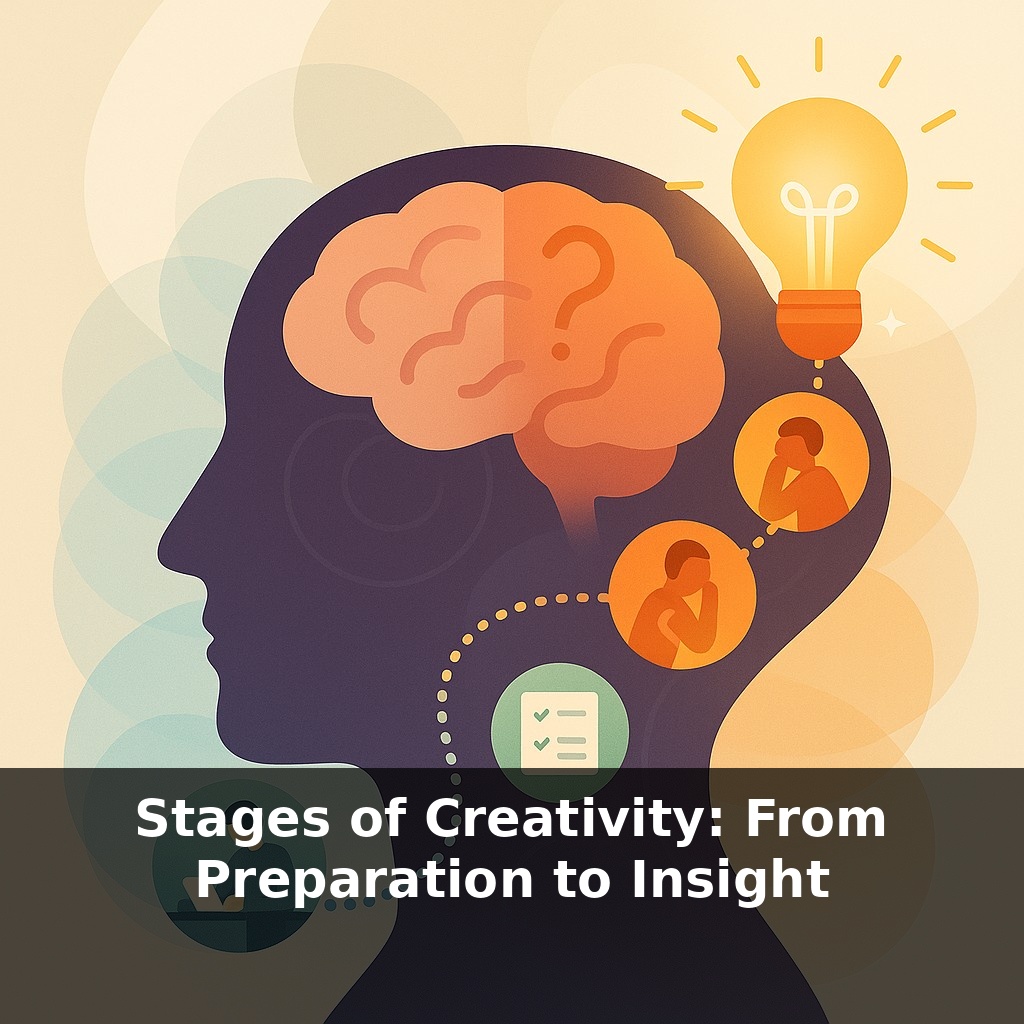
So if your best ideas don’t arrive when you’re “trying,” what exactly are you supposed to do—schedule not-trying? This is where the classic stages of creativity become useful, not as theory, but as a practical workflow. Instead of treating inspiration like a lightning strike, you can treat it more like running a relay race where different “mental runners” hand the baton off at the right moments.
In the early stretch, you dig into problems, gather raw material, and wrestle with constraints. Then you deliberately stop pushing and let a different mode take over while you’re walking, showering, or doing admin work. Later, when a promising spark appears, you don’t just trust it blindly; you stress-test it, refine it, and loop in feedback. Across this series, we’ll unpack each stage, how to trigger it on purpose, and how to stop losing ideas in the gaps between them.
Think of this series as a tour of a factory you’ve been running blindly for years. You see the finished “products” — the ideas that survive — but not the conveyor belts, side doors, and bottlenecks behind them. Each stage in the cycle has different raw materials, tools, and quality checks, and most people unknowingly mix them together. They try to plan while daydreaming, or chase insight while buried in email. We’ll zoom into each phase, notice what your mind is actually doing there, then tweak tiny levers: when to feed it data, when to step back, and when to deliberately invite friction.
If you zoom in on the very first stage—Preparation—it looks a lot less mystical and a lot more like disciplined curiosity. The people we label “naturally creative” usually just have a richer stockroom of patterns, examples, and half-finished thoughts to work with. They’re constantly feeding that front end of the cycle, often in ways that don’t look impressive from the outside.
Here’s the twist: useful preparation is not the same as hoarding information. It’s selective and question-driven. A designer staring at yet another mood board isn’t necessarily preparing well; a designer asking, “How have three totally different industries solved a similar constraint?” is. The cognitive load is similar, but the mental question changes which details your brain tags as important.
Research backs this up: domain knowledge predicts creative performance more reliably than generic “creative personality” scores. Teresa Amabile’s work shows that people who know their field deeply generate not just more ideas, but more *relevant* unconventional ones. They’re not trying to think outside the box; they’re just seeing more of the box’s structure.
Two levers matter most at this stage:
1. **The quality of the inputs.** If all your examples come from the same niche, you get variations on the same answers. When Google engineers explored user pain around email, they didn’t just study other email clients; they looked at chat, forums, and even paper mail workflows. That cross-pollination gave Gmail its threaded-conversation feel instead of a simple digital replica of old inboxes.
2. **The sharpness of the problem.** Vague prompts invite vague ideas. “We need innovation in customer experience” is too foggy for your mind to grip. Reframed as, “How might a first-time user accomplish X in under 30 seconds, without reading instructions?” it becomes a magnet for specific data points. Suddenly, every user hesitation you notice becomes fuel instead of noise.
Notice what’s missing here: there is no requirement to be original yet. Preparation is closer to good journalism than to art. You’re interviewing reality, pulling in constraints, contradictions, and examples until one particular question starts to feel alive—slightly uncomfortable, slightly exciting.
Your challenge this week: pick one real problem you care about and spend 25 focused minutes a day for five days doing *only* stage-one work on it. Day 1–2: collect concrete examples of how people currently handle it (screenshots, quotes, photos). Day 3–4: dig into constraints and edge cases (“When does this fail? Who is excluded?”). Day 5: rewrite the problem in one provocative, ultra-specific sentence. Stop there. No solutions yet. You’re training your mind to distinguish a well-stocked, well-framed starting line from the rest of the race.
Think of Preparation like adjusting the “settings” on a recommendation algorithm. If you only ever click on one genre, the system keeps serving you more of the same; your mind does something similar with the examples and questions you feed it. The twist is that small tweaks in what you notice radically change what your internal “engine” starts surfacing later.
Take an indie game studio stuck on a stale puzzle mechanic. Instead of browsing other games, they spend a week watching speedrunners, escape rooms, and even cooking competitions—any context where people solve time-pressured problems in public. They’re not copying techniques; they’re collecting live demonstrations of frustration, delight, and strategy. The result is a puzzle system built around improvisation and crowdsourced hints, something they’d never have reached by staying inside gaming alone.
Or consider a nonprofit redesigning donation flows. By shadowing street fundraisers and live-stream creators, they notice how micro-rewards keep people engaged, and those details quietly reprogram what “a form” can be.
As tools get better at sensing subtle shifts in your attention and mood, the “when” of each stage could become less guesswork and more guided. You might get a nudge to switch tasks the way maps suggest a new route when traffic changes. Classrooms and teams could schedule deep dives, loose wandering, and tough reviews around collective energy patterns, much like airports time takeoffs, landings, and maintenance to keep planes moving smoothly.
As you practice this staged approach, notice how your days start to feel less like a single uphill slog and more like a set of lanes at a swimming pool—some for sprints, some for drifting, some for drills. Over time, you’re not just “being creative” more often; you’re learning when to switch lanes so momentum doesn’t quietly leak away.
Start with this tiny habit: When you sit down to work on something creative, whisper to yourself, “This is the preparation stage,” and then spend 60 seconds scanning one concrete source related to your problem (a single paragraph from an article, one page of notes, or one example from someone else’s work). When you stand up to take a break, quietly say, “Incubation time,” and do one totally unrelated, low-effort activity for 2 minutes—like washing a dish or stretching—without checking your phone. When a small idea or image pops into your mind later (your mini “insight” moment), immediately give it a 10-second upgrade by asking, “What’s one tiny tweak that would make this more interesting?” and speak that tweak out loud.