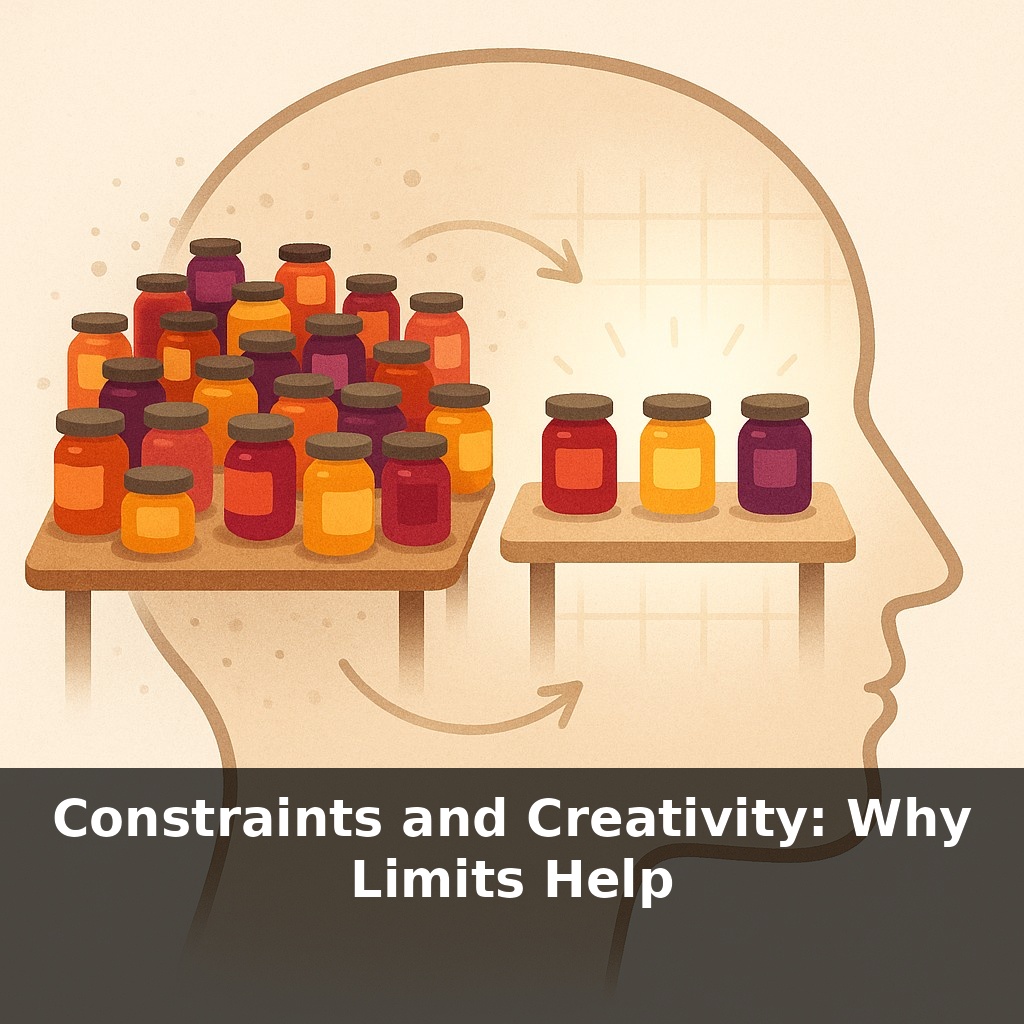
A store offers two tasting tables: one with every flavor of jam you can think of, the other with just a small handful. More people buy from the tiny display. Why do fewer choices, tighter limits, so often unlock bolder decisions and more original ideas?
Psychologists have a blunt way of putting it: your brain is a “resource-limited information processor.” In plain terms, attention is expensive—and constraints are a budgeting tool. When you reduce what’s allowed, you’re not just cutting options; you’re shaping *where* your best mental energy goes. That’s why some of the most creative work emerges from tight rules: Dr. Seuss wrestling with a tiny word list, or engineers forced to ship a prototype in days, not months. Constraints don’t merely trim excess; they act like rails on a train track, converting scattered effort into forward motion. In teams, this effect multiplies: clear time, budget, and scope boundaries sync people’s expectations and reduce friction. Instead of fighting over infinite possibilities, they’re solving the *same* focused puzzle—and that’s when surprisingly elegant answers start to appear.
In practice, limits show up in more shapes than we notice. There are **material limits** (you only have this much money, space, or staff), **informational limits** (you only know so much about your users or your market), and **rule-based limits** (brand guidelines, regulations, or a stubborn technical constraint). Each kind of boundary quietly steers what “counts” as a viable move. This is why some teams do their best work under a strict release calendar or with a tiny feature set: the frame is narrow, but inside that frame, the question becomes, “Given *this* box, what’s the smartest way to break expectations?”
Creative people across fields quietly use a similar trick: they **design the box** before they think outside it.
One way to see this is to separate *imposed* limits from *chosen* ones. Imposed limits come from outside—regulations, deadlines, legacy systems. Chosen limits are voluntary rules you adopt: “Only 50 words,” “One prototype in six days,” “No new Lego shapes.” Both shape behavior, but chosen limits carry a different psychology. They turn constraint into a game you opted into, not a punishment you’re stuck with.
That’s why the most effective boundaries feel like **rules of play** rather than bureaucratic red tape. Adobe’s Kickbox doesn’t say, “Innovate more.” It says, “Here’s $1,000 and six days. Build *something* people can touch.” The kit quietly narrows *how* you experiment (small, fast, concrete) without dictating *what* you must create. People move faster because the frame is sharp, but the content is still theirs.
Good limits have three properties:
1. **They’re specific.** “Reduce cost” is vague. “Cut weight by 20% without changing safety ratings” gives engineers a concrete target that can spark unusual approaches—like rethinking the materials or the assembly process itself.
2. **They’re visible.** Constraints that are written down, timed, or tracked turn into shared reference points. Lego’s decision to cut unique brick shapes forced designers to mine more value from each remaining piece, leading to clever recombinations rather than constant reinvention.
3. **They’re just tight enough.** When everything is fixed, you’re executing, not inventing. When nothing is fixed, you’re drifting. Research on “creative midpoints” shows that moderate constraints tend to pull people into an optimal zone: enough resistance to demand ingenuity, enough slack to allow surprise.
A useful question, then, isn’t “How do I get more freedom?” but “Where would a smart wall actually **help** me?” Time-box a problem. Cap the tools you’ll use. Limit the audience you’re designing for. You’re not shrinking your ambition; you’re sharpening its edge.
A useful way to *use* limits is to aim them at a single, sharp tension. Dr. Seuss didn’t just “have fewer words”; he had a playful target—make a whole story kids love under an absurd vocabulary cap. Kickbox doesn’t just hand out money; it forces a bet on what can be made real in under a week. Those kinds of constraints are like a lens: they don’t add power, they concentrate what you already have.
In your own work, you can set “provocation constraints” that deliberately clash: - Design a premium-feeling service that a student could still afford. - Draft a serious message that could fit on a single sticky note. - Plan a launch that assumes zero paid ads.
These are small, precise rule-sets that push you past your first, obvious answer. The goal isn’t to suffer under limitations; it’s to pick a few that make the problem interesting enough that your brain *wants* to attack it.
Iyengar & Lepper’s jam study hinted at it; AI will force the issue. When abundance is the default, *self-imposed scarcity* becomes a competitive edge. Teams that can carve sharp edges into vague problems will move faster than those drowning in options. Your skill won’t just be “having ideas,” but drafting constraints that pull better ideas out of messy systems, like a good filter turning noisy market data into a clear trading signal.
Your challenge this week: Pick one project that feels fuzzy or stalled. Don’t “brainstorm harder.” Instead, design **three deliberate constraints** for it, each in a different dimension:
1. **Time:** Cut the horizon. What can you ship, test, or show *by Friday* that is real enough to get a reaction? 2. **Resources:** Cap an input. Force yourself to use only tools, assets, or collaborators you already have. 3. **Audience:** Narrow who it’s for. Define the most specific user or stakeholder you can, and ignore everyone else.
Run the project under these rules for 7 days. At the end, keep only the constraints that clearly improved momentum or insight—and discard the rest.
Think of this as tuning an instrument: you’re not cutting its range, you’re choosing the key so a song can actually start. As tools and options keep multiplying, the rare skill is learning which dials to ignore. Treat each new limit as a hypothesis: “If I only allow *this*, do I learn faster?” That mindset turns every boundary into a potential shortcut.
To go deeper, here are 3 next steps: 1) Block off a 2‑hour “constraint lab” this week using the website [Focusmate](https://www.focusmate.com/) and challenge yourself to create something (a sketch, outline, or prototype) using only tools you already have open on your laptop—no new tabs, apps, or purchases. 2) Read the chapter on constraints from *A Beautiful Constraint* by Adam Morgan & Mark Barden, then immediately try their “Can-If” method on a current project (“We can hit this deadline if…”), capturing your options in a simple Notion page or Google Doc. 3) Install the free browser extension Freedom or StayFocusd and set a 45‑minute limit on your top 3 distraction sites, then use that newly “walled-in” time to do a 3–prompt sprint from the Oblique Strategies web app, forcing yourself to ship one imperfect but finished idea by the end of the session.