Brainwriting sessions can spark about half again as many ideas as classic brainstorming. Yet most teams still crowd into a room and talk over each other. You’re in that room now: voices collide, a few people dominate… and the best idea never even makes it to the whiteboard.
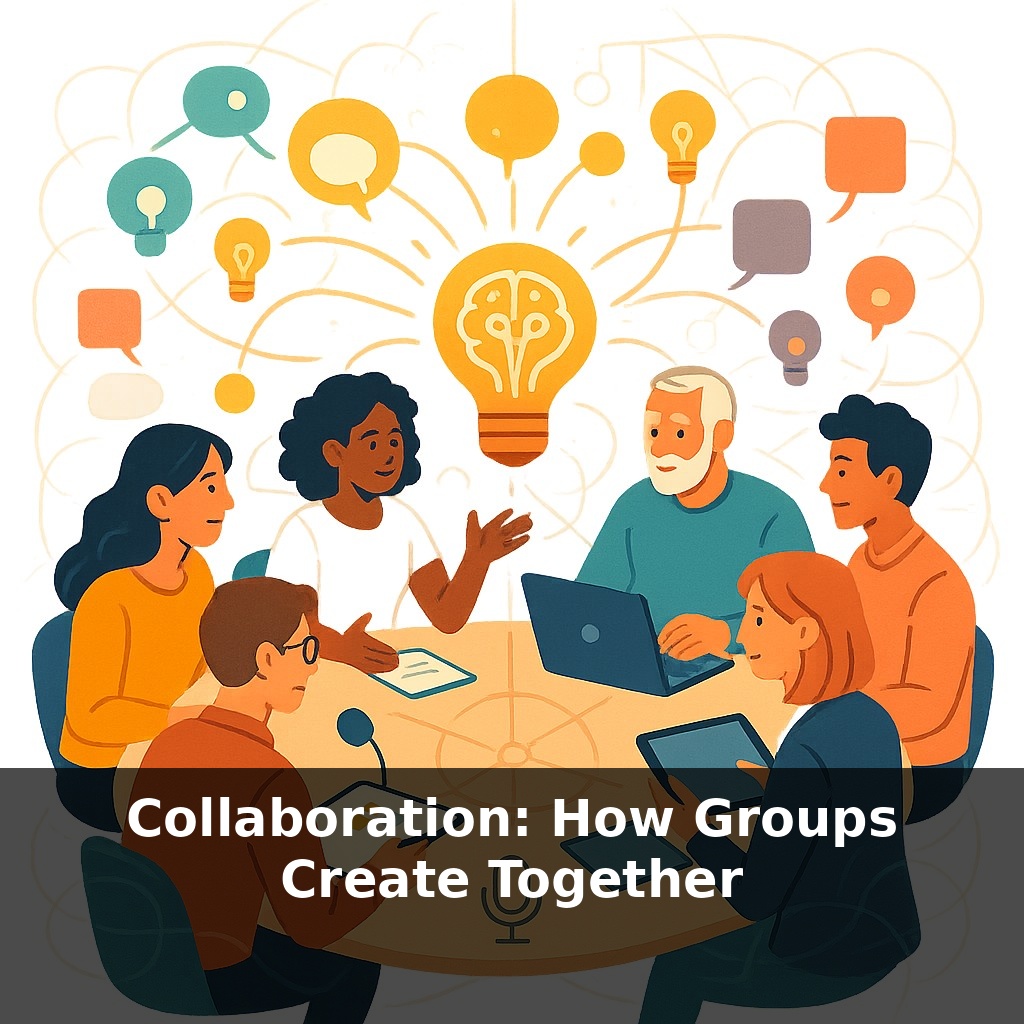
In the strongest creative teams, the magic isn’t in having “the best people” – it’s in how those people work together. Studies of innovation teams show a consistent pattern: when three conditions line up, groups don’t just add their members’ ideas, they multiply them. First, members feel safe enough to offer half-baked thoughts or dissent without bracing for embarrassment or punishment. Second, the group isn’t a monoculture; it mixes backgrounds, expertise, and thinking styles so ideas actually collide. Third, the team doesn’t stay in permanent discussion mode. Instead, it deliberately alternates between stretching the space of possibilities and then narrowing it down. In practice, this means separating sessions where the only goal is generating options from moments where the team evaluates, combines, and selects what to pursue next.
In real organizations, these principles show up in surprisingly concrete ways. Google’s Project Aristotle, which studied over 180 teams, linked consistent revenue gains and higher retention to one core pattern: members spoke roughly equally and felt free to admit mistakes or ask “naïve” questions. At Pixar, a film might receive candid scrutiny from 10–20 peers every few months, long before marketing ever sees it. Meanwhile, lab experiments using electronic tools to collect input silently find groups can surface nearly 50% more distinct ideas simply by removing the need to compete for airtime.
Think of a typical “creative” meeting: a 60‑minute block, 8 people, 1 whiteboard. Now compare that to a team that deliberately engineers *how* those 60 minutes are spent. In lab studies, when groups simply change the process—without changing who’s in the room—they can produce 30–50% more usable ideas and reach decisions faster, with fewer politics afterward.
There are three levers you can pull in practice: how people *enter* the collaboration, how ideas *move* through the group, and how decisions are *locked in*.
First, entry. Teams that jump straight into talking create invisible hierarchies in the first 5–10 minutes: early speakers are rated as up to 20–30% more competent, regardless of idea quality. To counter this, some product groups at large tech firms require everyone to submit 3–5 written options before a meeting. The result: the meeting starts with 24–40 raw ideas for an 8‑person team, not the usual 5–7 voiced by the most extroverted.
Second, flow. Once ideas exist, the question is: who actually engages with them? Studies of “rotating review” formats show that when each person briefly scores or comments on 10–15 ideas *individually* before group discussion, the final shortlist is more original and less biased toward the highest‑status proposer. One experiment found that when initial ratings were private, low‑status members’ suggestions were 2x more likely to survive into the final set.
Third, closure. Many groups stall at the fuzzy “so… what now?” phase. High‑performing design teams often restrict this to a fixed window—say, 20 minutes—to choose 1–3 options and assign concrete next steps with owners and deadlines. That constraint sounds rigid, but it sharply reduces the post‑meeting drift where nothing happens and people quietly revert to the safest path.
A useful way to structure all this is to treat collaboration like a software pipeline: separate modules for input, processing, and output, each with its own rules and tools. Once those rules are explicit—how many ideas each person brings, how they’ll be reviewed, how many will advance—you rely less on charisma and more on system design to get better creative work from the same people.
At one consumer app startup, a weekly “10–10–1” session transformed stalled feature work. Every Thursday, 6 teammates spent 10 minutes silently listing exactly 10 product tweaks each in a shared doc (no comments allowed), then 10 minutes privately scoring every idea from 1–5 on user impact and implementation cost. The top 1–2 ideas with the best combined score moved straight into a design spike. In three months, they shipped 11 small improvements—like a streamlined onboarding flow—that lifted activation by 7% without adding headcount.
A marketing team used a similar pattern with content. For a campaign calendar, 5 people each brought 8 specific concepts with working titles and target personas. Before talking, they used a form with three sliders: originality, strategic fit, and testability. Anything averaging 4.0+ on fit and 3.5+ on testability entered rapid A/B tests. Over a quarter, they ran 24 micro‑experiments and found 3 winning angles that doubled click‑through on key ads.
High‑performing collaborators will treat “how we work together” as a core skill, not a soft extra. Within 3–5 years, expect job postings to specify facilitation abilities and tool fluency (e.g., async boards, AI co-editors) alongside technical skills. Teams already using explicit pipelines for input–review–decision report up to 30% shorter cycle times. Your challenge this week: map one recurring meeting into those three stages and cut or automate 2–3 steps.
Next step: run a live trial. In your next 60‑minute session, reserve 15 minutes for solo input, 20 for structured review, and 15 for fast decisions, leaving 10 for clarifying next steps. Track three metrics for 4 weeks: ideas shipped, cycle time per decision, and rework rate. If any doesn’t improve by 20%, refine the pipeline and test again.
Start with this tiny habit: When you open a shared document or group chat for a project, add one sentence that builds on someone else’s idea using the phrase “Yes, and what if we also…”. Keep it focused on their actual words—quote a specific line or suggestion before you add your “yes, and”. The goal isn’t to be brilliant, just to practice turning your first reaction from “but” into “yes, and” once a day.