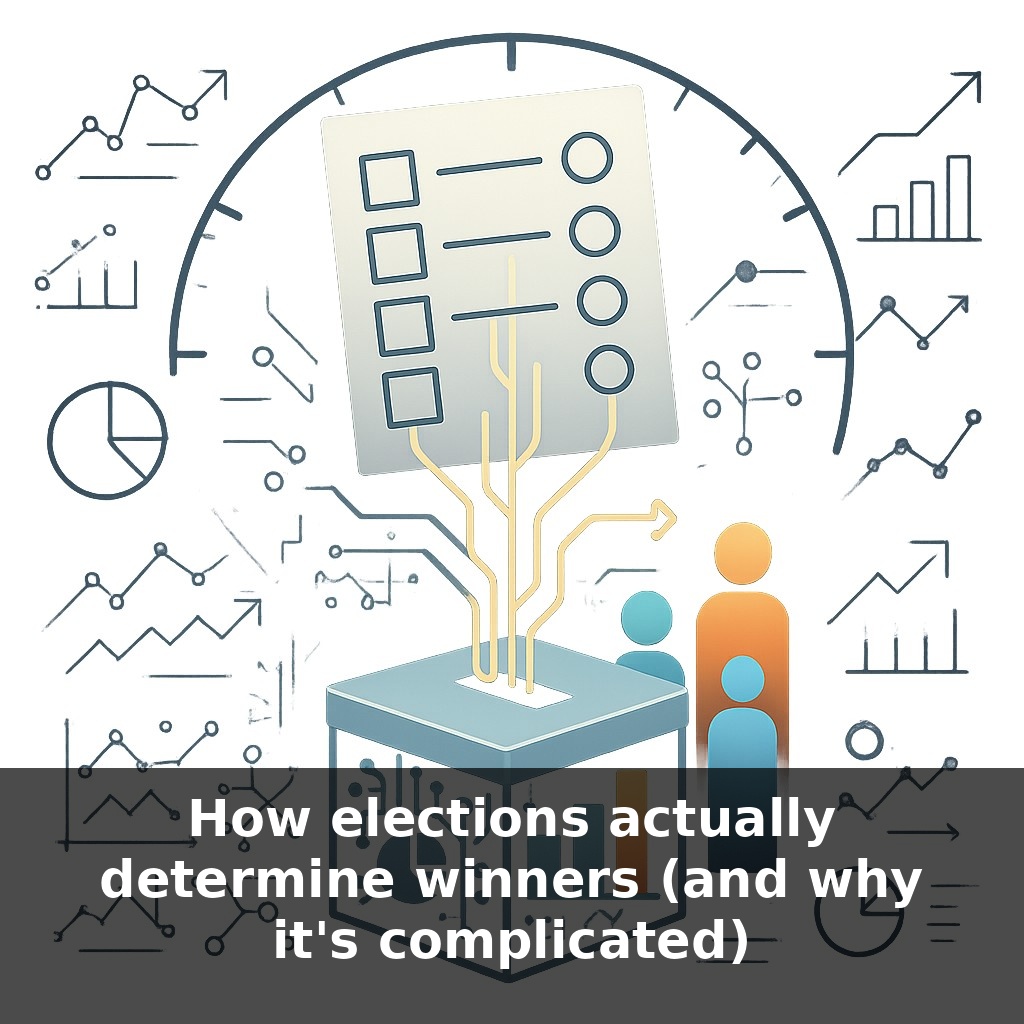
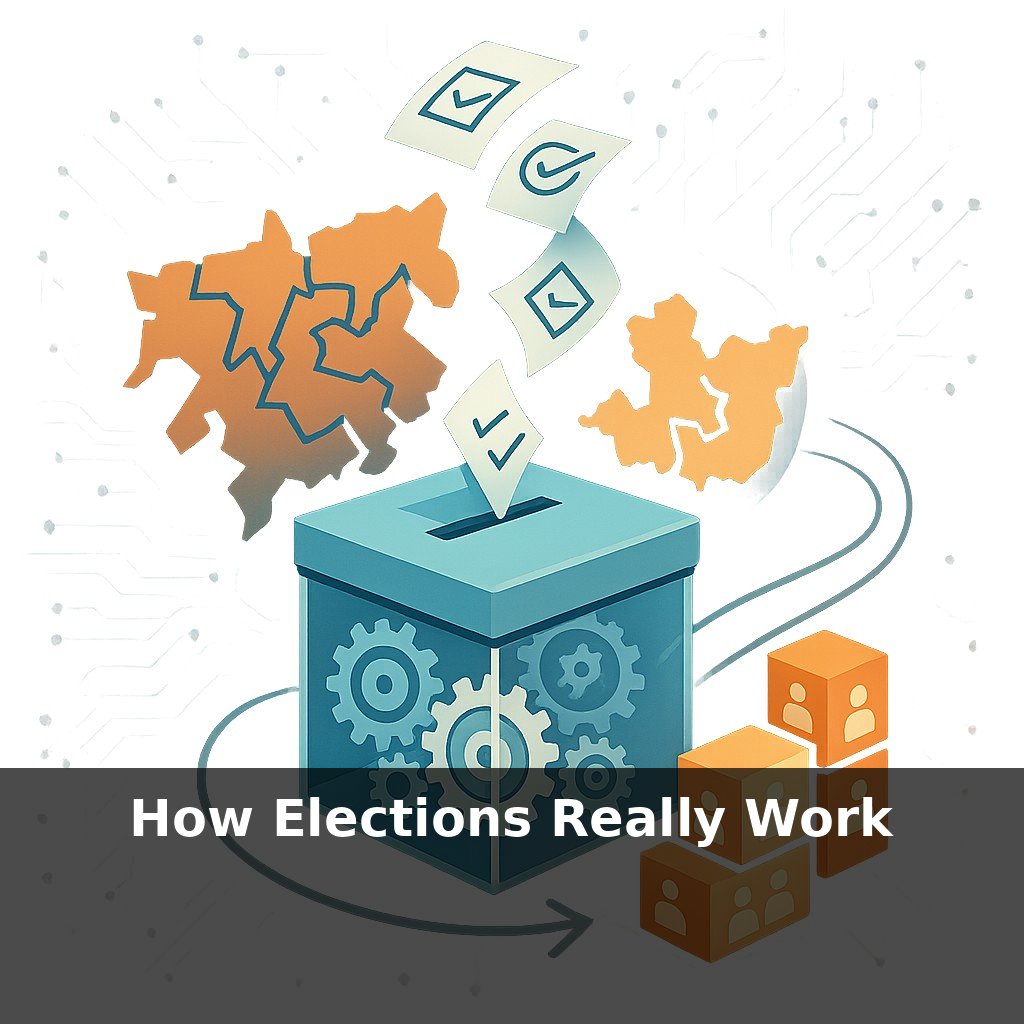
About half the world’s democracies *don’t* pick winners by “who got the most votes.” Election night headlines skip a crucial twist: the *rules* for turning ballots into winners. Today, we drop into the counting room and watch how the same votes can produce different leaders.
In most elections, the real drama happens *before* a single vote is cast. Long before the counting room opens, someone has already decided:
- How many winners there will be - Who gets to appear on the ballot - Which neighborhoods are grouped into which districts - How high the bar is to win a seat at all
These choices don’t just “organize” elections; they quietly shape which kinds of candidates stand a chance. A grassroots organizer, a billionaire outsider, and a disciplined party machine will each thrive—or wither—under different setups.
Think of a musician planning a tour: the same songs feel totally different in a tiny club, a festival, or a concert hall. Likewise, identical public support can translate into a landslide, a narrow loss, or no representation, depending on how the stage of the election is built.
So to understand winners, we first have to inspect the stage itself.
Behind that stage is a maze of technical and legal choices most voters never see. Registration rules decide who even makes it into the audience. Ballot design can nudge you toward some options and bury others in fine print. Tabulation software encodes a set of priorities: speed vs. transparency, centralization vs. local control. Then come recount triggers, thresholds to win any seats, and tie‑breaking rules that can elevate one candidate over another by a handful of ballots. Each layer looks procedural, but together they quietly script how “the will of the people” is translated—or distorted—into power.
When the doors to the counting room finally close, the spotlight shifts to the rulebook you rarely see: *how* votes get aggregated.
Start with the simplest-looking rule: “whoever has the most votes in this district wins the only seat.” That’s plurality, the logic behind first‑past‑the‑post. It rewards concentrated support and punishes being everyone’s second choice. A party can pile up huge margins in some areas, lose narrowly in others, and still walk away with most of the seats. That’s how one side can earn under half the votes nationwide yet capture a comfortable majority in parliament.
Change one ingredient—require a majority instead of a mere plurality—and strategy bends. In runoff systems, the first round is about surviving; the second is about coalition‑building. Candidates soften rhetoric to attract eliminated rivals’ supporters, or form pre‑election pacts. The winner isn’t just who is most loved, but who is least unacceptable to enough people.
Ranked‑choice voting bakes this into a single round. Voters list preferences; the last‑place candidate drops out; their ballots flow to next choices; repeat. The story shifts from “where can I be first?” to “where can I be first *and* an acceptable backup?” Polarizing figures can lead early yet lose as moderate rivals accumulate transfers.
Now zoom out from single seats. Proportional systems say: seats should mirror vote shares. But *how* close that mirror gets depends on details—district size, legal thresholds, bonus seats. A 5% cutoff might freeze out small parties entirely; a low threshold and large districts can splinter the legislature into many factions. Designers trade off fine‑grained representation against the risk of fragile coalitions.
Layer on geography and timing, and the plot thickens. Multi‑member districts or national party lists encourage broad, programmatic appeals; tiny single‑member districts reward hyper‑local targeting. Frequent elections can discipline incumbents—or exhaust voters and campaigners, skewing turnout toward the most mobilized.
The paradox: every system claims to convert citizen preferences into power, yet each elevates different virtues—clarity vs. compromise, stability vs. diversity, bold mandates vs. shared governance. The “will of the people” is not a single number waiting to be discovered; it’s a pattern that shifts when you rotate the lens.
In practice, these rulebooks leave fingerprints on real elections. A party that excels at turning out loyal supporters in a few strongholds may thrive under one design but stall under another. In the U.K.’s 2019 election, the Conservatives didn’t just “win big”; they benefited from how their vote was spread—efficiently converting support into seats while rivals wasted votes in safer or losing areas. In contrast, systems that allocate seats in proportion to party vote share can reward steady, nationwide backing that never reaches first place locally.
To see why this matters, listen to how campaigns talk. Under rules that demand a majority, candidates hunt for backup support: “If your favorite can’t win, keep me in mind.” Where small parties risk being shut out by thresholds, they may merge, form alliances, or rebrand to clear the bar. The same ideological space can be occupied by one broad party or several niche ones, depending on how finely the system slices representation—and that reshapes the menu of choices voters actually see.
A single tweak to how winners are declared can reshape everything that happens *before* election day. As ranked and proportional methods spread, parties may splinter, then recombine into coalitions the way bands form side projects to reach new audiences. Cryptographic verification, open‑source code, and independent map‑drawing could make the “black box” more transparent—but only if people understand what they’re seeing. Future power struggles may focus less on candidates and more on who writes the rules.
In the end, “who won?” is really “which rules did we use this time?” Future fights may center on turnout tech, deepfake campaigns, and AI‑driven micro‑targeting that nudges specific voters, not just blocs. Your job as a citizen isn’t to memorize every formula, but to notice when the sheet music quietly changes—and who suddenly hits all the right notes.
Before next week, ask yourself: 1) “If my city suddenly switched from ‘whoever gets the most votes wins’ to ranked-choice voting, how might that change which candidate I’d feel comfortable supporting—and why?” 2) “Looking at the last election I voted in (or followed), how would the outcome or campaign strategies have changed under a system like proportional representation or a runoff, and what does that reveal about who our current rules favor?” 3) “If I had to explain to a friend, in two minutes, how our local election rules (primaries, districts, runoffs, etc.) shape which voices get heard, what would I say—and what’s one thing I now see differently after this episode?”