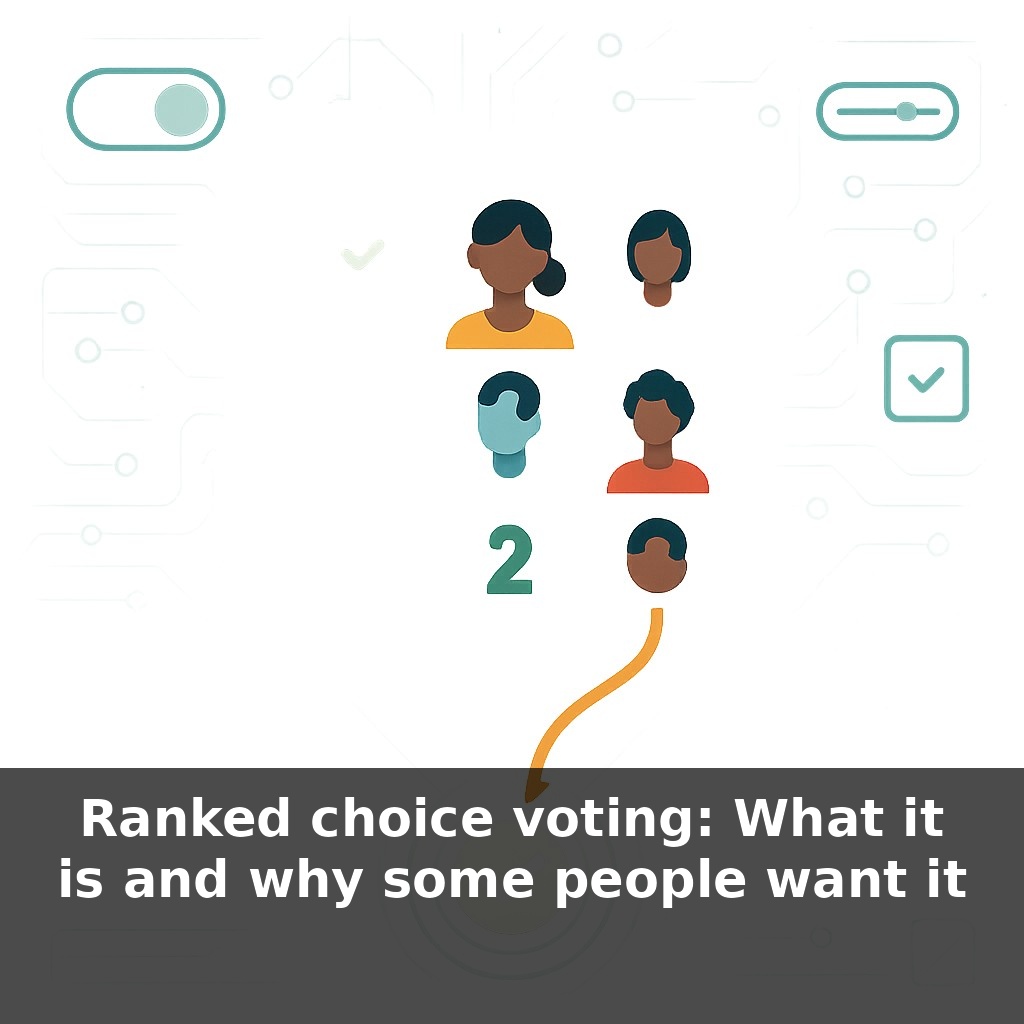
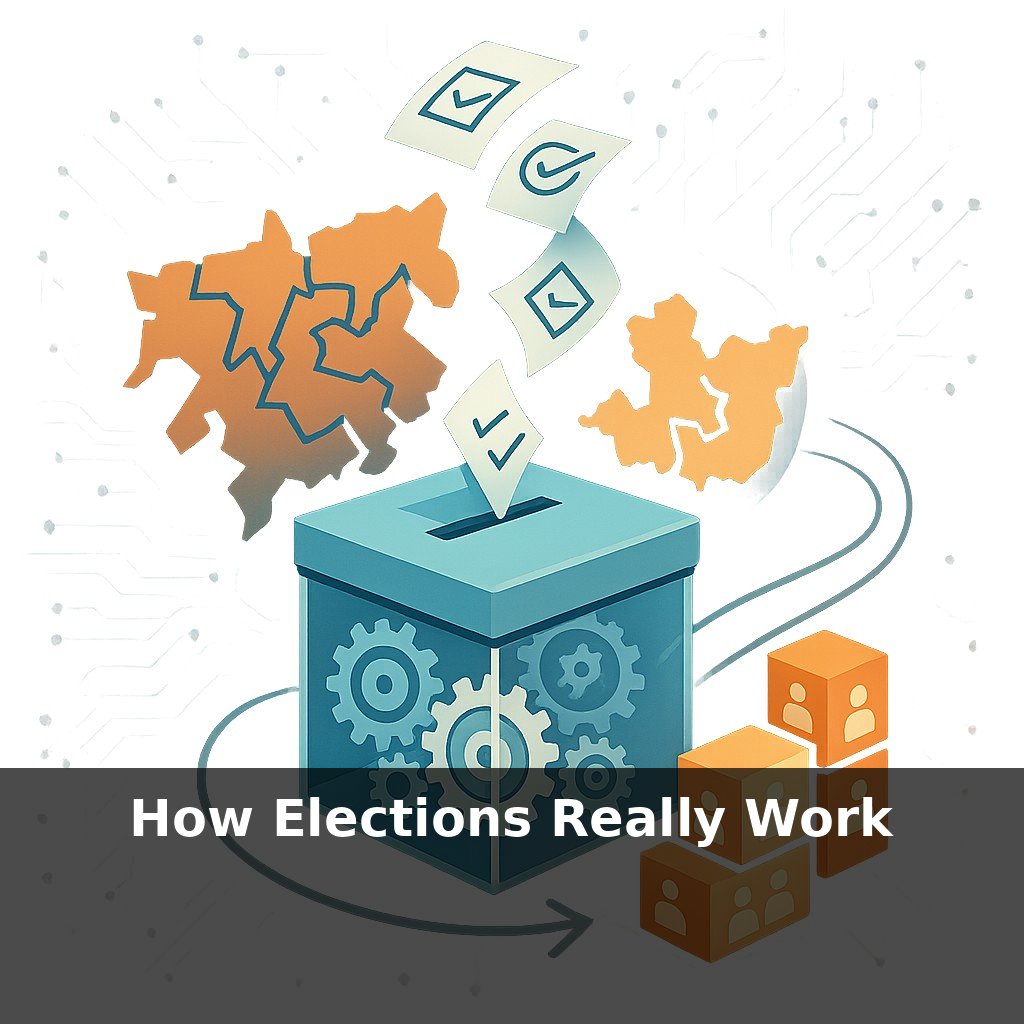
In one U.S. city election, the “winner” was chosen by barely more than a third of voters. Yet the rules said that was enough. Now, picture a mayor’s race where you can say, “Here’s who I like best—and here’s my backup.” How would that change the way candidates campaign?
In the last section, we saw how small slices of the electorate can end up deciding who gets power. Ranked-choice voting is one proposed fix—but it’s not just a new way to fill in bubbles; it reshapes the incentives behind the scenes. When candidates know they might need to be someone’s second or third choice, they have to think differently about coalitions, tone, and policy. Parties, too, start to recalibrate: do they run fewer candidates to avoid splitting support, or more, to give voters a “menu” of adjacent options? And what happens to independent or outsider campaigns when “spoiler” fears shrink? Beneath the surface, there are also nuts-and-bolts questions: how do election officials tally multi-round results securely, how do campaigns teach voters a new system, and how do we tell whether the promised benefits actually show up in real elections?
In places that have actually adopted these rules, the story gets more concrete. Alaska, New York City, and Maine didn’t just flip a switch; they rewired how local media cover races, how donors place bets, and how civic groups “grade” candidates. New patterns show up: more candidates staying in until the end, unusual alliances forming around shared issues, and quieter shifts in who decides to run at all. For election administrators and tech vendors, it’s less about philosophy and more like upgrading a hospital’s record system while patients are still in the building: nothing can break, and trust is everything.
In the first big U.S. test of statewide RCV, Maine’s 2018 congressional race flipped after later rounds—not because the “rules changed midstream,” but because second and third preferences finally had somewhere to go. Supporters pointed to something they’d long argued in theory: the candidate who could unite more of the electorate, not just a strong faction, ended up in Congress. Opponents countered that some voters’ ballots “dropped out” before the final round, raising questions about fairness.
That “exhausted ballot” issue is one of the most technical—and emotional—fault lines. A ballot becomes exhausted when a voter has no remaining ranked candidates still in the running. Reformers say that’s no different from today’s system: if your single favorite loses, you don’t get a say in a runoff you didn’t plan for. Critics reply that this makes RCV look smoother on paper than it feels to people whose preferences can’t carry all the way to the end.
Election administrators, meanwhile, focus less on philosophy and more on logistics. They have to certify scanners that can interpret ranking layouts, verify that tabulation software matches the legally required rules, and publish data in a way that outside auditors can reconstruct every round. In New York City, officials released full ballot images (with privacy protections) so researchers could analyze patterns like “how many voters actually used all their rankings?” and “which communities ranked across party lines?”
Campaign behavior under RCV also leaves fingerprints in the data. In San Francisco and Minneapolis, candidates from aligned communities have sometimes formed “slates,” urging supporters to rank them as a group. That can mean more diverse fields—because a newcomer can run without being told, “you’ll just split the vote”—but it can also concentrate power among organizations that can coordinate these slates effectively.
Here’s where technology vendors quietly become major political actors. The choice of interface on a ballot-marking device—how rankings are displayed, warnings for over-votes, whether sample ballots are interactive online—can influence both error rates and public confidence. Jurisdictions that invested heavily in hands-on demos, multilingual instructions, and clear round-by-round result graphics generally saw fewer complaints and higher reported understanding.
Your challenge this week: take one recent race you care about and, using the actual first-choice results, sketch out how it *might* have unfolded under RCV. Who would be eliminated first? Where might their supporters turn next? You don’t need perfect data—just your best, reasoned guesses. The goal isn’t to prove RCV is better or worse, but to feel how different rules could reshape the path from raw preferences to final power.
Think about how candidate tone shifts when every “second-place” ranking still matters. In New York City’s first RCV mayoral race, you saw rivals co-hosting events and cutting joint ads, nudging supporters: “Rank me first—but put her right after.” That wasn’t politeness; it was math. In Alaska, candidates had to decide whether to appeal beyond their party’s core, knowing that alienating another camp could cost crucial backup rankings in later rounds.
RCV also changes what counts as “viable.” A community organizer who knows she won’t top the field can still run to showcase an issue, hoping to prove that thousands of voters care enough to rank her somewhere. If her support transfers in later rounds, larger parties suddenly have data showing that particular platform planks carry real weight.
One analogy from music: instead of a single battle-of-the-bands vote where the loudest fanbase wins, the crowd lists their favorite sets in order. A band that was everyone’s solid second choice can edge out the polarizing headliner.
If RCV spreads, it could quietly reshape how power is negotiated *after* election night. Think beyond who wins: party leaders might bargain over committee chairs using detailed ranking data, and community groups could prove their leverage by delivering blocs of lower-order preferences. It may also affect how maps are drawn; modelers are already testing how multi-member districts plus RCV change which neighborhoods politicians feel they must actually listen to between campaigns.
RCV’s future may hinge less on theory and more on trust: transparent audits, open data, and clear dispute rules. Think of it as upgrading the “rules manual” for a competitive game—players accept new mechanics when they can see the scoreboard, replay the moves, and know the refs can’t quietly swap the deck mid-match.
Before next week, ask yourself: 1) “If my city adopted ranked choice voting tomorrow, which actual recent race (mayor, governor, president) would have played out differently, and how might that have changed who felt fairly represented?” 2) “Looking at the last election I voted in, how would I have honestly ranked the top 3–5 candidates (including any I ignored), and what does that reveal about my real preferences versus the ‘lesser of two evils’ choice I made?” 3) “Who in my life (a skeptical friend, a relative, or a local official) could I talk with this week about ranked choice voting, and what one concrete example from the podcast could I use to make the idea clearer or challenge their assumptions?”