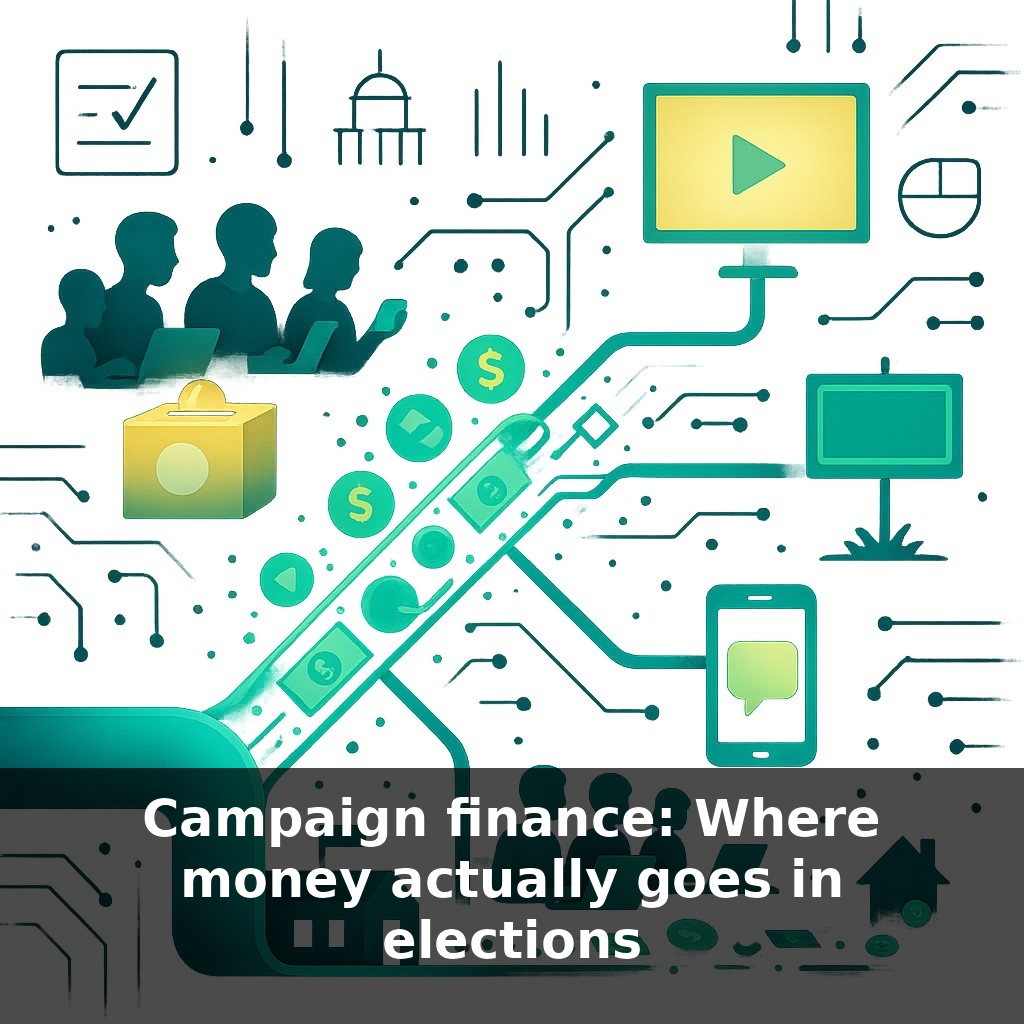
In the time it takes you to listen to this episode, campaigns across the country will burn through more money than most families earn in a year. A simple yard sign, a single TV ad, a text to your phone—each one has a price tag, and almost none of that cash goes where you think.
That money isn’t just disappearing into a big political black hole—it’s moving through a surprisingly structured machine. Four main pipelines feed it: everyday people giving online or at events, PACs tied to interests like labor or industry, party committees steering resources where races are tight, and candidates writing their own checks to prove they’re “all in.” On a separate track, Super PACs and nonprofits push torrents of cash that legally can’t be steered by the campaign, but often seem to be dancing to the same rhythm. If campaigns feel chaotic from the outside, the money side is closer to a studio session: who shows up, who pays for studio time, and who controls the final mix quietly shapes what the public hears on repeat.
Now zoom in on what happens *after* the money hits a campaign’s bank account. Behind every glossy ad blitz is a long spreadsheet where staff argue over tradeoffs: more TV in October or more organizers in August; another poll or a better data file; a fancy fundraiser or cheaper, high-volume emails. For House races, these choices are made with a few million dollars; for Senate or presidential contests, they’re managing budgets closer to a mid-size tech startup. The same basic categories show up everywhere, but how campaigns prioritize them quietly decides which voters get attention—and which never hear a knock at their door.
Here’s the strange part: the checks that *start* this process are huge, but the decisions that *spend* them often hinge on differences of pennies.
Campaigns obsess over what each dollar *buys* in terms of actual votes—or at least, chances to persuade or mobilize people. That’s why budgets are built around “cost per contact” and “cost per persuasion.” A consultant might say: “This digital ad program costs $40 per thousand impressions in our target district; that door‑knocking operation costs us roughly $30 per meaningful conversation.” On paper, both are “voter contact,” but the math and risk are very different.
Television is still the heavyweight because it reaches people who’d never open a political email or answer a pollster. But TV is brutally expensive and inefficient: you end up paying to reach lots of people who can’t vote for you or already made up their minds. Digital ads promise better targeting—only hitting, say, sporadic midterm voters in certain ZIP codes—but they live in a crowded feed where you’re competing with sports highlights and baby photos.
Then there’s payroll. High‑level strategists can command six‑figure fees for a single cycle, yet the most consequential line items are often the least glamorous: field organizers making modest salaries, data staff cleaning up addresses and phone numbers, compliance teams making sure the whole operation doesn’t accidentally break the law. These are fixed costs you carry whether you’re up 10 points or down 10.
Fundraising itself behaves like a business unit with its own return-on-investment logic. If a candidate spends $50,000 on an event that nets $300,000, that’s a win. But as small‑dollar platforms scale up, campaigns lean into lower‑overhead tactics: aggressive email, text, and social media appeals that might bring in millions but can also alienate supporters with constant “EMERGENCY” subject lines.
Data and analytics quietly shape all of this. Modern campaigns buy commercial data, voting histories, and modeling services that score each person on how likely they are to vote, whom they might support, and which issues move them. It’s less about knowing *you* personally and more about assigning you to a statistically predicted lane. That, in turn, dictates whether you get a knock, a call, an ad—or nothing at all.
A Senate race in a mid‑sized state might quietly run three parallel “experiments” in the same week. In one region, they pour money into streaming audio ads and YouTube pre‑rolls aimed at younger, irregular voters. In another, they bankroll dense mailers about prescription‑drug prices for seniors who vote every election. In a third, they fund a late‑night phone bank testing which version of the candidate’s biography keeps skeptical independents on the line longest. None of these efforts looks dramatic from the outside, but each produces data the campaign feeds back into its models.
Think of it like a band workshopping a new song on tour. They’ll try a stripped‑down acoustic version in one city, a louder, faster version in the next, then swap the order of the set list somewhere else. Crowd reactions—who leans in, who heads for the bar—tell them which arrangement to record. Campaigns do the same with messages and messengers, then route fresh money toward the “hooks” that keep the most voters from walking away before Election Day.
As AI micro‑targeting matures, money may shift from blunt saturation to customized “playlists” of messages tuned to your habits, moods, even time of day. That could make persuasion cheaper yet harder to detect—like background music you stop noticing but still shapes your pace. If platforms quietly prioritize political content that keeps you scrolling, campaigns will pay to ride those currents, raising a deeper question: who’s steering opinion, and who’s just surfing invisible algorithmic tides?
In the end, following the money isn’t just about spotting big checks—it’s about decoding priorities. Budget lines quietly reveal whose fears get amplified, whose needs stay on mute, and which voters become background noise. Your challenge this week: when you see a political message, ask yourself not “Do I like this?” but “Who paid for this—and who’s missing?”