What Is Government? The Basic Functions
📝 Transcript
Someone, right now, can legally decide whether you pay tax, drive slower, or go to war—without ever meeting you. In one city, that’s a mayor; in another, a king; in another, a council of elders. Same basic job. Different costumes. So what *is* this thing we call “government”?
Across history, people have tried living without formal rulers—small bands deciding everything face‑to‑face. That works…until it doesn’t. As groups grow past a few dozen people, conflicts multiply: Who settles disputes? Who maintains roads or irrigation? Who organizes defense when danger comes from outside? Informal “we’ll figure it out when it happens” stops being enough.
That’s when societies start building something more structured: roles, rules, and routines that outlast any one person. Instead of arguing every time, they agree in advance: here’s who decides, here’s how we’ll enforce it, here’s what everyone must contribute.
Think of it less as one powerful figure at the top, and more as a system for answering three constant questions: Who can decide for the group? How do we make those decisions stick? And what shared problems are we solving together?
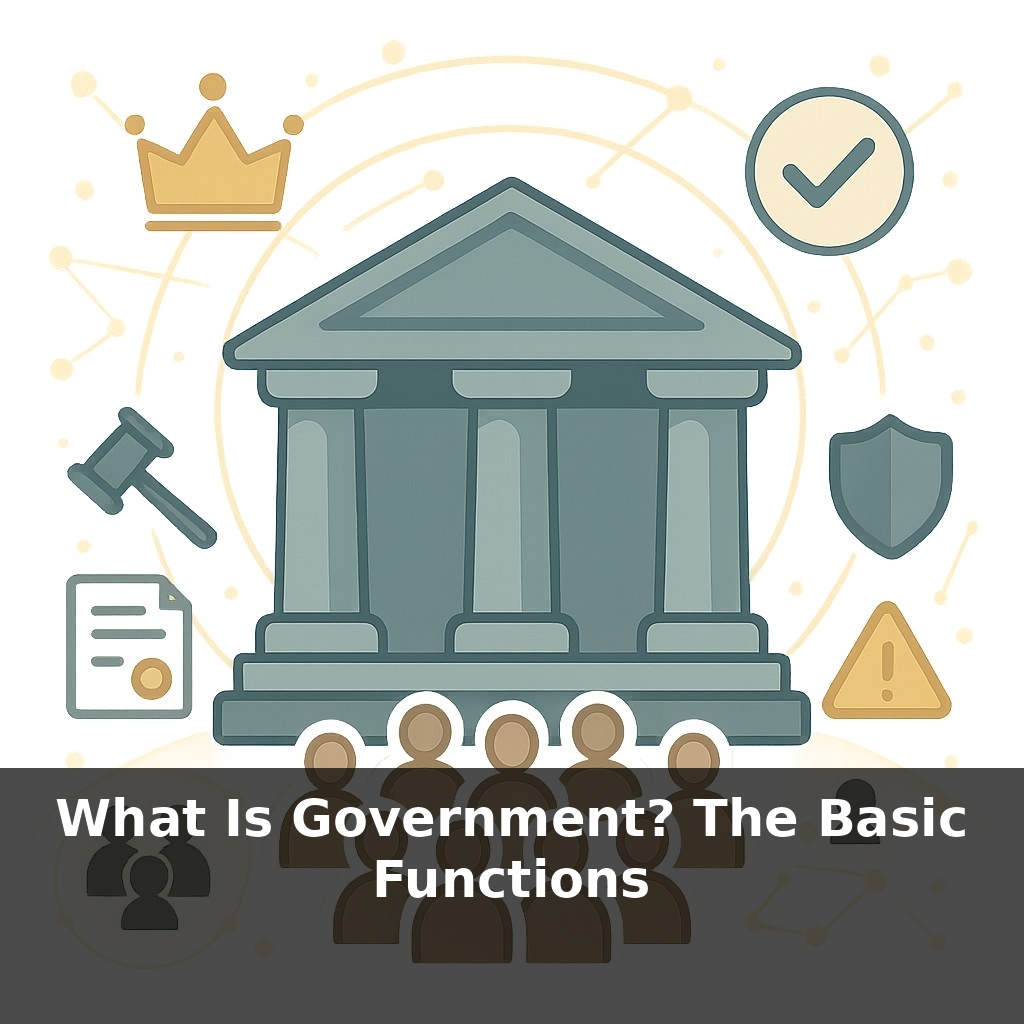
Zoom out from titles and ceremonies and you notice something quieter: every government is really a bundle of jobs that have to be done, or everything else falls apart. Protect people from violence. Keep basic order so trade and daily life can happen. Decide what happens when two claims clash over the same piece of land or money. Build and maintain the shared stuff no individual can profitably own alone, like highways or flood defenses. Like a carefully written recipe, the details vary wildly by culture—but the core steps keep reappearing, because the underlying needs do.
Start with the least glamorous job: preventing chaos from spreading. Not just dramatic crime or invasion, but the slow drift into dysfunction when no one is clearly in charge of “who does what, when.” Governments do this by coordinating expectations. Signals like traffic lights, school calendars, business regulations, and zoning rules tell millions of strangers how to move around each other without colliding—literally and figuratively.
Next comes the quieter work of defining “fair” in practical terms. Courts and legal codes aren’t only about punishing wrongdoing; they also answer routine questions: Who owns this land? What happens if a company fails to deliver? How do we handle divorce or inheritance? That predictable backdrop lets people take risks—start a business, buy a home, sign a contract—because they can guess how disputes will be resolved. Remove that predictability, and transactions shrink back to people you personally trust.
Then there’s the physical skeleton of collective life: infrastructure. Private firms can and do build a lot, but some systems are so large, long-term, or unprofitable in the short run that only a public actor will take them on. The U.S. Interstate Highway System is a classic case: decades of coordinated investment that individual companies had little incentive to finance alone, yet it transformed logistics, commuting, and even where people chose to live.
Layered on top is economic and fiscal management. When a government taxes and spends, it’s not just redistributing money; it’s steering resources toward things markets tend to underprovide: basic research, disease control, universal schooling. In rich democracies, that typically adds up to roughly a third of the economy—34.1% of GDP in taxes across OECD countries in 2022—channeled through public budgets rather than left entirely to private choice.
Finally, modern governments are expected to look beyond the next quarter’s profits or election cycle. They sign climate agreements, regulate pollution, plan for aging populations, and prepare for pandemics. Like a long-range weather service, they scan the horizon for slow-building threats and coordinate responses that no single household or firm could organize at scale.
Think of a crowded kitchen at dinner rush. One station chops, another sautés, someone else calls tickets and watches the clock. No single cook sees the whole picture, but the head chef has to time every dish so they land on the table together, hot and edible. That’s close to what’s happening when a government synchronizes school hours with public transit, or coordinates power grids that cross state lines.
Concrete examples help. When a river crosses several countries, each one could overuse the water, pollute it, and blame the others. Instead, they sometimes sign binding water‑sharing treaties, agreeing on who can draw how much, and when. That’s not just law on paper—it’s joint monitoring stations, emergency drought rules, and shared data so farmers and factories can plan.
Or take disease outbreaks: labs in different cities report unusual cases, health agencies compare patterns, budgets shift to fund vaccines, and border controls adjust. No single hospital can do that; only a coordinating layer above them can.
Governments now face problems that leak across borders and screens: cyberattacks, viral rumors, supply-chain shocks. None stops at a frontier sign. So the job quietly shifts from just “ruling a place” to “managing interdependence.” Expect more data-sharing pacts, cross-border crisis drills, and public dashboards tracking risks—useful, but also unsettling as sensors spread. Your challenge this week: notice every time an app or device reports data upward. Ask: who might govern this, and how?
In the next episodes, we’ll unpack *who* actually pulls these levers: civil servants, lobbyists, judges, voters, even algorithms. Think of this as learning a city’s back streets instead of just its postcard skyline. The more you see the wiring behind public decisions, the harder it is to accept “that’s just how things are” as an answer.
Try this experiment: Pick one basic function of government discussed in the episode—like providing public goods (parks, roads, libraries) or ensuring public safety—and spend 30 minutes today walking or driving around your community hunting for real-world examples of it in action. For each example you spot (a traffic light, a school, a fire station, a public bus), ask: “What would happen here if government *didn’t* do this?” and quickly rate from 1–5 how essential it feels. Then, talk to one friend or family member and compare which functions each of you rated as most essential—you’ll likely discover you disagree on which roles government should prioritize, and that’s the insight.
From this course
How Governments Actually Work: Systems of Power
7 episodesUnlock all episodes
Full access to 7 episodes and everything on OwlUp.
Subscribe — $1.99/monthLess than a coffee ☕ · Cancel anytime