Right now, most people on Earth live under not one, but several governments at the same time. You’re pulled over by a local cop, protected by national rights, and taxed by both. So here’s the puzzle: who’s really in charge when all those layers disagree?
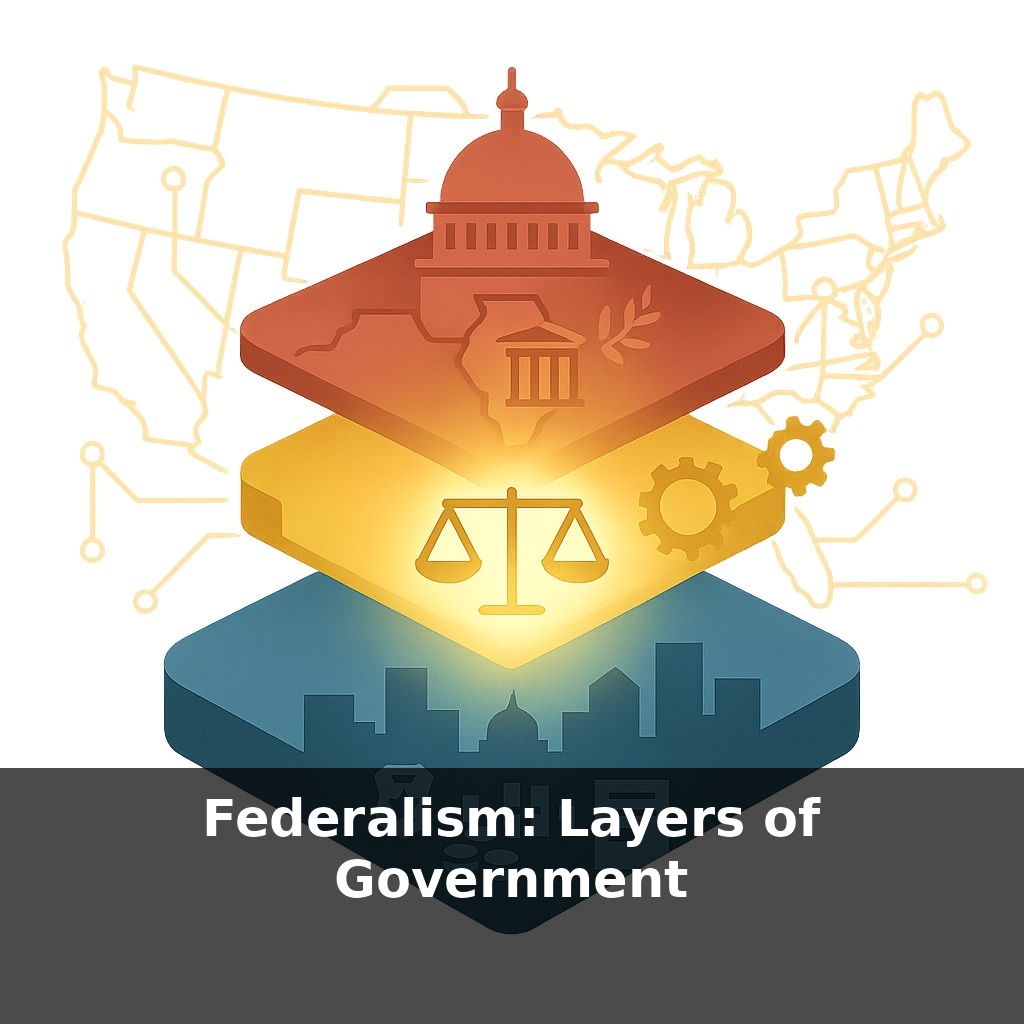
In federal systems, those layers of government aren’t stacked by accident; they’re wired into the country’s basic operating system. A constitution doesn’t just say “we have states and a center” — it carves up who can tax, who can regulate, who can spend, and who gets the final word when rules collide. That’s why a protest over a local school policy can quietly turn into a fight about national rights, or why a state environmental rule can trigger a Supreme Court case with global business implications. Federalism also isn’t one-size-fits-all: in Germany, regional governments carry out most national laws; in India, states had to bargain with New Delhi to unify taxes; in the U.S., health crises expose how much depends on governors and mayors. To understand “who rules,” you have to see how these power-sharing deals were struck—and how they keep being renegotiated.
Federalism also decides *how* problems move through the system. Some issues start “close to home” and climb upward: a town bans a pesticide, a state copies the rule, then lawmakers in the capital face pressure to standardize it. Others run the opposite way: a national climate pledge turns into state energy targets and, eventually, into the price on your electricity bill. The same pattern shows up in policing, schooling, even disaster response. To really see federalism, you don’t just look at laws on paper—you follow how an idea travels from street-level complaint to national debate.
Federal systems answer a basic design question: when should power be scattered, and when should it be pooled? Different countries draw that line in very different ways, and that’s where the real-world consequences show up.
Start with how powers are assigned. Some are **exclusive**: only one tier can do them. In many countries, only the center can print money or sign treaties, while only states or provinces can run local policing or land-use decisions. Others are **concurrent**: both levels can act, like taxing income or regulating business conditions. The tricky part isn’t the labels, it’s what happens when both levels try to solve the same problem in different ways.
Then there’s a quieter category: **“implied” or “necessary” powers**. Constitutions can’t list every future technology or crisis, so courts often decide whether a tier can stretch existing powers to cover something new. Arguments over data privacy, online speech, or carbon markets frequently turn into fights about whether a level of government is improvising legitimately, or grabbing extra turf.
How money moves through the system matters as much as formal powers. When one tier collects more revenue than it needs for its own tasks, it can use grants to steer the others. Strings on that money—like “we’ll fund your roads if you adopt our safety rules”—let a central government shape local behavior without rewriting the constitution. Refusing the funds is technically voluntary, but politically painful.
Federalism also shapes **rights**. You might have a national baseline (no one can go below it), while regions are free to go further—stronger labor protections here, broader speech rules there. But sometimes rights conflict: one state prioritizes religious freedom, another anti-discrimination; both invoke constitutional values, and a top court has to decide which prevails in that context.
Finally, you can’t freeze any of this. Parties in power, regional inequalities, and crises constantly push the boundaries. During emergencies, executives often test how far “temporary” centralization can go; afterward, some powers quietly stay where they migrated. Over decades, that slow drift can turn a formally balanced federation into something much more centralized—or, occasionally, the reverse.
Federalism shows up in small, concrete ways. In the U.S., when Colorado legalized recreational cannabis while federal law still banned it, the result wasn’t instant chaos—it was a negotiated truce. Federal agencies quietly narrowed enforcement, banks hesitated, and neighboring states sued over spillover crime. The “who decides?” question turned into “who blinks first?” In India, the national GST pulls states into a shared tax forum, but they still haggle over rates on everyday items like food delivery or phone data. That council meeting is less like a classroom lecture and more like a messy budget potluck: every state arrives insisting it brought too much and is leaving with too little. Germany offers a different twist: when Berlin sets an education reform, Länder decide how it lands in actual classrooms, so the same national goal can produce different textbooks, grading rules, and teacher hiring, depending on where you live. Your postal code quietly edits which state experiments you’re part of, and which you only read about.
Federalism’s next tests won’t look like old textbook battles over who runs schools. They’ll arrive as tangled problems that ignore borders: wildfire smoke drifting across states, hacked hospital networks, AI systems trained on data stored who-knows-where. Expect more “joint custody” arrangements—shared databases, regional climate compacts, metro coalitions—layered on top of existing rules, like adding new instruments to an orchestra without rewriting the score.
Federalism is less a finished blueprint than an ongoing renovation. As cities sprawl, data flows, and climate shocks ripple, expect new “rooms” to be bolted on: cross-border transit agencies, river-basin compacts, regional AI rules. Watch where these hybrid forums appear; that’s where tomorrow’s real bargains over power and responsibility are quietly being struck.
Start with this tiny habit: When you check the news or scroll social media, pause for 10 seconds and ask yourself, “Is this mainly a federal, state, or local issue?” Then quickly say out loud which level you think it is and why (for example, “This road repair story is local government,” or “This Supreme Court case is federal”). If you’re unsure, just guess and move on—no googling required. Over time, you’ll start seeing the layers of government in everyday life without adding anything big to your schedule.