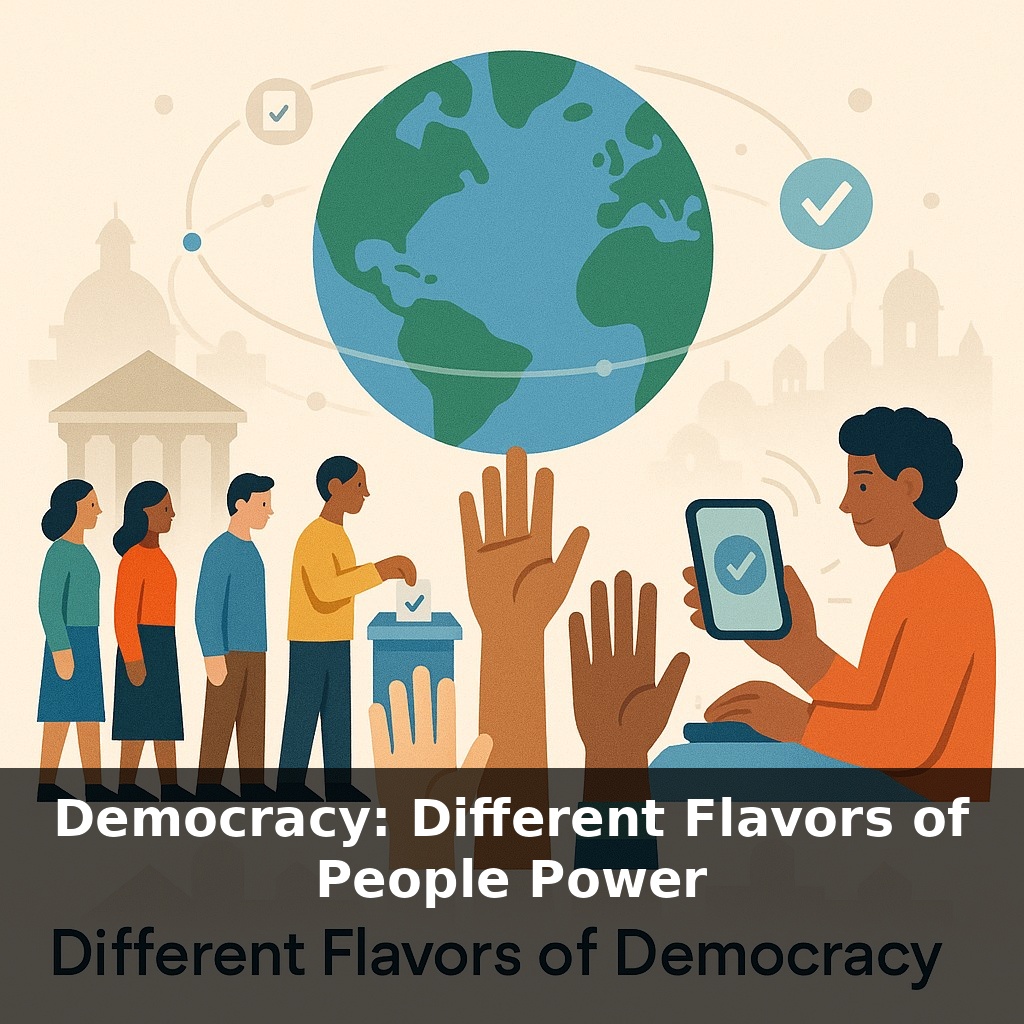
Right now, more than a third of the world’s countries call themselves democracies—yet if you walked into their parliaments, town halls, or online voting portals, they’d feel wildly different. In this episode, we’re pulling that word “democracy” apart to see what’s really inside.
Walk down a street in Delhi during an election and you’ll see endless queues of voters snaking past schools and temples. Check your phone in Tallinn, and you can cast a binding parliamentary vote from your couch. Sit in a Swiss village square on a Sunday, and you might watch neighbors raise their hands to approve a local budget line by line. All three places claim the same basic idea—that power ultimately rests with the people—but they route that power through very different channels, with very different results for who participates, how often, and how strongly their voices register.
In this episode, we’ll zoom in on those channels. We’ll look at systems built for mass participation, others designed for deep discussion, and others optimized for choosing representatives efficiently—and how each setup quietly shapes what “rule by the people” feels like in daily life.
Some democracies lean heavily on ballots, others on debates, others on digital tools—but underneath, they all have to solve the same three practical questions. First: who actually counts as “the people” at any given moment—citizens, residents, party members, even verified online users? Second: how are those people organized—into districts, parties, or looser networks that can push issues onto the agenda? Third: once decisions are made, who checks that leaders and laws still match public consent? In the next sections, we’ll trace how different countries answer those questions in practice.
If you line up a few real democracies side by side, the first thing you notice is not their shared ideals, but the wildly different tools they use to put those ideals to work.
Start with systems that let people say “yes” or “no” on specific questions over and over again. Modern Switzerland is the poster child here. Voters are regularly asked to weigh in on everything from pension reforms to environmental rules. The mechanics matter: frequent national votes push parties and interest groups to negotiate in advance, knowing hostile citizens can overturn a law later. That threat changes how laws are written in the first place—more compromise up front, more information campaigns, more visible trade‑offs.
Then there are systems that push citizens into structured conversations before any decision is made. Citizens’ assemblies in places like Ireland, Belgium, and parts of Canada do this intentionally. A random group of people is drawn, given time, money, and expert input, and asked to produce recommendations on knotty issues such as abortion or climate policy. Those recommendations are not magical “public opinion”; they are what public opinion can become when ordinary people get time, facts, and a clear mandate. When parliaments later act on these proposals, they’re not just counting noses; they’re borrowing the legitimacy of that concentrated, informed effort.
Other democracies channel energy into how representatives are selected and constrained. Proportional systems in countries like the Netherlands or Spain encourage many parties, coalition cabinets, and constant bargaining. Single‑member systems like in the UK or India favor bigger parties and clearer winners, but also risk leaving substantial currents of opinion with little direct voice in the chamber. Written constitutions and independent courts then sit on top of all this, acting less like loudspeakers for public moods and more like circuit breakers when popular demands slam into basic rights.
Across these cases, the same claim—government by the people—produces different rhythms of power: slow and negotiated, sudden and plebiscitary, expert‑aided and assembly‑based, or strongly filtered through parties and courts.
In practice, countries mix these tools in quirky ways. Ireland paired a citizens’ assembly with a national vote on marriage equality; the careful small‑group work set the stage, but the whole electorate had to sign off. Taiwan’s government hosts an online platform where proposals that gather enough support must be formally answered, nudging officials to treat digital buzz as a policy inbox rather than background noise. In Brazil, some cities open parts of their budgets to neighborhood‑level decision meetings, letting residents argue over streetlights versus school roofs in concrete, tangible terms. Think of it like cooking: some recipes rely on slow marinating (long consultations), others on quick stir‑frying (fast votes), and the final dish depends on the combination. The interesting question becomes less “Is this a real democracy?” and more “Which ingredients dominate here—and who picked the recipe?”
Democracies now face pressure to act faster on crises like climate, pandemics, and debt while staying trusted. Digital tools may feel like “instant feedback,” but they also create echo chambers, bot storms, and data trails governments might be tempted to mine. Expect more experiments: AI summarizing huge comment piles, real‑time dashboards on policy results, and small, rotating public panels that stress‑test big decisions before they hit the news. The open question is who will set the guardrails.
Democratic “flavors” don’t stay fixed; they evolve as problems and tools change. Cryptographic voting, AI translation in parliaments, even youth “shadow councils” are already being tested. Your own context shapes which experiments feel urgent: housing crunch, climate shocks, disinformation. The live question isn’t just who decides—but who designs the next upgrade.
Try this experiment: Over the next week, run a “mini-democracy lab” in your everyday life by testing two different decision models with the same group (family, roommates, coworkers). One day, decide something small (like what to eat for dinner or how to spend a shared budget) using strict majority rule; the next time, decide a similar-scale issue using consensus or ranked choice (everyone ranks options and you pick the one with broadest support, not just most first-place votes). Before and after each decision, quickly ask everyone how satisfied they feel (0–10) and how fairly they felt heard, then compare the scores and the mood in the group. Notice which “flavor” of democracy produces better decisions, less resentment, and more willingness to participate next time.