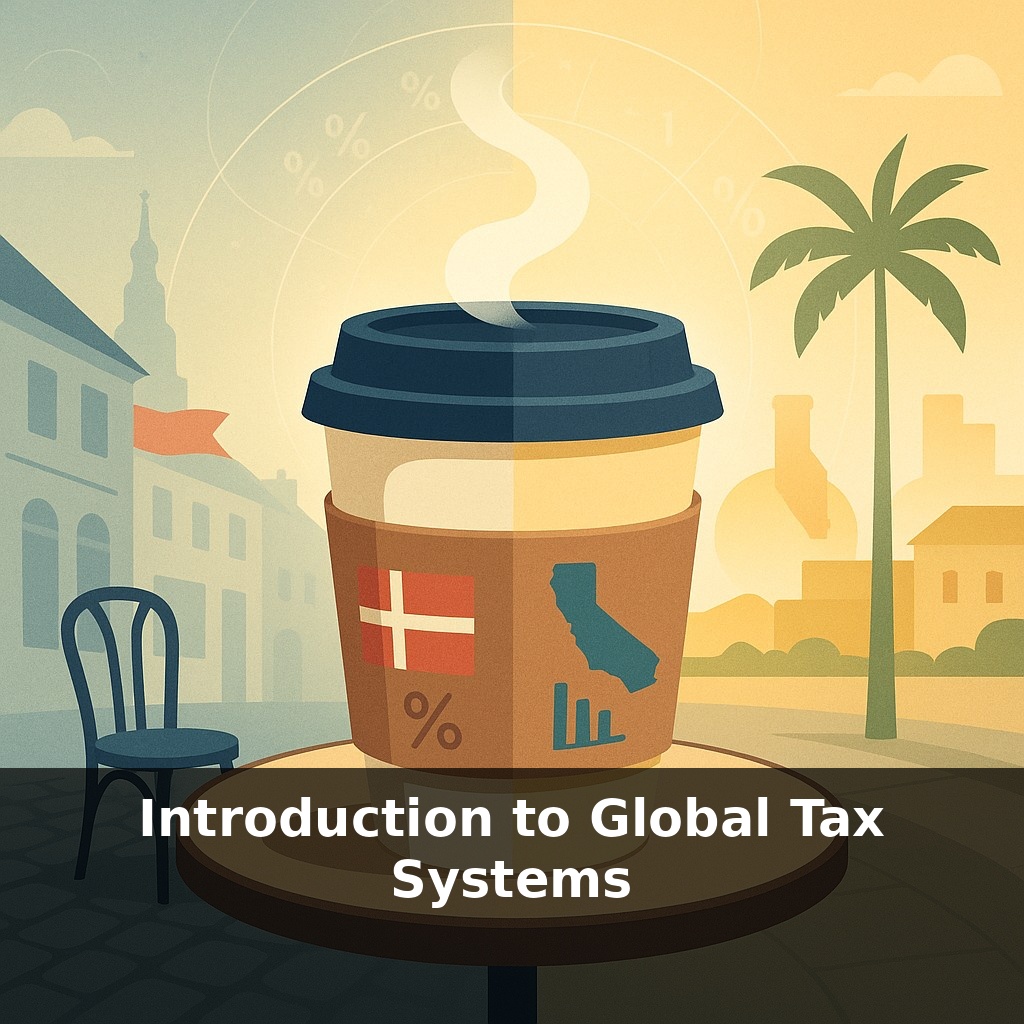
A coffee in Copenhagen quietly sends far more money to the government than the same drink in California. Yet both customers feel they’re paying “about the usual.” How can tax systems look so different on paper, but feel strangely similar in daily life? Let’s pull that apart.
That coffee price hides dozens of quiet decisions a country has made about fairness, growth, and what “a good society” looks like. Some places lean heavily on taxing paychecks, others on taxing spending, others on taxing land and profits. And the mix isn’t random: it reflects history, politics, demographics, even geography. A small, aging country with generous public healthcare may need a very different tax recipe than a young, fast‑growing one trying to attract factories and startups.
To see how dramatic this can be, follow three levers: how steeply countries tax higher incomes, how heavily they tax what you buy, and how much they squeeze or spare companies. Shift any one, and you reshuffle who keeps what, who gets help, and which behaviours are rewarded—saving vs. spending, working locally vs. moving profits abroad.
Behind those levers sits a deeper choice: who should carry risk in a modern economy—individuals, businesses, or the state? Countries that collect around 40% of GDP in tax often promise robust safety nets: healthcare, pensions, childcare, unemployment insurance. Places closer to 20% lean more on families and markets to fill those gaps. The twist is that both models can claim to be “pro‑growth” and “fair,” just in different ways. Like divers building a portfolio, governments spread taxes across income, consumption, property, and corporate profits to balance stability, competitiveness, and public trust.
Across countries, the “shape” of the tax system matters as much as the overall size. Three broad shapes show up again and again: progressive, flat (or close to it), and regressive systems.
In a progressive design, the share taken rises with income. You see this clearly in personal income‑tax schedules where top brackets can reach 50% or more, but also in targeted credits and benefits at the bottom—earned‑income credits, child allowances, or refundable tax breaks that push effective rates for low earners close to zero or even negative. The political promise is that those who gain more from the economy shoulder more of the formal bill, while those near the bottom are partly shielded.
Flat or proportional systems keep statutory rates similar across the income spectrum. Some Eastern European countries experiment with this: one main rate on wages, plus relatively uniform rates on interest or dividends. The pitch is simplicity and competitiveness—fewer loopholes, easier compliance, and a clear message to investors. But the “flatness” is often softened in practice by exemptions, minimum thresholds, or separate social‑contribution rules.
Regressive patterns typically emerge not from a single law but from a heavy tilt toward consumption‑based taxes and fees. Value‑added taxes, general sales taxes, fuel duties, and telecom levies bite as a larger fraction of disposable income for poorer households. Without strong compensating transfers, the overall system can pull more, proportionally, from those with the least.
Then add cross‑border pressure. When one country slashes corporate rates or offers generous patent boxes, neighbours worry about losing factories, intellectual property, and high‑skill jobs. This is part of why international bodies push for minimum effective corporate rates and for sharing information on where profits are really made. The aim is to narrow the gap between where multinationals book income and where real activity happens.
Think of it like a hiking trail network in a mountain range: each path (progressive, flat, regressive mixes) climbs to similar heights of revenue in different ways—some steeper early, some gentler but longer, some riddled with shortcuts used only by insiders. Hikers care not just about the summit, but how tough the route feels, how crowded it is, and whether everyone has suitable gear. Tax design, similarly, is judged not only by how much it raises, but by how predictable, legible, and shared the effort seems along the way.
Germany and New Zealand, for instance, both lean on broad consumption taxes, yet a low‑wage worker’s wallet feels different in each place because of how benefits, wage floors, and housing policy interact with the tax bill. Two systems that look similar in a chart can produce very different lived outcomes once rent, childcare, and transit are priced in.
Now shift to companies: a cloud software firm routing profits through Ireland faces a different world than a local restaurant that can’t relocate its kitchen. The software firm can respond to headline corporate rates by moving intellectual property on paper; the restaurant mostly responds to payroll taxes and local levies. That’s one reason policymakers worry about mobile capital: rules built for factories don’t always fit footloose algorithms.
Your challenge this week: pick one everyday purchase and trace who was taxed along the way—importers, wholesalers, landlords, workers, shareholders—and where each might try to shift that burden onward.
As governments tweak these systems, they are also quietly testing new frontiers: charging for carbon, taxing sugary drinks, even debating levies on robots or extreme wealth. The more work and profits detach from a fixed office or factory, the harder it is to pin down where “tax home” really is. Remote coders, AI‑driven firms, and digital coins stretch rules built for paper files and factory lines, forcing countries to decide what—and whom—they most want to keep within their borders.
Tax rules will keep mutating as work, climate policy, and aging populations collide. Wealth taxes, carbon pricing, and digital‑services levies are test balloons for what comes next. Like a city redrawing its transit map, each new line reshapes which routes feel fair, which feel crowded, and who decides where the journey is supposed to end.
Before next week, ask yourself: Where in my current life (job, investments, remote work, possible relocation) could differences between territorial vs. worldwide tax systems actually affect how much tax I pay, and what’s one concrete scenario I should map out (e.g., earning freelance income from another country)? Looking at at least two countries mentioned in the episode (for example, the U.S. and a territorial system like Singapore or the UAE), how would my tax situation change if I moved or started earning from there—what would I gain, and what new risks or reporting obligations (like foreign income or double taxation) would I face? If I had to explain to a friend how tax treaties and concepts like residency vs. source-based taxation might protect them from being taxed twice, where do I realize my own understanding is fuzzy—and what’s the first specific term from the episode (like “tax residency tie-breaker rules” or “withholding tax”) I should look up today to clarify it?