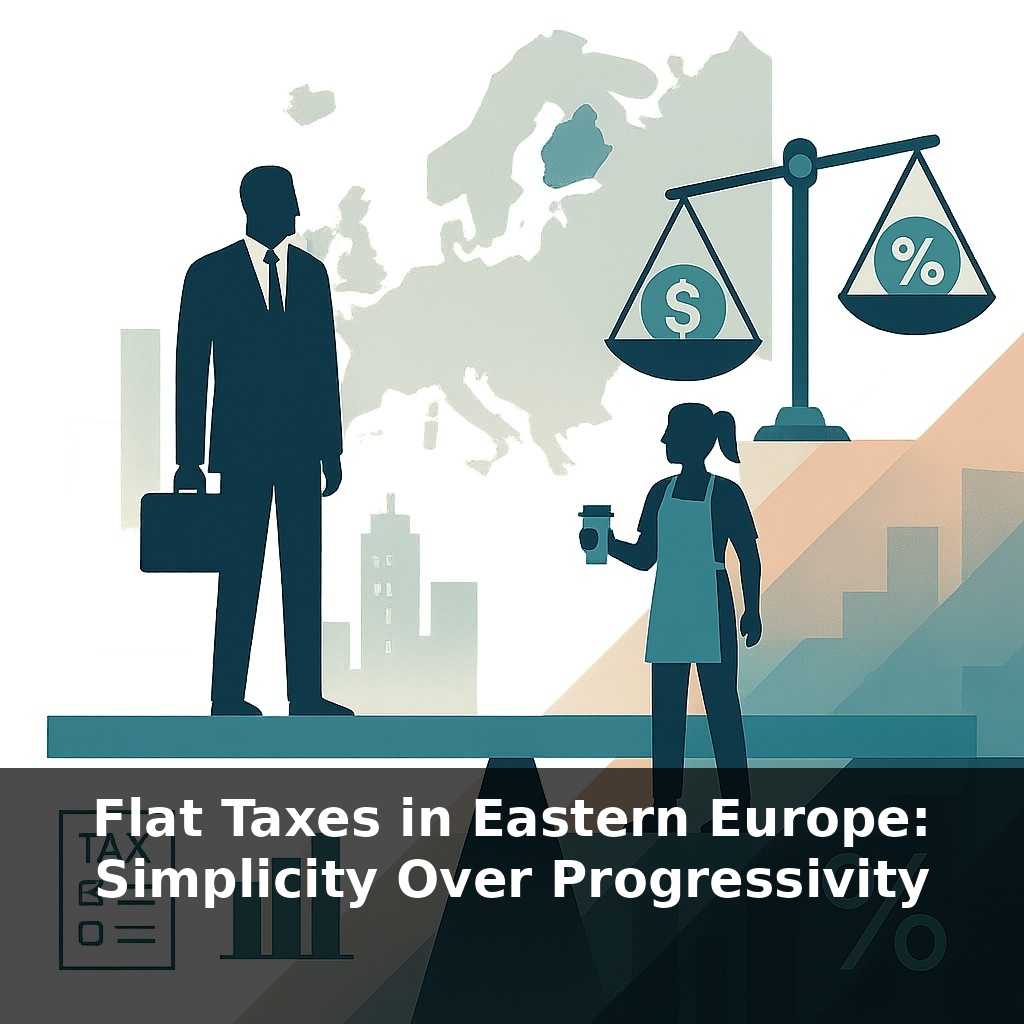
A country where billionaires and baristas face the same income tax rate sounds like a libertarian fantasy or a math error. Yet across Eastern Europe, that’s close to reality—and it hasn’t produced the simple, fair paradise that its early champions promised.
By the early 2000s, parts of Eastern Europe turned their tax codes into something that looked radically clean on paper: one rate, few loopholes, short forms. Compared with the sprawling, progressive systems we saw in Scandinavia and the U.S., this was a sharp pivot toward “less is more.” But simplicity came with trade‑offs that only showed up once the dust settled.
Governments still had to fund schools, hospitals, and pensions. When top earners’ rates dropped, the money had to come from somewhere else—most often from higher VAT and payroll contributions that bite harder on ordinary paychecks and everyday purchases.
Think of the region’s tax mix as a budget airline ticket: the headline price (the flat rate) looks low and transparent, but the real cost shows up in the add‑ons you can’t easily avoid.
For governments emerging from Soviet‑era bureaucracy, flat taxes were also a political rebranding exercise. Leaders could hold up a short tax form like a new passport and say, “We’ve left the old system behind.” That symbolism mattered in countries where trust in institutions was fragile and corruption felt routine. At the same time, international advisors—from the IMF to Western think tanks—promoted these reforms as proof of being “open for business.” The bet was that cleaner rules would lure investors, formalize shadow wages, and modernize economies still learning how to run markets.
When you zoom in on how these reforms actually worked, three patterns keep repeating.
First, the headline rate cuts were usually funded sideways, not by shrinking the state. Governments trimmed what top earners paid on wages and business income, then quietly leaned more on what everyone pays when they work or spend. In Russia, the IMF found that after the shift to a 13 % rate, declared wages jumped as workers and firms moved income out of envelopes and onto pay slips—yet total revenue barely nudged upward. The state collected more cleanly, but not dramatically more overall.
Second, distribution shifted even when benefits looked broad. A single worker on a modest salary might see a lower marginal rate on paper, but their total burden could still rise once higher consumption taxes and social‑security contributions were counted. Meanwhile, high earners who previously faced steep top brackets enjoyed larger absolute tax cuts. Early evidence from Slovakia and others suggests inequality edged up in the years after reform, even where unemployment fell and growth accelerated.
Third, simplicity had winners and losers in the business world. For small and medium‑sized firms, dealing with tax authorities often became faster and less arbitrary. Estonia’s experience illustrates this: streamlined rules and digital filing cut compliance costs for SMEs roughly in half relative to neighbors, according to the World Bank. But multinationals, which had once devoted teams to exploiting loopholes and exemptions, sometimes saw fewer bespoke deals and special regimes. The playing field became more level in form, if not in outcome.
Over time, politics circled back. As wage gaps widened and public debate matured, some countries partially reversed course, re‑introducing higher brackets or surtaxes on top incomes while keeping the simpler machinery underneath. The result today is a patchwork: some states hold to a single rate as a brand; others quietly blend flat‑style administration with elements of progressivity on paper.
Your challenge this week: pick one country that adopted a flat tax and then changed course—like Slovakia or Czechia—and trace what happened before and after by looking at three numbers only: the top statutory rate, the Gini coefficient, and total tax revenue as a share of GDP. Treat it like a mini‑investigation: can you see the trade‑offs between simplicity, equality, and state capacity in those three lines of data?
Consider two neighbors in Bratislava in the mid‑2000s. One is a software engineer at an international firm; the other runs a small corner shop. When the flat tax arrives, the engineer’s official salary jumps as more income moves out of side contracts and into clean payroll. Their take‑home rises, and their employer appreciates the predictable rate. The shopkeeper, meanwhile, finds it easier to file but notices something else: suppliers’ prices creep up as higher indirect taxes ripple through the chain. End‑of‑month, the engineer’s gain feels tangible; the shopkeeper’s costs, equally real, are spread across every delivery and utility bill.
Now zoom out to Estonia. A start‑up founder there in the 2010s could register online in minutes, file quarterly with little accounting help, and reinvest profits tax‑deferred. The simplicity didn’t just lower overhead; it shaped business culture. When the rules are short and legible, more people are willing to step from informal gigs into formal enterprises, even if the headline rate itself isn’t dramatically lower than elsewhere.
Eastern Europe’s “simple” systems now face pressure from two directions: EU‑level climate levies and minimum corporate rates on one side, aging populations on the other. Governments can’t just keep shifting weight onto consumption and work. One emerging path is digital, real‑time withholding that adjusts automatically with each payslip—more like a navigation app rerouting in traffic than a fixed paper map. If that scales, today’s flat designs may look less like destinations and more like scaffolding for a more flexible, data‑driven progressivity.
As more data flows through e‑filing and real‑time payroll, governments can test “what‑if” tax tweaks like a coder refactoring legacy code: small changes, quick feedback, fewer crashes. Eastern Europe may become a laboratory for hybrids—keeping clean rules while layering subtle rate shifts—so the system bends with economic shocks instead of snapping under them.
Before next week, ask yourself: 1) “If my country switched to a flat tax like in Estonia or Romania, which specific public services I rely on most (schools, healthcare, transit, pensions) would likely improve, stay the same, or get squeezed—and how comfortable am I with that trade-off?” 2) “Looking at my own last tax return, would a flat rate more like 20% have made my total tax bill fairer or less fair compared to higher earners I know, and why?” 3) “If I had to argue in a town hall tonight either for or against a flat tax, which two concrete pieces of evidence from Eastern Europe (e.g., growth in Slovakia vs. inequality concerns in Latvia) would I feel confident using, and what does that reveal about my real priorities: simplicity, growth, or redistribution?”