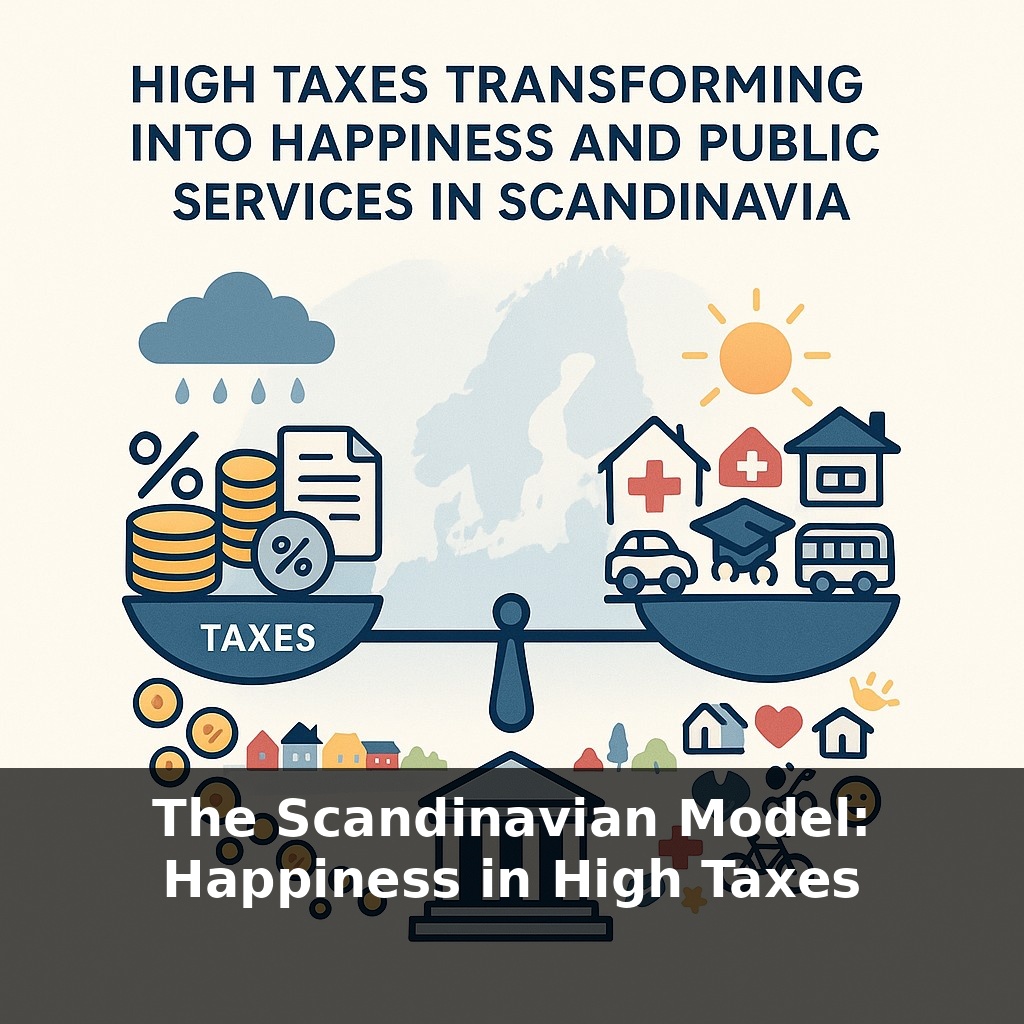
Scandinavians pay some of the highest taxes on Earth—yet when researchers ask who’s happiest, those same countries crowd the top of the list. In this episode, we dive into that paradox: how sending so much of your paycheck to the state can actually make life feel lighter.
Here’s where the Scandinavian story gets more interesting: it isn’t just about paying a lot, it’s about what people *expect* to get back. In Denmark, Sweden, Norway, Finland, and Iceland, taxes quietly shape everyday decisions—whether to have a child, switch careers, or start a business—because healthcare, education, and basic security don’t hinge as directly on your next paycheck. That changes the emotional weight of risk. A Swedish parent taking parental leave, or a Finnish worker retraining mid‑career, isn’t gambling their future in the same way someone might in a system where losing your job also threatens your health insurance or your kids’ schooling. As we look closer, notice how this shared safety net doesn’t just reduce hardship; it rewrites what “normal” feels like when people think about work, family, and the state itself.
Zoom in for a moment on what those tax-funded systems actually *do* to the rhythm of a life. In much of Scandinavia, university doesn’t come with decades of debt calculations; quitting a bad job isn’t shadowed by terror of losing medical coverage; having a child is less a financial cliff and more a planned detour on a well-marked road. That changes how people negotiate with employers, how couples plan breakups or moves, even how likely someone is to start over at 40. The interesting question isn’t just “Are they happier?” but “What choices become thinkable when the floor feels solid?”
Start with a curiosity: when Scandinavians say “we pay a lot,” they usually follow it with “but look what we get.” That “what we get” is less about a single benefit and more about how many parts of life are quietly co‑financed in the background.
Take family life. Those 480 days of Swedish parental leave don’t sit in isolation. They link to subsidized childcare, income‑based child allowances, and job protection rules that make it normal—not heroic—for both parents to step back from work. The tax system then splits the bill broadly rather than loading it onto whichever couple happens to have a baby this year.
You see the same pattern in the labor market. Losing a job in Denmark triggers a chain: relatively generous unemployment insurance, active job‑search support, and publicly funded retraining. Economists call this “flexicurity”: employers can hire and fire with fewer legal frictions, while workers know a layoff isn’t a personal catastrophe. High taxes are the subscription fee for keeping that system running.
Education spending leans heavily toward “pre‑distribution.” Instead of only correcting inequality after it appears, the state tries to shrink the gaps forming in the first place: strong early‑childhood programs, special‑needs support in regular schools, adult education when industries change. Over time, this shows up in higher social mobility than in many lower‑tax countries; your parents’ income is less decisive in predicting your own.
Crucially, the tax design aims to minimize the sense of paying into a black box. Local governments handle much of the visible welfare state—schools, eldercare, local clinics—so residents can see and complain about how money is used. Because services are universal rather than narrowly targeted at “the poor,” most people are both net payers and frequent users of the system. That softens the usual tension between “taxpayers” and “benefit recipients.”
The result is a feedback loop: broad use of shared services builds support for funding them; support keeps quality high; high quality keeps trust alive. Breaking that loop—through underfunding or corruption—tends to be what erodes consent for high taxes elsewhere.
Your challenge this week: pick one major bill you or people around you routinely worry about—rent, medical costs, childcare, student loans. Then, dig up how that specific risk is handled in one Scandinavian country: What’s publicly covered? What’s subsidized? What’s left to the individual? As you compare, notice not just the money difference, but which everyday anxieties exist—or quietly disappear—when that risk is socialized.
Think about something as small as a rainy Tuesday commute. In Stockholm, the same tax system that backs parental leave also funds dense public transit: frequent trains, heated shelters, stroller‑friendly buses. That’s not a luxury add‑on; it quietly expands where you can live and work without needing a second car. In Copenhagen, bike lanes, libraries, and neighborhood health clinics layer together so a teenager can cross the city for free tutoring or sports without a parent’s wallet or schedule deciding everything.
Sweden’s tax agency is regularly rated one of the country’s most trusted institutions, in part because filing is radically simple: much is pre‑filled from employer data, and many people confirm their returns by SMS. In Norway, detailed public budgets and open data let journalists and citizens trace where oil and tax revenues go, down to municipal services.
This isn’t utopia—waiting lists, rural gaps, and political fights are real—but the baseline expectation is that the state’s side of the deal is visible, legible, and adjustable.
As Nordic societies age, that “tax as investment” mindset is being tested. More retirees per worker means today’s model must stretch further or bend: later retirement, higher immigration, or new levies on wealth and pollution. Automation adds another twist, nudging governments to treat retraining like public roads—shared infrastructure for changing jobs. How voters react will show whether trust can keep evolving as quickly as the economies it helps stabilize.
As more countries quietly borrow Nordic ideas—childcare credits here, sick‑leave reforms there—the real question becomes less “copy this model” and more “which risks do we want to hold alone?” High‑tax or low‑tax, every society is drawing that line. The Scandinavian story simply shows what happens when that line is pushed further toward the collective.
Before next week, ask yourself: “If my country suddenly offered universal healthcare, free university, and strong unemployment benefits like in Denmark or Sweden, which of those would most change my day-to-day stress level—and what does that reveal about what I most need from my current system right now?” Then ask: “Looking at my last month of spending and taxes, where do I see clear evidence that I’m contributing to a shared good (schools, transit, safety nets), and where do I feel a mismatch between what I pay and what I get back?” Finally, wonder: “If I adopted a more ‘Scandinavian’ mindset of high trust in institutions, what is one specific public service I’d be more willing to use, support, or defend this week—and what small step could I take today to lean into that?”