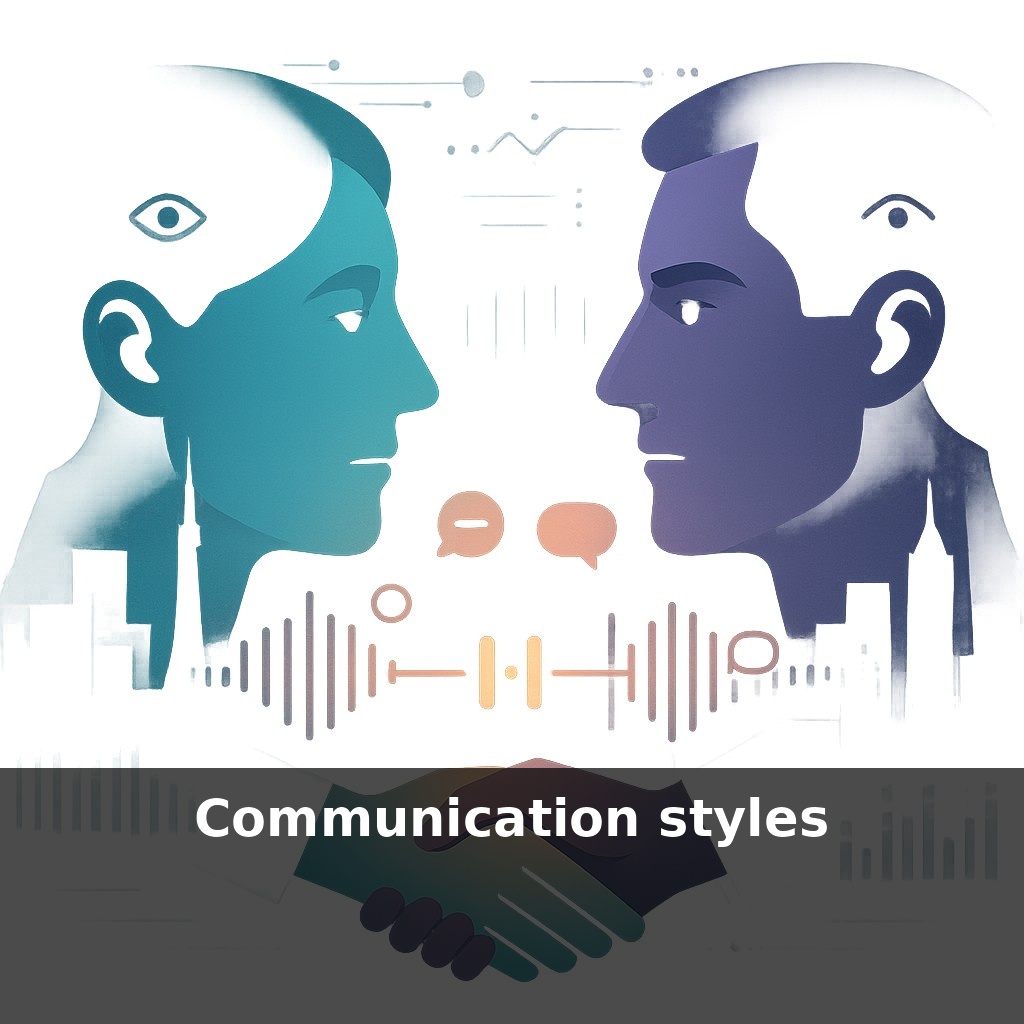
Communication styles
📝 Transcript
A silence that feels respectful in Tokyo can feel painfully awkward in New York. In fact, Japanese speakers often pause for over a second between turns; Americans usually jump in almost instantly. So when your colleague goes quiet in a meeting… are they disagreeing, or just thinking?
Now layer in tone, eye contact, and even how firmly you shake hands, and the room gets more complicated. A calm, low-key voice in one culture can be read as uncertain in another. A steady gaze might earn you trust in Toronto and tension in Taipei. Add hierarchy to the mix: in a high–power-distance setting, people may wait for the most senior person to speak first, while in more egalitarian teams, interrupting with ideas is a sign of engagement, not disrespect.
Digital tools don’t erase these gaps; they remix them. On Zoom, a brief camera-off can signal technical issues, modesty, or quiet resistance—depending on who’s watching. Short Slack messages may feel efficient to some and cold to others.
This series will unpack those hidden codes so you can spot patterns, adapt deliberately, and protect trust—especially in global, hybrid teams.
Think of each colleague as tuning into a slightly different radio frequency: same meeting, different signal strength. Some rely heavily on context—who speaks first, where people sit, how fast decisions are made. Others want everything spelled out in the agenda and follow‑up notes. Add in power dynamics: in Malaysia, hierarchy shapes who feels safe to challenge an idea; in Sweden, a junior engineer might comfortably question a VP. Then there’s clarity: teams that align on “what we mean by urgent, next, and done” consistently report higher engagement and fewer conflicts across locations.
Some teams treat words like precision tools; others treat them like sketches you’re meant to fill in. In a German engineering firm, “we will consider this” might signal a serious review process is underway. In a U.S. startup, the same phrase can be a polite way of saying “probably not.” The vocabulary overlaps; the underlying commitments don’t.
Communication style is really a cocktail of three elements: **directness**, **context**, and **relationship to hierarchy**. In low‑context, low‑power‑distance cultures, people tend to say what they mean, quickly, and expect you to do the same—whether you’re an intern or a VP. In high‑context or more hierarchical settings, much of the message lives in *how* something is said, *when* it’s said, and *who* says it. “That will be difficult” from a senior manager could actually mean “no,” but only if you know the code.
Technology adds extra layers. Email strips away tone but preserves hierarchy through subject lines, greetings and sign‑offs. Chat tools compress everything into fragments: “?” might be friendly urgency for one teammate and aggressive pressure for another. Even read receipts and response times carry meaning—instant replies can be seen as dedication, or as impulsiveness that bypasses thoughtful reflection.
Then there’s pacing. Some cultures favor rapid‑fire brainstorming, others prefer pre‑circulated documents and written input before a meeting. If you only listen to the loudest, fastest voices on a global call, you systematically miss contributions from colleagues whose norms reward preparation over improvisation.
Cultural intelligence (CQ) is your ability to notice these patterns, suspend automatic judgment, and experiment with small adjustments. It’s less about memorizing national dos and don’ts, and more about running micro‑tests: “If I summarize decisions in writing, does this quieter group engage more?” Over time, you build a flexible repertoire: switching from blunt feedback to question‑based coaching, or from spontaneous debate to structured rounds where each person has space to speak.
Your most reliable guide is curiosity. Instead of assuming confusion or resistance, you start asking, “What communication style would make this easier for them?”
In one global product team, the Brazilian lead kicked off meetings with lively small talk; her Dutch colleague routinely skipped it and went straight to the agenda. Neither was wrong, but each read the other as slightly rude—until they explicitly agreed: two minutes for human catch‑up, then crisp decisions. In another case, an Indian manager moved a tense performance conversation from video to a carefully worded email, giving a U.S. teammate time to process without reacting on the spot; follow‑up on chat then felt calmer for both.
A practical cue: watch who speaks only when invited. They may come from places where you wait to be brought in. Rotating facilitation and using tools like silent docs or polls lets different styles surface without forcing anyone to imitate the dominant mode.
A bit like a jazz ensemble, effective teams listen for each other’s rhythm—when to solo, when to hold back, when to change tempo—so the piece works as a whole, not as competing tracks.
Leaders who treat CQ like a “fitbit for conversations” will start spotting strain before relationships burn out: tense side-chats, one-word replies, cameras vanishing. As AI begins flagging tone gaps—like blunt feedback landing in a nuance‑oriented culture—the advantage shifts to teams that treat these alerts as hypotheses, not verdicts. Expect performance reviews, onboarding and even RFPs to include: “Show us how you adapt your communication playbook across cultures.”
Treat CQ like tuning your gear before a long trip: you’ll still hit bumps, but you won’t shred the engine on the first hill. Your challenge this week: when a message lands oddly—too blunt, too vague—pause and ask one curious question before reacting. Over time, those tiny “course checks” turn cultural friction into forward motion.
From this course
How to Navigate Cultural Differences in Work
6 episodesUnlock all episodes
Full access to 6 episodes and everything on OwlUp.
Subscribe — $1.99/monthLess than a coffee ☕ · Cancel anytime

