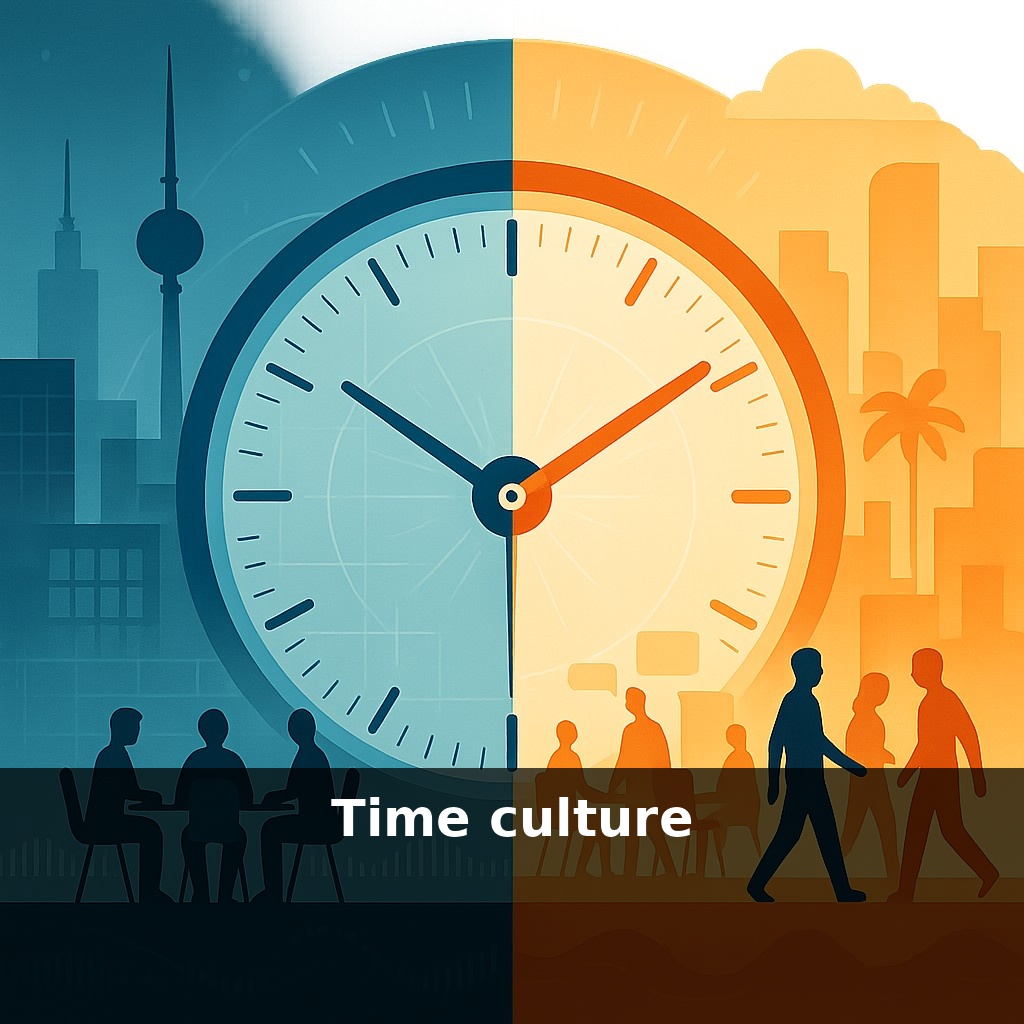
A meeting in Berlin begins almost exactly on time. The same meeting in São Paulo? People are still arriving, chatting, easing in. Both groups think they’re being respectful. One clock, two completely different cultures of time. Which one feels more “normal” to you?
Now zoom out from those meetings and look at the whole workday. Time isn’t just *when* you show up; it’s *how* you stack, slice, and protect your attention. Some teams treat the day like a carefully plated tasting menu: one course at a time, precise portions, clear sequence. Others run more like an open buffet: multiple dishes at once, people circling back, improvising combinations as they go.
Neither approach is random; both grow from deep assumptions about control, relationships, and what “being productive” looks like. In strongly task-focused cultures, blocking a two‑hour chunk for solo work feels responsible. In relationship-focused cultures, being constantly interruptible can feel equally responsible.
These invisible expectations shape who gets praised, who gets labeled “disorganized” or “rigid,” and whose style quietly becomes the default in global teams.
Those expectations get even sharper once you cross borders on a video call. A manager in Tokyo may quietly expect a three‑year roadmap in the first project discussion, while a manager in New York wants quick wins this quarter and proof you can “move fast.” One team treats deadlines like a train schedule; the other treats them more like a weather forecast—important, but subject to change. Layer on remote tools—shared calendars, status lights, auto‑scheduled meetings—and these different futures collide inside the same app, even when nobody says out loud how they think time *should* work.
One useful way to map these differences is along two intersecting axes. The first is **monochronic vs. polychronic orientation**. Monochronic cultures like to give each task its own protected lane: meetings are bounded, agendas are tight, side conversations feel like derailments. Polychronic cultures are more comfortable letting lanes blur: answering a message during a meeting isn’t a sign of disrespect; it’s an attempt to keep multiple commitments alive at once.
This isn’t about who “cares more” about work. Research on temporal attention shows that in polychronic contexts, people develop wider windows for what counts as “on time” and “on task.” Someone can be fully committed to a project while also juggling a client visit, a family obligation, and a last‑minute request from a senior leader. From the inside, that juggling feels like competence, not chaos.
The second axis is a **strict vs. flexible future time perspective**. In strict‑future cultures, the horizon is mapped in milestones: roadmaps, annual plans, performance cycles. Leaders gain status by predicting and locking in sequences. In flexible‑future cultures, the horizon is more like a landscape to explore: plans are sketches that will be redrawn as relationships, markets, or politics shift. Here, leaders gain status by adapting quickly and keeping optionality open.
Put those axes together and you get four distinct time environments a global team might occupy without naming them:
- Monochronic + strict future: “We committed; now we execute.” - Monochronic + flexible future: “One thing at a time, but we can re‑plan.” - Polychronic + strict future: “We’ll improvise day‑to‑day, but the long arc is fixed.” - Polychronic + flexible future: “Many things at once, and the path will emerge.”
Trouble starts when one quadrant silently dominates. A monochronic‑strict leader may read a polychronic‑flexible teammate as evasive or unfocused. The reverse side: that leader can look naïve—trying to freeze a future everyone knows will shift.
For leaders, the real work is to **surface** which quadrant people are operating from and then deliberately choose where the team needs strictness (e.g., regulatory deadlines) and where it can afford flexibility (e.g., meeting formats, response times) so time becomes a shared design choice, not an ongoing source of friction.
A German‑led product squad at a global software firm agreed on a 9:00 a.m. sprint review. The Brazilian and Indian engineers consistently joined at 9:08–9:12, often still closing out chats with stakeholders. No one complained out loud, but after two sprints, the product owner quietly cut their speaking slots to “keep us on track.” Velocity dropped—not because people worked less, but because key context stopped flowing in the room.
At another company, a Japanese–U.S. joint venture hit the opposite snag. The Japanese side kept proposing three‑year architectural options; the American side kept asking, “What ships this quarter?” Both were frustrated—until they split decisions into two tracks: a “now board” for commits inside 90 days, and a “later board” for moves beyond a year. Simply naming which board a discussion belonged to turned debates into design choices instead of turf wars over whose sense of time was “realistic.”
Leaders who treat time preferences as design inputs, not quirks to “fix,” will be better positioned for AI‑mediated work. As calendar tools learn patterns—who needs buffers, who prefers clusters—teams can experiment with “temporal sprints”: weeks optimized for exploration, others for decisions. Your challenge this week: pick one recurring meeting and renegotiate only its *time rules*—start, stop, and follow‑up—then notice whose participation changes, and how.
As AI schedules more of our hours, the real skill won’t be squeezing in extra tasks; it will be choosing which *tempo* fits each collaboration. Treat your calendar less like a cage and more like a mixing board: you can raise or lower tracks, mute some, spotlight others. The more consciously you tune it, the less often time will decide for you.
Before next week, ask yourself: 1) “If a new hire watched my calendar for a week, what would they assume our ‘time culture’ really is—would they see focus time protected, meetings starting/ending on time, and breaks actually honored?” 2) “Which recurring meeting on my calendar least reflects the time culture I *say* I want (e.g., no agenda, always runs over, no decisions made), and what specific boundary or experiment could I try this week to change it?” 3) “Where am I personally modeling ‘performative busyness’—like replying instantly to every message or booking back‑to‑back calls—and what is one concrete behavior I’m willing to shift tomorrow so my team sees a healthier norm?”