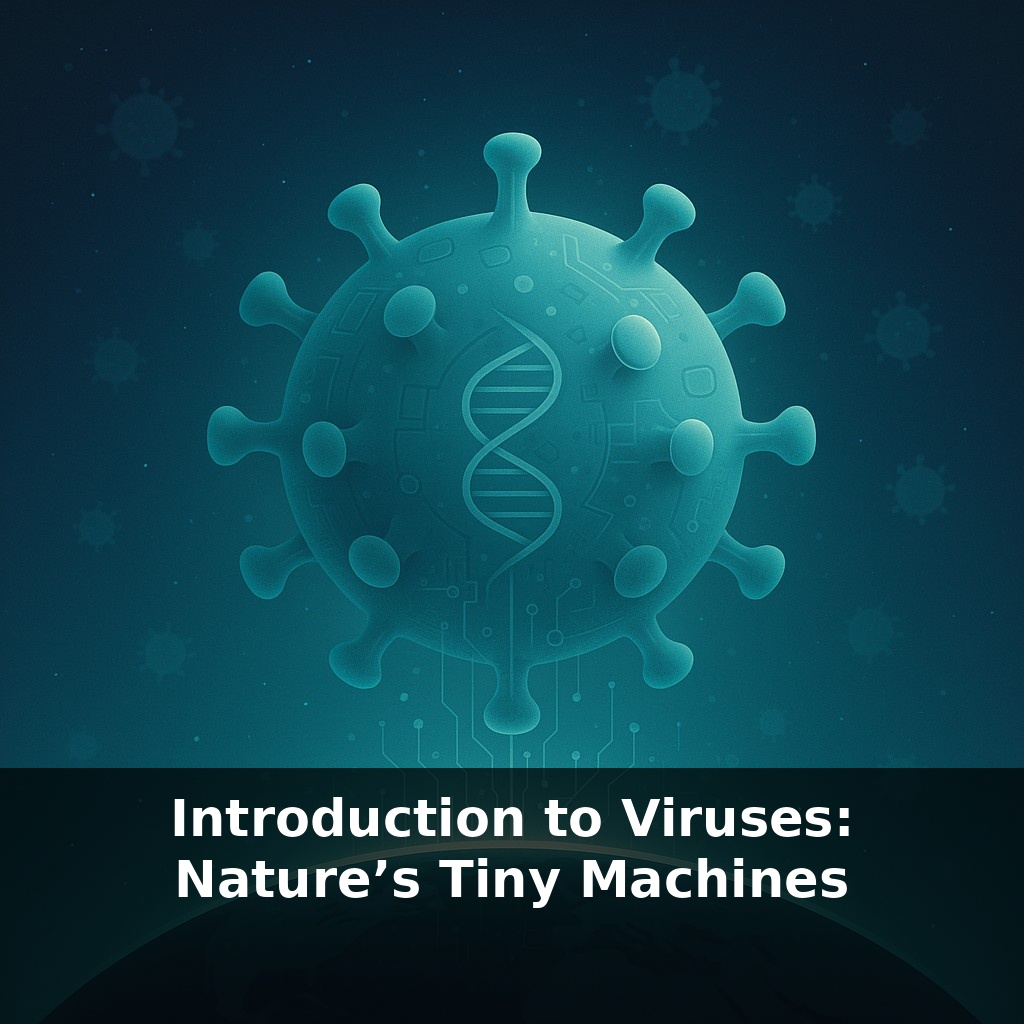
Introduction to Viruses: Nature’s Tiny Machines
📝 Transcript
Right now, there are more viruses on Earth than stars in the observable universe. Yet each one is basically a tiny packet of instructions, waiting. In this episode, we’ll step inside that packet and ask: how does something that isn’t really “alive” reshape entire worlds?
A strange thing happens when you zoom out from individual infections and look at viruses at planetary scale: they stop being just agents of disease and start to look like a hidden operating system for life on Earth. Out in the oceans, for example, marine viruses kill an estimated 20% of all microbes every single day. That’s not just microscopic carnage; it constantly recycles carbon and nutrients, shaping climate and food webs. Inside us, remnants of ancient viral invasions help control placenta formation and gene regulation. Even bacteria carry molecular “wanted posters” in their DNA—CRISPR sequences—recording past viral attacks and powering one of the most important tools in modern biotechnology. In this episode, we’ll trace how these tiny genetic hit‑and‑run artists quietly write the rules for ecosystems, evolution, and even the technologies we use to edit life itself.
Beyond oceans and genomes, virologists are now uncovering viral footprints in places we barely thought to look. Soil viruses can tweak how forests store carbon; gut viruses (the “virome”) may influence how we respond to food, drugs, and even vaccines. Hospitals track viral evolution in real time to predict the next outbreak, while data centers borrow viral replication ideas for error‑correcting codes. One analogy helps here: like a global stock market of genes, viruses constantly “trade” bits of DNA and RNA between species, shifting biological fortunes in ways we’re only starting to map.
Viruses don’t just nudge evolution; they sometimes slam the accelerator. One of the most dramatic ways is by moving genes sideways between species—horizontal gene transfer. When a virus infects, bits of its genome, or even fragments of its host’s DNA, can end up packaged into new viral particles. The next time those particles infect a different organism, that genetic “stowaway” can be dropped into a brand‑new genome. Over many generations, this process has shuffled innovations like antibiotic‑resistance genes among bacteria and may have helped spread key metabolic tricks through microbial communities.
This gene‑shuffling power is exactly why modern biotechnology keeps borrowing viral ideas. Viral vectors—engineered shells that deliver customized genetic cargo—sit at the heart of many gene therapies under development. In some treatments for inherited blindness, for instance, an adeno‑associated virus is repurposed to carry a working copy of a missing gene into retinal cells, restoring crucial proteins that the patient’s DNA couldn’t produce on its own. Similar strategies are being tested for blood disorders, immune deficiencies, and certain neuromuscular diseases.
Even mRNA vaccines lean on viral logic. Instead of delivering whole viruses, they deliver a temporary genetic script that cells read to make a viral protein for a short time. The immune system practices on that harmless target, learning to recognize the real pathogen without enduring the full infection. It’s a deliberate, highly controlled echo of what viruses have done for billions of years: insert instructions, hijack cellular machinery, trigger a response.
Not all viral applications are so high‑tech. In agriculture, researchers are exploring “viral pesticides” that target specific crop pests while sparing beneficial insects. In wastewater treatment, tailored bacteriophages can knock down problematic bacterial blooms without blanketing whole systems with chemicals. And in cancer clinics, oncolytic viruses are being tuned to preferentially infect and rupture tumor cells while flagging them to the immune system.
In each case, we’re trying to flip the script: harness the precision and efficiency that make viruses dangerous, and redirect those same traits toward repair, control, and, sometimes, cure.
Viruses also show up in surprising corners of technology once you start looking. In computer security, for instance, some intrusion‑detection systems watch networks the way epidemiologists watch populations, flagging “superspreading” data patterns that hint at digital outbreaks. In synthetic biology labs, designers borrow viral attachment proteins as ultra‑specific docking tools, letting engineered microbes pass molecular “packages” only to the right neighbors. Ecologists now deploy portable sequencers in the field to read viral fingerprints in water or air, turning them into early‑warning sensors for ecosystem stress. Even in materials science, researchers study how certain plant viruses self‑assemble into precise, repeating shapes, then swap in metal atoms to grow nano‑wires along the same scaffolds. One way to picture this: in the same way frequent‑flyer programs quietly track and route travelers across the globe, viruses quietly track and reroute genetic and informational traffic across the biosphere and our technologies.
Future implications are sprawling. Labs are already exploring viruses as adaptable hardware: swappable “modules” for editing cells, training immune systems, or even building nano‑scale batteries. Policy will have to sprint to keep up, balancing open research with guardrails against do‑it‑yourself bioweapons. Your challenge this week: each time you see a headline about outbreaks, vaccines, or gene therapy, ask yourself, “What viral idea is hiding under this story?”
Viruses won’t stop surprising us. Next‑gen tools may use them to map cell‑to‑cell “conversations” in real time, like turning on subtitles for your own biology. Others may log infections across your lifespan, a molecular travel history stamped into your cells. As we learn to read that record, we’re not just curing disease—we’re decoding where life has already been.
Before next week, ask yourself: - “When I think about viruses as ‘tiny machines’ that hijack host cells, which step of that process (attachment, entry, replication, assembly, or release) is still fuzzy for me—and what’s one concrete example virus (like influenza, HIV, or bacteriophages) I can quickly look up today to clarify that step?” - “If I imagine a virus moving through my own body, how would I trace its journey—from first contact at a mucosal surface to recognition by my immune system—and where along that path do I see the best opportunity for vaccines or antivirals to ‘interrupt the machine’?” - “Which common misconception about viruses that I heard in the episode (like ‘all viruses are always harmful’ or ‘antibiotics work on viruses’) do I still catch myself believing, and how could I explain the corrected version in one simple analogy to a friend or family member this week?”
From this course
How Viruses Work: From Common Cold to Pandemics
5 episodesUnlock all episodes
Full access to 5 episodes and everything on OwlUp.
Subscribe — $1.99/monthLess than a coffee ☕ · Cancel anytime