1900: The World Before Everything Changed
📝 Transcript
In 1900, most people on Earth would never see a car, a plane, or a voting booth. Trains and telegraphs carried news faster than ever, yet daily life still moved at a walking pace. This episode steps into that in‑between world, right before everything tilts into the modern age.
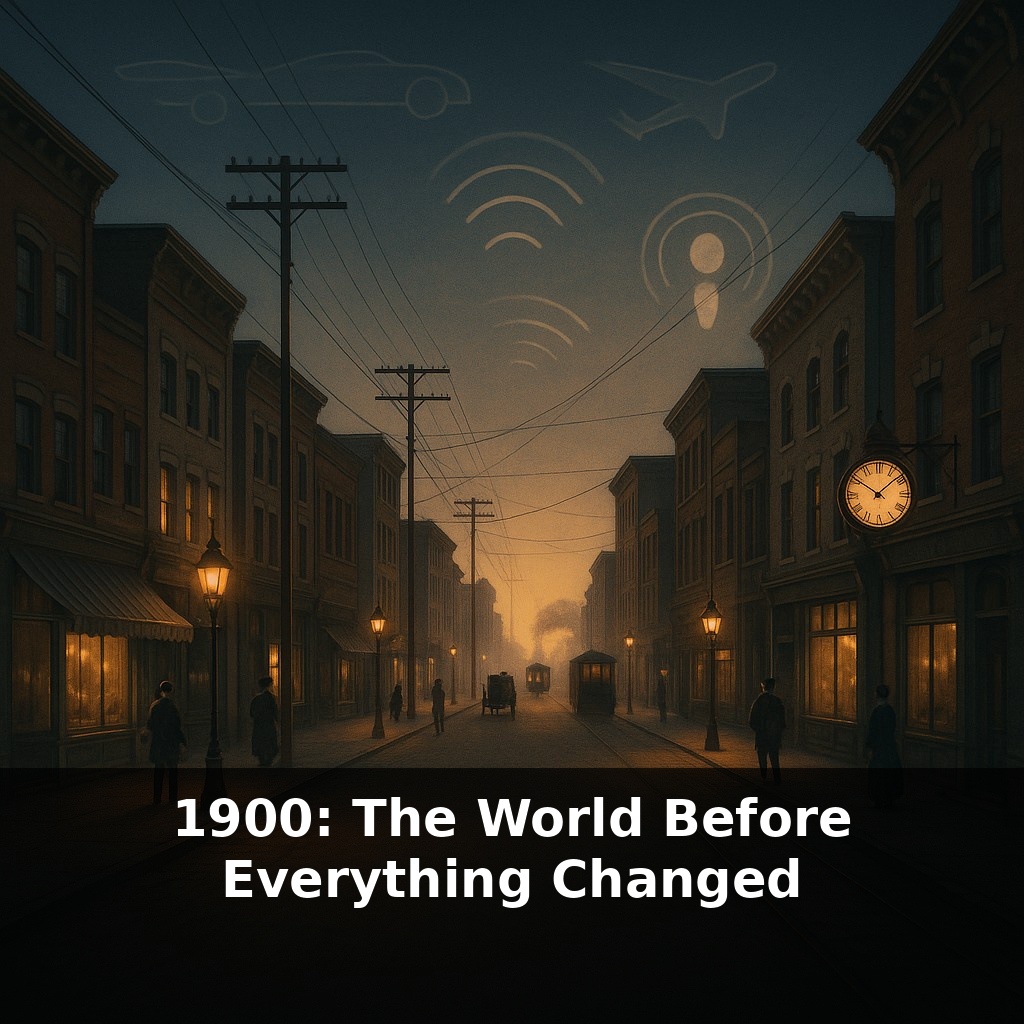
Walk down a main street in 1900 and the strangest thing wouldn’t be what you see—it would be what you don’t. No traffic lights, no neon ads, no phone screens pulling heads downward. Most shops go dark at sunset; “late night” means gas lamps and candles, not 24/7 anything. A doctor might still arrive at your door by horse, carrying tools your great‑grandparents would recognize. News from another continent is fast enough to read in tomorrow’s paper, but a letter from a nearby village can still take days to arrive if the roads are bad. The cutting edge is uneven, like a loaf sliced thick in some places, paper‑thin in others. In Berlin or New York, you might ride an electric streetcar; a few miles away, a farmer is still plowing with oxen. 1900 isn’t a single moment so much as overlapping timelines, old and new running side by side, not yet forced to choose.
Step back from the street and zoom out to the planet. In 1900, nearly everyone still lives close to the soil; farming isn’t a “sector,” it’s the default. Nations are more like stacked layers than unified communities: emperors and kings on top, colonial subjects at the bottom, with parliaments and newspapers squeezed awkwardly in between. A factory whistle might set the rhythm of life in one district, church bells or the call to prayer in another. Science is beginning to feel like a new kind of authority, but it shares the stage with tradition, scriptural rules, and royal decrees, all competing to define what “progress” should mean.
Stand on that 1900 street a bit longer and ask: who actually has a say in how this world works? For most people, the answer is “almost no one.” Power runs downward, not outward. Thrones, governors, and ministries set the rules; ordinary voices rarely travel any farther than the local café or market stall.
Legally, citizenship is a narrow doorway. In most countries, even adult men can’t vote unless they own enough property, pay certain taxes, or fit the right ethnic or racial category. Women, almost everywhere, are expected to influence politics only indirectly—through husbands, sons, or social pressure. Yet suffrage movements are already organizing petitions, rallies, and street marches, testing how far the system will bend before it breaks.
Zoom into an imperial capital and the map looks reassuringly solid—vast territories shaded in a single color. Up close, it’s patchwork. British officials in India rely on local princes and landlords; French administrators in West Africa bargain with chiefs and merchants; the Ottoman sultan balances Arab notables, Balkan elites, and restive minorities. Order is less a firm grip than a constant juggling act.
Economically, 1900 runs on global threads most people never see. A Lancashire mill worker depends on cotton from the American South; a clerk in Bombay wears cloth spun in those English mills; a farmer in Egypt pays taxes in cash because his grain goes to feed cities he will never visit. Prices in one port ripple outward to villages an ocean away. It’s an interconnectedness without smartphones, enforced by steam, credit, and empire.
Daily work reflects this split reality. In one block: engineers maintaining electric tram lines, typists tapping in busy offices, chemists experimenting with new dyes and explosives. In the next: servants hauling water, children in factories doing twelve‑hour shifts, peasants measuring seasons by the same cues their ancestors watched—frost on the fields, birds returning, the angle of the sun.
Many who sense that something big is changing can’t yet name it. Reformers talk about “the social question,” generals about “preparedness,” businessmen about “new markets.” Few realize these threads are part of the same tightening knot, drawing distant cities, classes, and colonies into a shared, and increasingly fragile, system.
Think of three people whose days never cross. First, a Paris lawyer in 1900: he reads thick newspapers, debates in cafés, and treats politics as a sport played by men in suits. He knows colonies exist—rubber, coffee, headlines about “troubles”—but they’re abstractions, like numbers on a balance sheet.
Now shift to a Congolese rubber tapper working under King Leopold’s rule. His “news” is the arrival of armed agents demanding quotas. Telegraph wires and stock prices in Europe turn into missing hands and burned villages where he lives, without his name ever appearing in print.
Lastly, meet a Japanese engineering student in Tokyo. He pores over German textbooks, builds tiny steam engines, and watches his country copy and bend Western tools to its own purposes. For him, “modern” isn’t a distant showcase; it’s an urgent race not to be carved up like China or Africa.
These three don’t know one another, but a change in any of their worlds—an election, a scandal, a rebellion—can quietly shove the others’ lives in a new direction.
A century later, we live inside systems those 1900 crowds were only beginning to stir. Movements they whispered about—labor rights, feminism, anti‑colonial struggles—have redrawn laws and borders, yet none of their wins feel permanently “locked in.” The lesson isn’t that change is guaranteed; it’s that pressure accumulates quietly. Like weather building offshore, today’s arguments over data, climate, and AI may look abstract—until they arrive as the next era’s “obvious” reality.
Building on the transformations we've explored, the real question isn’t how different 1900 looks from today, but which of our “normal” habits will seem just as strange in another hundred years. Some future historian may study our feeds and climate graphs the way we study coal smoke and telegrams—clues to pressures we barely noticed while we hurried through our own version of the street.
Try this experiment: For one day, live as if it’s the year 1900 in one specific part of your life—communication. Turn off your smartphone for 12 hours and only allow yourself “1900-style” tools: handwritten notes, printed books or newspapers, and face‑to‑face conversations. Notice what changes in your attention, stress level, and the depth of your interactions, and jot a quick comparison at the end: what felt harder, what felt surprisingly better, and what (if anything) you’d like to keep from that 1900 mindset in your modern routine.
From this course
How We Got Here: The Story of the Modern World
7 episodesUnlock all episodes
Full access to 7 episodes and everything on OwlUp.
Subscribe — $1.99/monthLess than a coffee ☕ · Cancel anytime