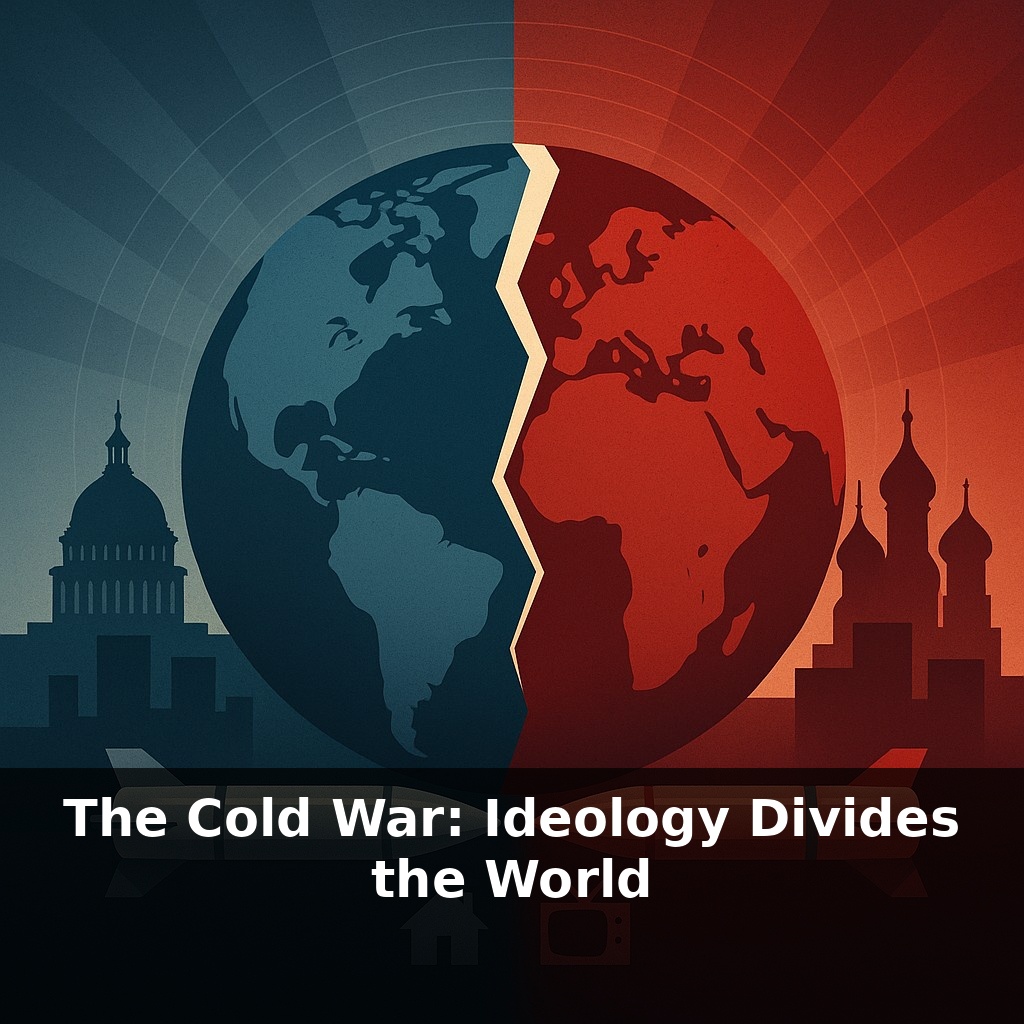
A war that spanned every continent, lasted for decades, and shaped your daily life… without ever being officially declared. In this episode, we step into a world where two superpowers stalk each other across the globe, armed with ideas as dangerous as their missiles.
Seventy thousand. That’s roughly how many nuclear warheads the U.S. and the Soviet Union held at the Cold War’s peak—enough to destroy human civilization many times over, yet most people still went to work, watched TV, and planned for the future. In this strange normality, governments poured staggering resources into weapons they hoped never to use: the U.S. alone may have spent up to $8 trillion (in today’s dollars) on its nuclear arsenal. While missiles multiplied, the conflict also played out in quieter ways—through airlifts that kept a city alive, hushed crises in smoky rooms, and scientists racing to stay ahead of an enemy they might never meet. Think of daily life then as cooking in a kitchen where the oven is always on broil: you learn to live with the heat, but one mistake could burn everything.
Yet the story of this era isn’t just tension and terror; it’s also about how that pressure reshaped politics, borders, and even everyday expectations of government. States lined up in rival camps—NATO on one side, the Warsaw Pact on the other—while many newly independent countries tried to stay “non-aligned,” like diners refusing the set menus offered by two rival chefs. Crises in places like Berlin and Cuba showed how local disputes could suddenly become global emergencies, forcing leaders to improvise rules for avoiding disaster in a world wired for instant escalation.
In this world wired for instant escalation, ideology wasn’t abstract theory—it decided who got money, weapons, and sometimes survival. Washington and Moscow each claimed to represent humanity’s future, and that claim traveled through radio signals, textbooks, films, and sacks of grain.
On the American side, “containment” became the organizing principle: don’t roll communism back everywhere, but stop it from spreading. That meant funding governments that promised to be anti-communist, even when they were authoritarian. U.S. leaders argued that if one country “fell,” neighbors might follow in a chain reaction; this “domino theory” helped justify interventions from Iran and Guatemala in the 1950s to Chile in 1973. At home, it also fed suspicion: loyalty oaths, blacklists, and hearings where careers could vanish on the hint of “un-American” views.
Moscow offered its own bargain: support for socialist parties, liberation movements, and governments that aligned with its vision. Soviet aid built dams, factories, and schools in parts of Asia, Africa, and Latin America. But that help often came with strings—security advisors, party trainers, and expectations about how closely local leaders would follow the Soviet line. When they drifted too far, as in Hungary in 1956 or Czechoslovakia in 1968, tanks reminded everyone where the limits lay.
Newly independent states had to navigate this battlefield of promises. Leaders in India, Egypt, Indonesia, and elsewhere tried to extract resources from both sides without surrendering autonomy, pushing a Non-Aligned Movement that said, in effect: we won’t be anyone’s pawn. Their citizens felt the tug-of-war in concrete ways—scholarships to study abroad, cheap wheat imports, or the sudden arrival of foreign military advisors.
Culture became another front. Hollywood spy thrillers, Soviet “friendship societies,” jazz tours, ballet companies, Olympics broadcasts—all carried subtle messages about which system produced better lives. Even scientific cooperation was double-edged: joint space projects coexisted with espionage and intense competition for prestige.
Your challenge this week: any time you see a news story about foreign aid, military bases abroad, or “defending democracy” and “fighting extremism,” pause and ask: if this were 1965, which side of a Cold War-style rivalry would this fit, and what trade-offs might be hidden behind the slogan?
Think of foreign aid during this era like a complicated medical trial: countries weren’t just getting “medicine,” they were testing rival treatments with different side effects. Take South Korea and Cuba. Both received massive external support—factories, training, credits—but from opposite camps, and ended up with sharply different political and economic systems that still shape them today. Or consider Afghanistan: in the 1980s, U.S.-backed fighters received weapons and training to bleed Soviet forces; some of those networks later evolved into groups Washington fought in the “War on Terror,” showing how yesterday’s anti-communist ally could become tomorrow’s security headache.
The same pattern shows up in education. Students from Ghana or Indonesia who studied engineering in Moscow or Chicago returned home with not just skills but assumptions about how a state should run an economy. Those assumptions filtered into constitutions, development plans, even city layouts—long after the original patrons’ flags came down.
By the 21st century, some Cold War habits quietly resurfaced in new forms: cyber units replacing covert radio, trade blacklists instead of grain embargoes. Tech supply chains now act like weather systems—disruptions in one region can trigger storms elsewhere. As states test AI weapons, satellite defenses, and quantum tools, they’re also reviving inspection regimes and “red phone” diplomacy, trying to keep mistrust from hardening into self-fulfilling prophecies or rigid economic blocs.
Today’s rivalries echo that era in quieter ways: sanctions tweak prices at your grocery store, satellite launches shape your navigation apps, and online disinformation campaigns seep into your group chats like a slow leak under a door. The Cold War may be over, but its habits linger, nudging how nations compete, cooperate, and calculate risk.
Try this experiment: for one day, “live” as if you’re in either 1950s Washington, D.C. or 1950s Moscow and make all your news and entertainment choices match that side of the Iron Curtain. For your chosen side, only consume media that bloc might have approved: e.g., read a Cold War–era newspaper front page from that country online, watch one propaganda film or newsreel from that side, and listen to one speech by a key leader (like Truman, Eisenhower, Khrushchev, or Brezhnev). As you go, keep a simple tally of how each piece of content frames “freedom,” “threat,” and “the other side” (just three columns and hash marks). At night, switch sides and briefly sample the opposite bloc’s media for 20–30 minutes, then compare which side felt more persuasive to you and why.