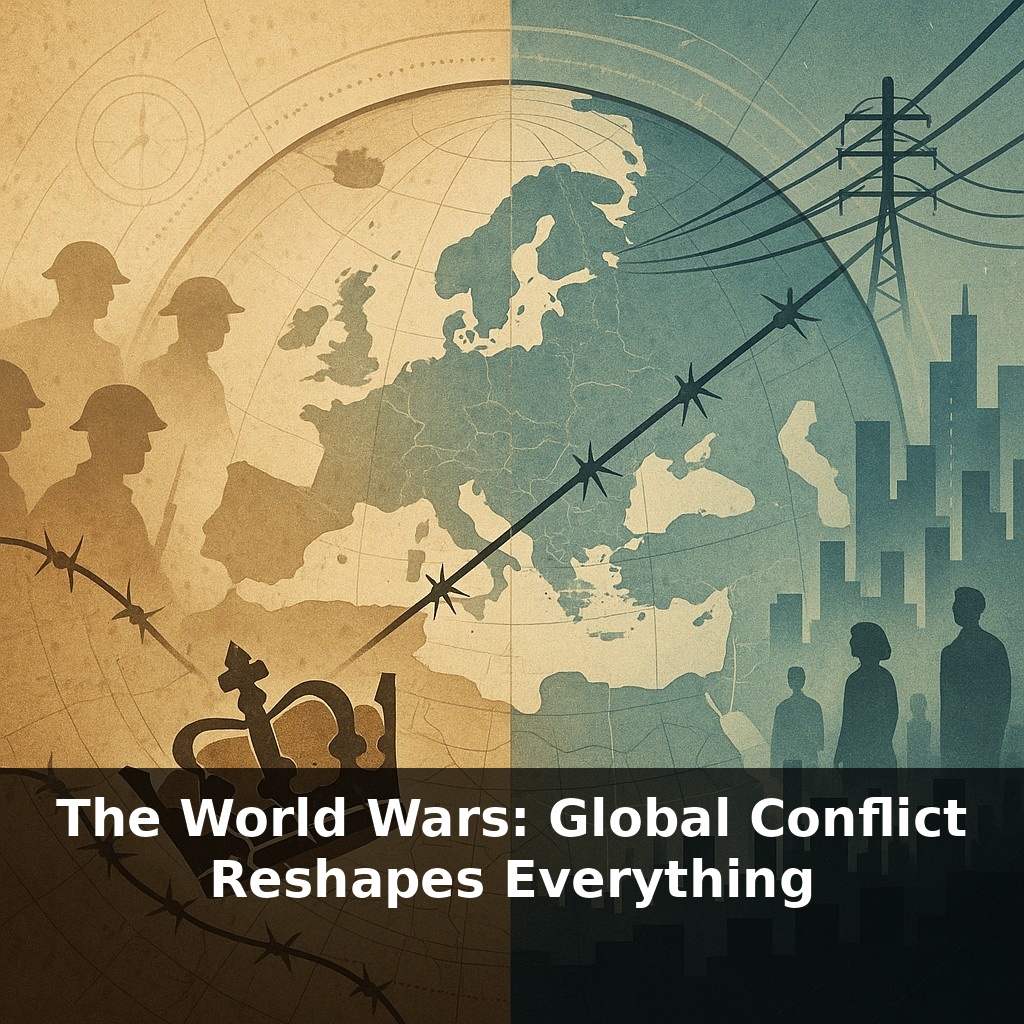
Guns fell silent in 1945—but in a strange twist, the war never really ended. It just changed shape. Borders, empires, even daily life were quietly rewired. In this episode, we trace how two brutal conflicts turned a Europe of kings into the global grid we all live inside today.
By 1913, most people in Europe still lived in a world that felt strangely “local.” You worked, married, and worried mostly within a day’s travel of home. News moved faster than in your grandparents’ time, but power still looked like uniforms, palaces, and church towers. Then, in less than a single human lifetime, two industrialized wars didn’t just redraw maps—they rewired how authority, money, and ideas flowed across the planet.
Think of it less as a story of trenches and tanks, and more as a story of systems under stress. When those systems snapped, new ones had to be built: global institutions, dollar-based finance, mass media, welfare states, Cold War blocs. In this episode, we’ll zoom in on the chain reactions: how battlefield decisions shaped boardrooms, parliaments, factory floors, and living rooms—and how that upheaval still structures everything from your passport to your paycheck.
The shock came in layers. First, the sheer scale: tens of millions of soldiers pulled from farms, offices, and factories into a war machine that chewed through resources faster than any king or emperor had ever imagined. To keep that machine running, governments learned to coordinate railways, rations, and raw materials the way a conductor manages an orchestra. Once that kind of centralized planning existed, it didn’t simply vanish in peacetime—it leaked into welfare systems, housing policy, and how whole populations thought about what a modern state owed its citizens.
Here’s the twist: the “world” in World War didn’t just mean more countries fighting. It meant whole societies getting wired into a single, high-stakes system—militarily, economically, and politically.
Start with the alliances. By 1914, Europe’s leaders had chained themselves into mutual-defense promises so tight that a regional crisis in the Balkans pulled in powers from across continents. That’s how a clash between Austria-Hungary and Serbia turned into German troops in Belgium, British ships blockading sea lanes, and colonial soldiers from India, North and West Africa, and Australia fighting in places they’d never heard of. These weren’t side-theaters; they were the first real test of what globalized logistics and communications could do in war.
The Second World War pushed this further. The same networks that moved coal and cotton now moved tanks, oil, and aircraft parts. U.S. Lend-Lease illustrates the new scale: Washington didn’t just send guns; it effectively plugged Allied economies into its own industrial output, shipping everything from locomotives to canned food. That level of coordination blurred the line between “home front” and “battlefield.” A factory in Detroit or a port in Murmansk could be as strategically important as a frontline city.
Mass mobilization also forced governments to treat populations differently. When you conscript millions and ask civilians to endure rationing and bombing, legitimacy can’t rest only on flags and dynasties. It nudged states toward promises of social security, veterans’ benefits, and, eventually, broader political participation. Leaders learned that people who had risked everything were less willing to go back to voicelessness.
Colonial subjects noticed this too. They fought and died to “defend freedom” while lacking it at home. After 1945, movements in India, Indonesia, Vietnam, Ghana, and beyond used the language of wartime sacrifice to press for independence. The exhaustion of European powers, plus the rise of two non-colonial superpowers, made old empires look both morally and financially unsustainable.
The result wasn’t just new flags on maps. It was a world where decisions in Washington or Moscow could sway elections in Rome, food supplies in Cairo, and security pacts in Tokyo—an interdependence that still shapes crises today.
Walk through a modern airport and you’re moving through the aftershocks of those wars, even if you never see a uniform. Passport control, security alliances that decide which lines you stand in, the very idea that some citizens glide through visa-free while others face interviews and paperwork—all of that hardened during and after global conflict, when states got serious about tracking bodies and loyalties across borders.
Follow the food in your carry-on. Canned tuna, instant coffee, chocolate bars, powdered milk: wartime research turned fragile goods into long-lasting rations, then into supermarket staples. The same labs that solved “how do we feed troops at sea?” later solved “how do we stock a suburban pantry?”
And then there’s the map in your phone. GPS owes its existence to Cold War military needs that grew directly from World War II targeting and navigation problems. Today, that guidance system quietly decides where taxis go, which routes trucks take, how relief supplies find disaster zones—a civilian lattice built on wartime math and satellites.
The next twist: those wartime systems didn’t just shape governments—they quietly trained us to think in “global crisis mode.” Pandemic dashboards, sanctions lists, climate summits, no‑fly zones: all inherit the logic of coordinating many states under pressure. Cyberattacks on grids, rare‑earth chokepoints, vaccine hoarding—they’re today’s version of contested sea lanes and oil fields. Your challenge this week: each time you see a headline about “security,” ask what’s really being defended—land, data, reputation, or supply chains.
With that historical groundwork, we’re still adding layers to systems those wars forced into being, like cooks tweaking a huge simmering stew instead of starting a new pot. Trade rules, migration policies, even climate deals now get poured into frameworks first hardened under total war. The open question is whose recipes will dominate next—and how much heat our shared pot can take before it boils over.
Before next week, ask yourself: - If my city suddenly faced the kind of supply shocks and rationing people lived through in the World Wars, what specific two changes would I make to how I get food, energy, or information—and what’s one small step I could take today to test that? - Looking at how propaganda, radio, and newsreels shaped public opinion back then, which of my current news sources would I still trust under that kind of pressure, and how could I “stress test” them this week (for example, by comparing how three outlets cover the same global story)? - Thinking about how borders, empires, and alliances were redrawn after 1945, which modern conflict or alliance worries me most right now, and what’s one concrete thing I can do this week to understand it better—like reading a primary document, a historian’s take, or a perspective from someone directly affected?