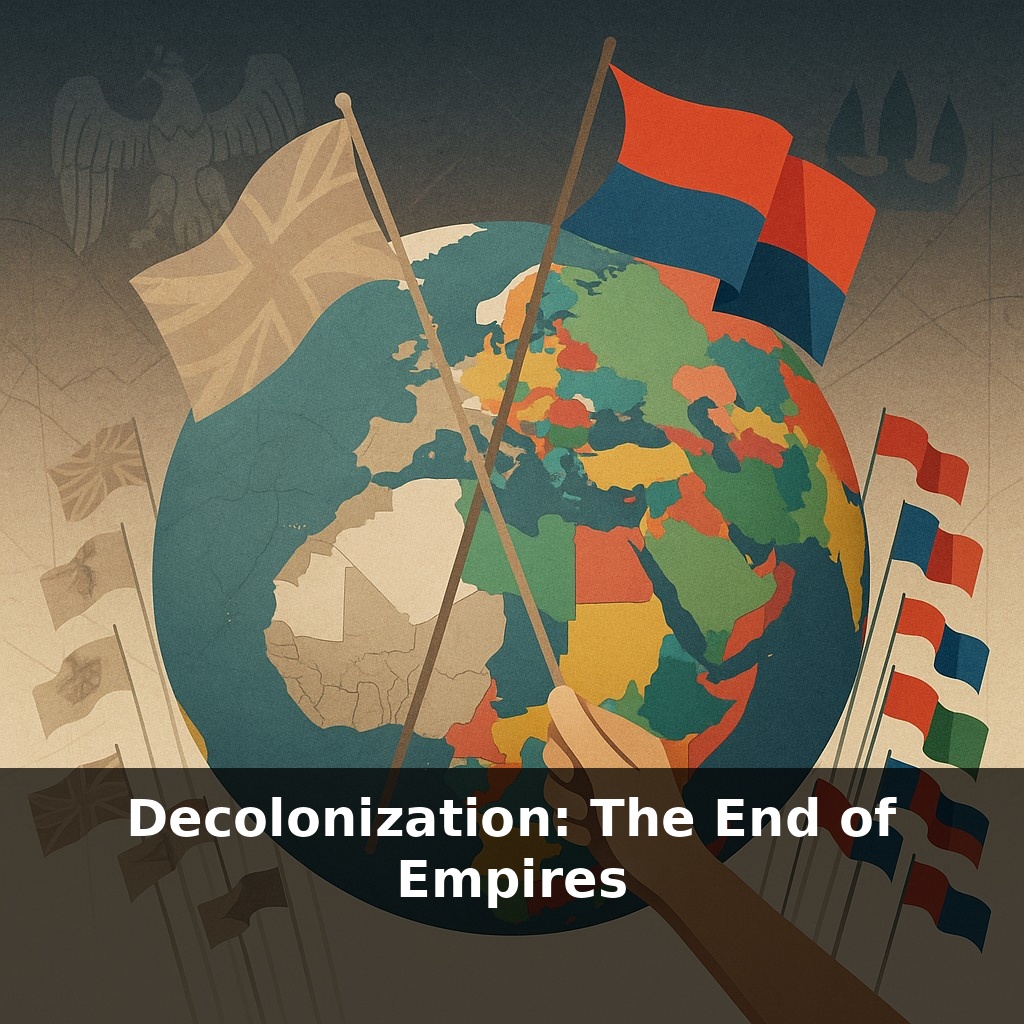
One morning in 1945, the United Nations had just 51 flags at its door. Within a single generation, that forest of flags would more than triple. How did sprawling European empires turn into a world of restless new nations—and why do their shadows still shape today’s conflicts?
Yet decolonization wasn’t a single, tidy process—more like hundreds of different break-ups unfolding at once, each with its own script, timing, and scars. In some places, independence came through negotiations and constitutional talks in distant capitals; in others, it arrived through guerrilla wars, urban terrorism, or rural insurgency. Some leaders wore suits and carried legal briefs; others wore uniforms and carried rifles. On paper, the transfer of power could look orderly: new flags, new anthems, new parliaments. But beneath the ceremonies, old economic hierarchies and racial orders often stayed put, only lightly repainted. To understand how we got from imperial rule to a “post-colonial” world, we have to look past the moment of independence itself and trace the deals, debts, and compromises that surrounded it.
The story also unfolds on several overlapping stages. There’s the local arena, where nationalist leaders, rural rebels, trade unionists and minority groups often clashed over what “freedom” should actually look like. There’s the imperial center, where exhausted governments weighed the costs of keeping distant possessions against rebuilding bombed-out cities at home. And there’s the global stage, where Washington, Moscow and newly assertive Asian and African diplomats pushed competing visions of world order, rewriting rules about sovereignty, self‑determination and who got a voice in international debates.
Stand in 1945 and look forward, and three currents start to converge.
First, inside the colonies, political movements that had been marginal before 1914 suddenly had wind in their sails. World War II had exposed just how vulnerable the old powers were: Britain falling back from Singapore, France collapsing in 1940, the Dutch and Belgians swept aside in months. Men recruited into colonial armies returned home with military training, widened horizons, and pointed questions: if they were “good enough” to die for empire, why weren’t they good enough to govern themselves? New parties—Congress in India, the FLN in Algeria, the Viet Minh in Indochina, the CPP in Ghana—linked urban elites, students, trade unions, and, crucially, rural communities. They built parallel structures: newspapers, schools, clandestine militias, networks of local sympathizers that could shut down a port or make a city ungovernable.
Second, the moral and legal climate outside shifted. The language of self‑determination, once a vague promise in Woodrow Wilson’s speeches, hardened into an expectation. The horrors of Nazi occupation made it harder for European politicians to defend their own overseas domination without sounding hypocritical. New forums—pan‑African congresses, Asian‑African gatherings like Bandung in 1955—let colonial representatives compare tactics, share lawyers, and draft petitions that embarrassed London, Paris, or Lisbon in front of a watching world. Anti‑colonial leaders became deft at playing audiences: one message for peasants in the countryside, another for the UN General Assembly or American journalists.
Third, the Cold War turned distant territories into bargaining chips and battlefields. Washington often pressed allies to loosen their grip, fearing that rigid colonial rule would drive movements toward Soviet backing. Moscow, for its part, cast itself as champion of anti‑imperial struggles, offering weapons, training, or diplomatic cover. Yet most emerging leaders didn’t want to be junior partners in someone else’s bloc. Figures like Nehru, Nasser, Nkrumah and Tito experimented with a “non‑aligned” path—courting aid from both sides, trying to widen their room for maneuver.
Put together, these forces didn’t produce a single script so much as a menu of strategies: mass boycotts and strikes, armed insurgency, constitutional conferences, international lobbying, or—often—some combustible mix of all four. The specific blend in each place would shape not only how rulers left, but also who stepped into the vacuum and what kinds of institutions they built.
Consider how different the “recipes” for ending rule looked on the ground. In the Gold Coast, Kwame Nkrumah blended mass rallies, strikes, and savvy media work to pressure Britain into transforming a colony into Ghana without a full‑scale war. In Indonesia, Sukarno proclaimed a republic in 1945, then faced four years of armed struggle, diplomatic parleys, and Dutch “police actions” before outsiders finally recognized what locals already treated as reality. Algeria’s FLN, by contrast, banked on a grinding war that bled France financially and morally until the cost of staying outweighed the shame of leaving. Internal fractures mattered, too: in Nigeria, rival regional elites bargained over federal structures that would outlast the flag‑raising; in Kenya, land‑hungry peasants in the highlands and more cautious urban politicians did not always pull in the same direction. One lesson: the balance between guns, negotiations, and international theater varied wildly, but each combination left deep institutional footprints.
Today’s fault lines over trade rules, migration, and climate loss carry echoes of those mid‑century ruptures. As more voices from Accra, Jakarta, or Port of Spain demand a say in setting the rules, older powers face a choice: share agenda‑setting or cling to inherited privileges. Legal claims for land, artifacts, and unpaid debts may expand, too—like long‑ignored tabs resurfacing at the end of a very long dinner. How these claims are handled will shape whose stories and interests define “global” policy next.
As more regions press for debt relief, climate reparations, or control over digital infrastructure, they’re not just tweaking old arrangements; they’re questioning who writes the rules in the first place. Your challenge this week: trace one news story about these demands back to its colonial-era roots, like following cracks to the fault line beneath.