Why Invest: Inflation Is a Silent Tax
📝 Transcript
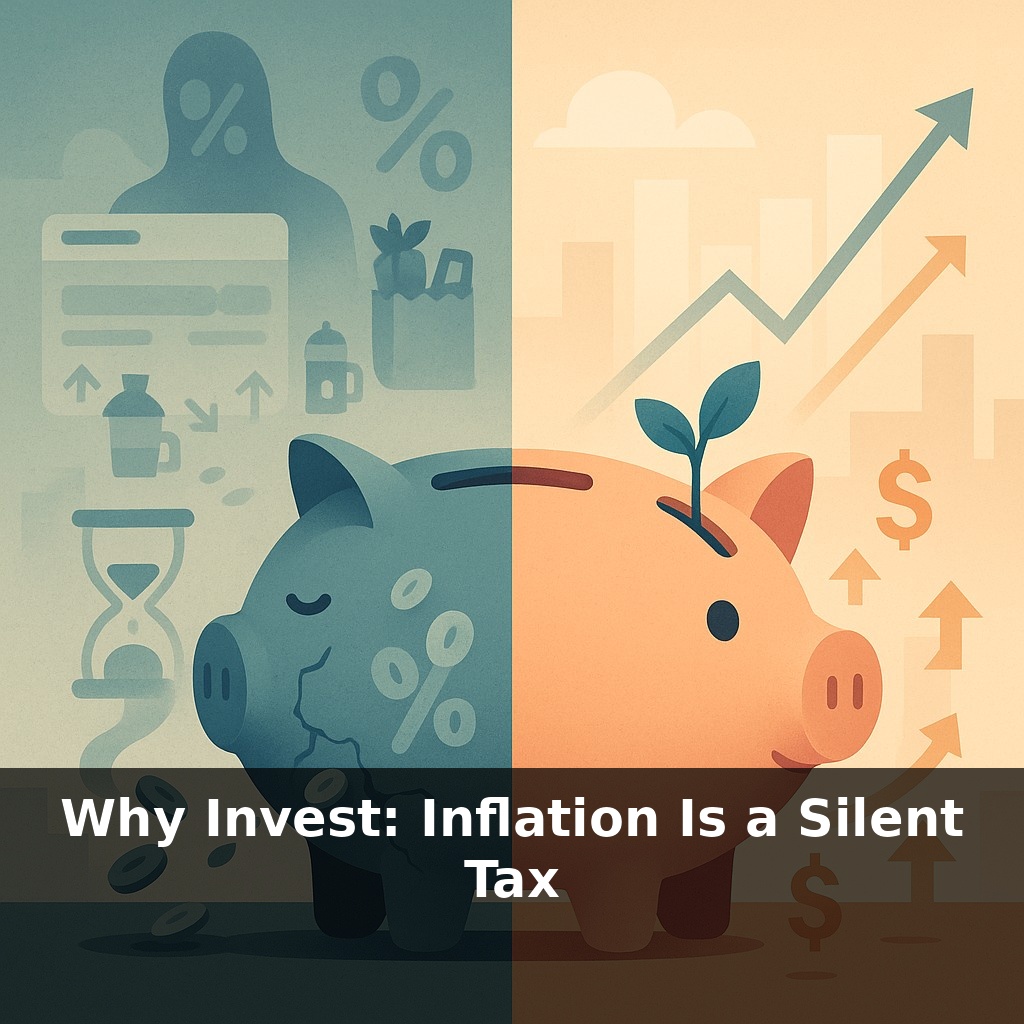
Your savings account is quietly making you poorer. Not because you’re spending, but because prices keep creeping up while your cash mostly sits still. Think about your future self two decades from now, staring at the same balance… that buys a lot less life than today.
A 3% price increase sounds harmless—until you stretch it over decades. That quiet creep is why investing isn’t just for “money people” or the ultra-ambitious; it’s basic self‑defense for your future spending power. The question isn’t “Should I invest to get rich?” but “What happens if I don’t invest at all?”
Zoom out to a lifetime: rent, food, healthcare, and education don’t politely pause while your cash sits still. Some things rise much faster than the average—college tuition and medical costs have often sprinted ahead of broad price levels. That means a nest egg parked in low-yield accounts is slowly mismatched against the bills you’ll actually face.
This is where owning productive assets comes in: shares of businesses, real estate, or bonds that adjust with inflation. You’re trading the comfort of seeing a fixed number today for the resilience of maintaining your lifestyle tomorrow.
That “silent tax” shows up in surprising ways. The menu with higher prices each year, the rent that jumps at renewal, the health insurance bill that seems to age faster than you do—all of them quietly demand more from the same pile of dollars. Meanwhile, your goals don’t get cheaper: a first home, a kid’s education, time off to change careers. Each year you delay putting money to work, you’re effectively accepting a pay cut from your future self. The real choice isn’t between risk and safety; it’s between taking controlled, chosen risks now or absorbing invisible, compulsory losses later.
Since 1926, U.S. prices have climbed about 3% a year on average. That sounds modest, but over 20 years it slices nearly half the usefulness out of a fixed pile of dollars. The key shift is moving from thinking in “account balances” to thinking in “purchasing power.”
Two people can both have $10,000, yet be in completely different positions depending on what that money is tied to. One leaves it idle. The other owns a mix of things that can raise prices, earn profits, or adjust with rising costs.
History shows the gap this creates. Berkshire Hathaway, under Warren Buffett, compounded at about 19.8% annually from 1965–2022, while consumer prices rose around 4% a year. That difference—roughly 15 percentage points of “extra” growth above rising costs—turned a small four‑figure stake into millions in today’s terms. The lesson isn’t that you need Buffett‑level skill, but that ownership of productive enterprises has, over long stretches, grown far faster than the cost of living.
However, not every asset wins every decade. In the 1970s, stocks returned about 5.9% a year before prices, but once you subtract the inflation of that era, investors actually lost purchasing power. That’s why relying on a single type of asset, even one usually considered strong, can backfire when economic conditions shift.
This is where diversification by role matters more than diversification by name. Some holdings are your growth engine (broad stock index funds). Others are shock absorbers that explicitly move with rising prices, like inflation‑linked bonds. For example, U.S. Series I Bonds paid an annualized 9.62% from May to October 2022, more than double long‑term stock averages, because they’re designed to reset as prices climb.
The misconception that “cash is safer” often ignores this role‑based view. Cash feels stable in the short run but can erode quietly. A high‑yield savings account may cushion the loss, yet rarely stays ahead once taxes and persistent price increases are included.
Think of your first $1,000 not as a treasure to guard, but as a tool to assemble a small, balanced lineup: something that can grow, something that can flex with prices, and enough liquidity so you’re not forced to sell at bad moments. Over time, that mix is what keeps your lifestyle, not just your balance, intact.
Consider three friends who each get a $1,000 bonus. Alex leaves it as cash. Jordan buys a broad stock index fund. Casey splits between an index fund and inflation‑linked bonds like I Bonds or TIPS.
Fast‑forward through a decade where living costs rise faster than usual and markets swing. Alex’s statement looks calm, but each year that same number covers slightly less rent, groceries, travel. On paper, nothing “bad” happened; in reality, the cost is hidden in what Alex can no longer afford.
Jordan’s ride is bumpier. Some years the account jumps, others it drops sharply. Over the full stretch, though, it likely ends far ahead of Alex, especially after dividends and recoveries from downturns.
Casey’s path sits between them. The index fund still does the heavy lifting in strong markets, while the inflation‑linked side adjusts with rising prices, softening the blow of rough years. None of them picked individual winners; they simply chose different rules for how their money would respond to a changing world.
Older populations, heavy government borrowing, and supply‑chain rewiring all act like tailwinds pushing costs upward over time. That backdrop rewards people who treat “real return” as their scoreboard, not just account size. Fintech tools now let you buy tiny slices of index funds, I Bonds, or REITs with a few taps, then auto‑rebalance. Used well, they’re like a navigation app: you still choose the destination, but the route updates as economic traffic shifts.
Think of your next big goal—a move, a sabbatical, early semi‑retirement. Each one comes with its own “price tag timeline,” rising at its own pace. Aligning specific assets to each goal’s horizon is like matching shoes to terrain: trail boots for long, rough paths, light sneakers for short, smooth ones. The more precise the pairing, the less guesswork your future self faces.
Start with this tiny habit: When you open your banking app to check your balance, scroll once to your savings account and move just $1 into a separate “Beat Inflation” folder or sub-account. While you’re on that screen, tap the 3-month or 6-month chart and notice whether your cash balance has actually grown or just sat still. Do this every time you peek at your bank, so you’re quietly training yourself to shift from “parking cash” to “putting cash to work” against inflation.
From this course

Invest Your First $1,000
6 episodesUnlock all episodes
Full access to 6 episodes and everything on OwlUp.
Subscribe — $1.99/monthLess than a coffee ☕ · Cancel anytime