Roughly eight out of ten professional stock pickers lose to a simple index fund over a decade. So why are beginners still obsessing over “the next Tesla”? You’re scrolling headlines, juggling hot tips—while one quiet product calmly beats most of the noise. Let’s unpack that.
If episodes 1 and 2 were about *why* you should invest at all, this one is about *where* your very first dollars can go without turning your life into a part‑time trading desk. You’ve heard that an index fund quietly outperforms most pros, but the real magic is what that means for an ordinary paycheck earner. Instead of chasing stories—AI, EVs, biotech—your money can ride on thousands of businesses at once, from mega‑caps like Apple and Microsoft down to smaller, boring firms that never hit the news. You’re no longer betting on a single hero; you’re backing the entire cast. This matters because every “hot” stock you skip is also hours of research, anxiety, and second‑guessing you never have to live through. In the long run, that saved energy can compound just like your returns.
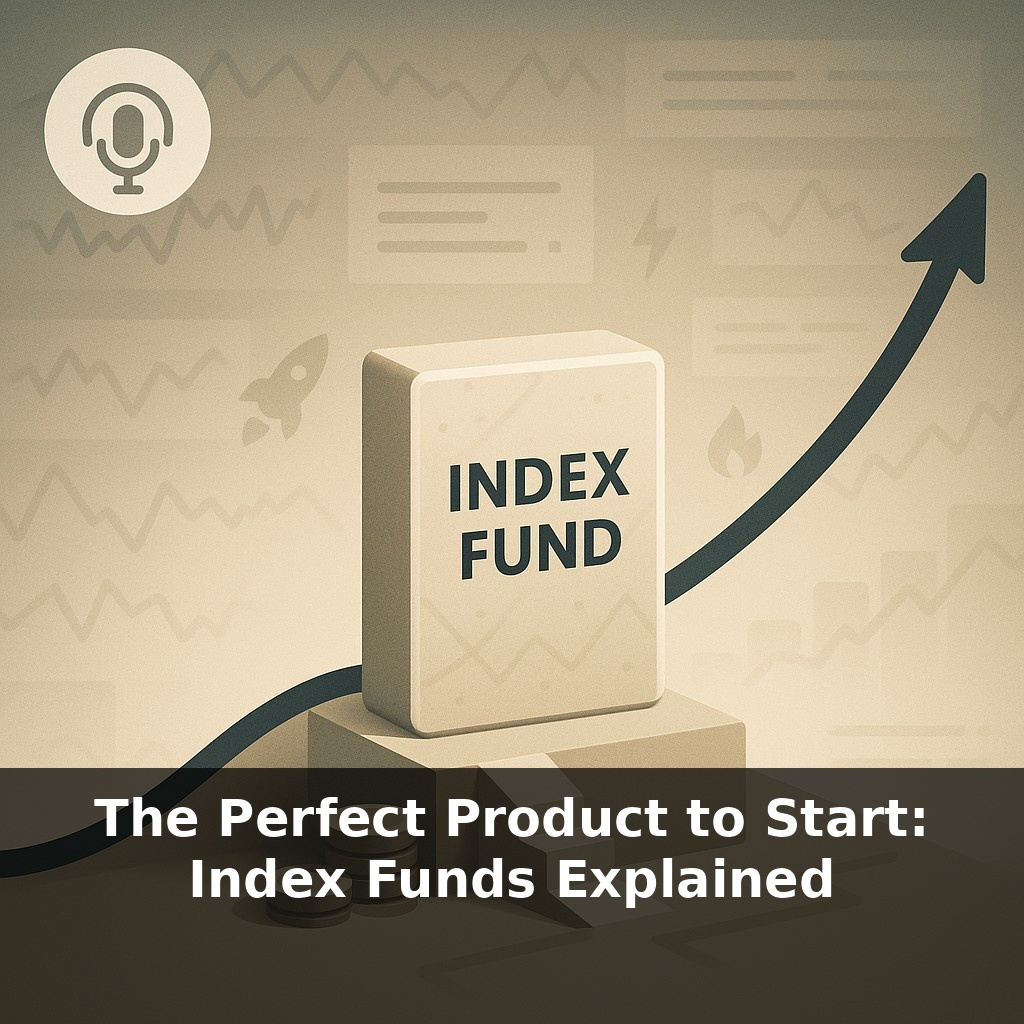
Here’s where this gets interesting for your first $1,000. Behind that calm “own the whole market” wrapper, index funds quietly solve three headaches at once: cost, effort, and error. Costs first: because they follow a formula instead of a star manager, fees often sit near zero. That tiny difference matters; shaving even 0.75% a year can mean keeping roughly 20% more of your ending wealth over 30 years. Effort next: no endless news-scrolling or chart-reading. And error: instead of guessing which sector wins—tech, energy, banks—you automatically ride whatever the economy’s next growth engine turns out to be.
When you strip away the jargon, what actually makes one index fund different from another—and how do you pick one for your first $1,000?
Start with **what slice of the market** it tracks. Three common “layers”:
1. **Total U.S. stock market funds** These aim to hold almost every publicly traded U.S. company—big, mid, and small. Think of something like Vanguard’s Total Stock Market Index Fund, which owns roughly 4,000 names. One purchase and you’re tied to the growth of the overall U.S. economy.
2. **Large‑cap U.S. funds (like S&P 500 trackers)** These focus on the 500 or so biggest, most established companies. Slightly narrower, still extremely diversified, and often the core building block in many retirement accounts.
3. **International and global funds** These reach beyond U.S. borders—either only non‑U.S. stocks or a mix of U.S. plus international. They’re a way to avoid having your future rely on a single country.
Next, look at **how much they quietly skim in fees**. Two numbers matter:
- **Expense ratio** – the annual percentage taken out to run the fund. For broad stock index funds, 0.03%–0.10% is common. At 0.04%, paying $4 a year on $10,000, the drag is tiny. - **Trading costs** – with many brokers, you’ll pay $0 commission on major index ETFs, and bid‑ask spreads under 0.01% mean you’re not losing much when you buy or sell small amounts.
Then, consider **how you access it**:
- **Index mutual fund** – easy for automatic monthly contributions; trades once per day at the closing price. - **Index ETF** – trades all day like a stock; handy if you like seeing your exact price but not necessary for long‑term success.
What about safety? Index funds **can** drop sharply when markets fall—you’re accepting that volatility upfront. The trade‑off is that you’re not betting on a single company blowing up; for a long‑term goal, that broad cushion is the point.
Finally, think in terms of **a simple core** instead of a collection of “cool” side bets. One broad U.S. index, maybe one international index, held for years, has historically beaten most complex, hyper‑active portfolios designed by people who get paid to look complicated.
Think of three friends starting with the same $1,000. Alex buys one “story” stock they saw on social media. Jamie buys five random names from a trending list. Riley drops the whole $1,000 into a broad index fund and walks away.
Fast‑forward ten years through layoffs, new tech, elections, hype cycles:
- Alex’s single pick boomed, then crashed on bad earnings. The balance is a few hundred dollars and a lingering grudge against “the market.” - Jamie’s mix is half winners, half disappointments. After panic‑selling twice, the account roughly matches what simple cash savings would’ve done—before inflation. - Riley’s index fund rode every wave: some companies died, others were born, but the overall market grew. Without guessing or flinching at each headline, the account quietly tracked that growth.
The twist: all three faced the same news, fear, and temptation. The difference wasn’t intelligence; it was choosing a setup where the default outcome favors patience instead of prediction.
As more money flows into these “set‑it‑and‑forget‑it” vehicles, the game around them is shifting. Direct indexing lets you sculpt your own mini‑market—tilting away from sectors you dislike or realizing losses for taxes—while still hugging the benchmark. Robo‑advisors quietly assemble global mixes for you, like a navigation app constantly rerouting around traffic. The open question: who steers when a few giants hold most of the voting power?
Your challenge this week: pick one broad fund you could commit to for 10 years, then read its top 10 holdings and sectors. Ask: “If this were a tiny country, would I want my future tied to it?” That’s the real decision—not today’s headline. From here, every extra layer—bonds, real estate, cash—just adjusts how bumpy you’re willing to let the ride be.