The stock market has lived through world wars, depressions, oil shocks, and tech bubbles—yet a simple U.S. stock index has still grown wealth faster than inflation over every 20‑year stretch for more than a century. So why does something this bumpy keep drifting upward at all?
Most of the time, owning broad stocks feels nothing like a sure thing. Headlines scream “trillions wiped out,” your account balance jumps around, and it can seem absurd that this chaos has historically produced steady, inflation-beating growth over long periods. Yet when we zoom out, something powerful shows up in the data: across modern history, diversified stock investors who stayed put for decades were repeatedly rewarded, despite wars, crashes, and political shocks.
To see why, look beneath the ticker symbols. You’re not buying blinking numbers; you’re buying slices of real businesses trying to earn profits in a changing world. As companies raise prices, innovate, cut costs, and expand globally, a portion of that growing economic pie funnels back to shareholders through higher earnings, dividends, and, over time, higher valuations. Markets stumble, recover, and reprice, but the underlying engine—human effort turning ideas into profits—keeps grinding forward.
Short-term, markets look driven by mood swings: fear, hype, and headlines. Long-term, something quieter does the heavy lifting: the equity risk premium. That’s the extra return shareholders demand for accepting uncertainty about when they’ll be paid back. It exists because business outcomes are messy—sales can miss, margins can shrink, recessions can hit. Yet investors still show up, like people buying storm-exposed beachfront property, only because the long-run reward has historically outweighed the risk. The key tension is that this reward arrives on its own unpredictable schedule.
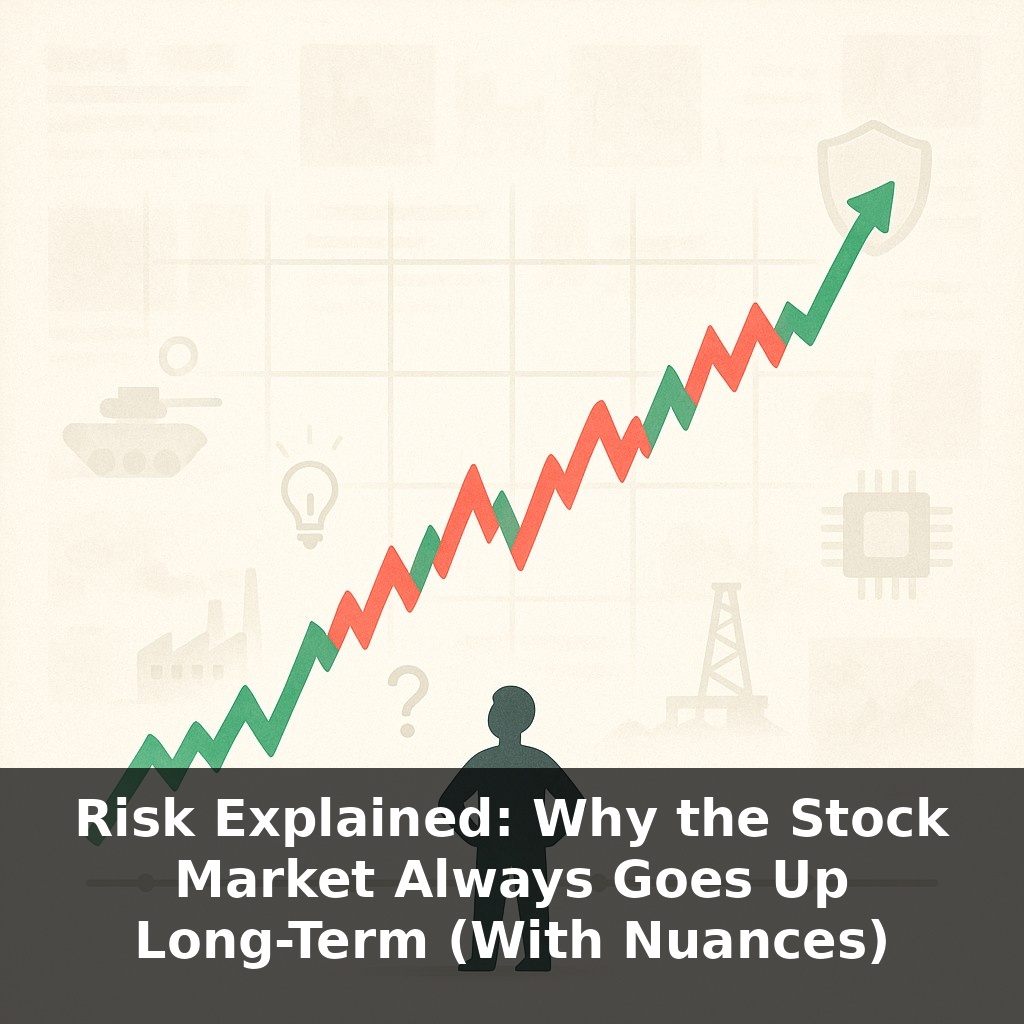
Risk is the price of admission for that long‑run reward, but it doesn’t show up as a neat, steady fee. It shows up as gut‑punch moments: years when your account is down 30 %, headlines say “end of capitalism,” and every instinct screams “get out.” Historically, roughly one out of every four calendar years in stocks has been negative. That’s not a bug in the system; that *is* the system. Those bad years are why good years have needed to pay so well.
What makes this tolerable is that you can shape *what kind* of risk you’re taking. One layer is business risk: will an individual company survive and stay profitable? Another is concentration risk: are you betting on a single country, sector, or fad? A third is time horizon risk: will you be forced to sell at a bad moment because you need the money soon? Index funds mostly help with the first two by spreading your bet across thousands of companies and many sectors. They do *nothing* about the third. If you might need the money in three years, the market doesn’t care; it can still be way down when your bill is due.
This is where time quietly becomes your biggest ally. Over months or a few years, returns are dominated by sentiment and surprises. Over decades, they’re increasingly anchored by fundamentals like productivity, population growth, and corporate profits. That’s why long holding periods have historically turned a series of scary coin flips into a more reliable upward trend.
But there’s a catch: that historical pattern isn’t a law of physics. It worked astonishingly well in the U.S., yet investors in other places learned that “stocks always win long‑term” can fail for a generation. Japan’s main index peaked in 1989 and, even decades later, spent long stretches far below that level. Country‑specific risks—demographics, policy mistakes, bubbles—can overwhelm even patient investors who were diversified *within* just one market.
So the real game isn’t asking, “Are stocks safe?” It’s asking, “Which risks am I being paid for, which am I ignoring, and how long can I leave this money alone?”
Think of two friends each investing $1,000. Sam buys a single “hot” stock. Riley buys a global index fund. Ten years later, Sam’s company might have doubled…or gone bankrupt. Riley almost certainly rode through multiple panics, but owns thousands of firms across continents. Same “stock market,” totally different odds.
Now add time. If Riley checks monthly, half the time it looks like nothing’s working; about one year in four, the account might even be lower. Stretch to 15–20 years, and history shows far fewer losing stretches for broad, global baskets. The underlying risk doesn’t vanish, but its *shape* changes: less about any one disaster, more about how the world economy evolves.
Here’s the subtle part: the premium you earn is payment for *stomach discomfort*. No crashes, no extra return. Trying to dodge every drop usually means missing a few huge rebounds—often clustered near the worst news—which can slash lifetime gains more than any single bear market.
Long-run return isn’t guaranteed, but you can tilt the odds. Think of your portfolio less like a lottery ticket, more like a small ecosystem: some species die out, others adapt, new ones appear. Global funds, periodic rebalancing, and adding fresh savings during scary headlines all help that ecosystem stay resilient. Your real edge isn’t prediction; it’s designing rules you’ll still follow when the future refuses to look like the past.
So instead of asking, “Will markets crash this year?”, a better question is, “What rules would I be proud I followed 30 years from now?” Think in seasons, not days: planting broadly, pruning occasionally, and letting time do heavy lifting. Your future self doesn’t need perfect timing—just a repeatable way to stay calmly invested when the weather turns.
Try this experiment: Open a paper-trading or tiny real-money brokerage account and buy a simple total-market index fund (like VTI or a broad S&P 500 ETF) plus one individual stock you *think* will beat the market. Every week for the next 8 weeks, log the percent return of both and compare which is ahead. Any time you feel tempted to “fix” the losing one, pause and write a one-sentence reason why, then leave both positions unchanged. At the end of 8 weeks, review which did better and how your emotions tracked the ups and downs—that’s your personal, real-time lesson in risk, volatility, and why the broad market tends to win over time.