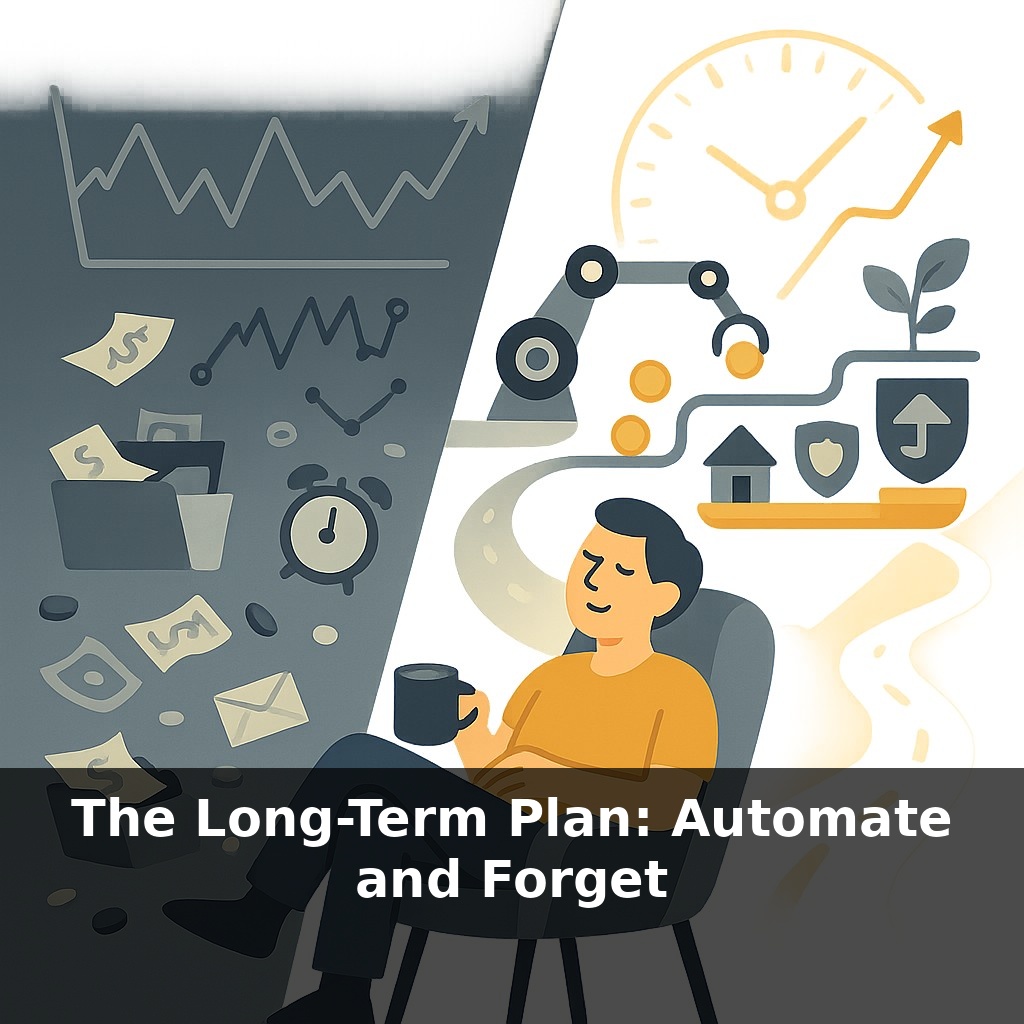
Most people will earn hundreds of thousands over their lifetime… yet never decide where most of that money actually goes. In this episode, we’ll step into two futures: one where your money runs on autopilot, and one where every decision is manual—and exhausting.
Since episode one, you’ve learned how to pick simple investments, open an account, and place your first trade. Now comes the part most people never reach: turning all of that into a system that mostly runs without you. The goal isn’t to think about investing every week; it’s to think about it *once*, set clear rules, and then let those rules quietly shape your future in the background.
This is where automated contributions, target‑date funds, index portfolios, and robo‑advisors shine. They’re designed to keep going on the days you’re tired, busy, or stressed—the exact days when most investors make their worst decisions. Instead of asking, “What should I do with my money this month?” you upgrade the question to, “What should my *system* do with my money every month?” In this episode, we’ll design that long-term plan so you can eventually invest less *attention* as your money invests more *dollars*.
Most people treat investing like a side project they’ll “get to” when life calms down—which it never does. Bills pop up, work gets busy, kids get sick, and suddenly that extra $200 never makes it from checking to your future. The real power move is shifting from good intentions to default actions: money that moves, invests, and rebalances *without* needing your energy each month. In this episode, we’ll zoom out from individual choices and design the rails your money will run on—how often it moves, where it lands, and what it does there for the next 10, 20, even 40 years.
Automation in investing really has three jobs: move money, invest it sensibly, and keep your plan on track as life and markets change. You’ve already seen how to get money into the market; now we’re zooming in on *which* parts are worth automating and what still needs your brain.
First, the “move money” piece. The behavioral research is brutal: when people must choose to save every month, they often don’t. Auto‑enrollment in retirement plans jumps participation from around 60% to as high as 80–90%. That one design choice—“you’re in unless you say no”—creates more investors than any motivational speech. For your own plan, the equivalent is a recurring transfer from your paycheck or checking account into your investment account on a fixed schedule, ideally right after payday. No feelings. No debate.
Next, the “invest sensibly” job. Rules beat moods. A simple rule like “every month, buy this low‑cost S&P 500 index fund” quietly captures a slice of that ~10% long‑term annual return history instead of trying to outguess it. Dollar‑cost averaging means your rule naturally buys more shares when prices are down and fewer when they’re high—without you having to declare, “Now is a buying opportunity,” which almost no one does confidently in real time.
Third, “keep your plan on track.” Markets don’t care about your target mix; they wander. Left alone, a 70/30 stock‑bond split could drift to 85/15 after a long boom, leaving you riskier than you ever meant to be. That’s where disciplined rebalancing matters. Morningstar finds that portfolios with automated rebalancing often beat ad‑hoc DIY ones by 1–2 percentage points a year, mostly because they stay diversified and avoid sitting in cash. Target‑date funds and many robo‑advisors do this quietly: they sell a bit of what’s grown too much and buy what’s lagged, nudging you back toward your plan instead of letting performance tempt you into chasing winners.
Costs are the other silent lever. The SEC’s math shows a 1% higher expense ratio can erase nearly a quarter of your gains over 30 years. Automation amplifies whatever fee structure you choose, good or bad. A “set it and forget it” portfolio with bloated fees is like pouring water into a bucket with a tiny hole: time works *against* you. Choose low‑cost options once, and every future automated dollar benefits.
The last layer is review. “Automate and forget” doesn’t mean ignore forever; it means let the system run until *you* change, not until the headlines do. Marriage, kids, a big raise, an inheritance—those are moments to adjust how much flows through your system or how much risk you take. The plan handles ordinary market noise; you handle the rare life upgrades.
Think of this as designing “rules of engagement” for your future self. For example, you might decide: “Any raise I get? Half goes to lifestyle, half gets added to my recurring investment.” That one rule quietly turns every promotion into an automatic wealth boost, without a fresh debate each year. Or set a threshold: “If my cash balance creeps above two months of expenses, the extra sweeps into my brokerage monthly.” Now laziness works *for* you instead of against you.
You can also layer rules around risk. Maybe you tell yourself: “Once my portfolio hits $50,000, I’ll introduce a small bond fund; at $100,000, I’ll cap any single holding at 5%.” You’re not reacting to headlines; you’re following a script you wrote when you were calm.
Even tax time can feed the machine: pledge in advance that a set slice of any refund gets invested within 48 hours. No “I’ll think about it.” Just execution. Over years, these tiny, pre‑decided moves compound into a structure where your habits—not your willpower—do the heavy lifting.
Automation won’t stay this simple. As open‑banking spreads, your future “set and forget” plan might scan your spending in real time and quietly adjust risk the way noise‑canceling headphones adapt to a loud subway. Regulators are also testing default options that tilt new contributions toward sustainable projects, turning passive savers into accidental impact investors. The trade‑off: if everyone rides similar algorithms, downturns could feel more synchronized, like crowds moving across a swaying bridge.
Your challenge this week: test-drive “forgetting.” Set one tiny rule that triggers without you—say, diverting a sliver of unexpected income. Then, *don’t touch it* for 30 days. Notice how quickly the “normal” path fades, like a side street you stop taking. The experiment isn’t about amounts; it’s about proving that systems quietly reshape the map.