Your broker choice can quietly cost more than your investment fees. One listener paid “zero commissions” yet lost hundreds a year to low cash interest and pricey margin. Another, with the same portfolio, kept that money. Same index fund, different broker, totally different outcome.
Twelve dollars and fifty cents versus six eighty-three. That’s the kind of gap some brokers charge on the same $10,000 margin balance. And that’s just one line item. In the background, your “free” account might be earning under 1% on idle cash while Treasury bills throw off something close to 5%. Add in hidden frictions—FX spreads, transfer-out fees, limited products—and two investors with identical portfolios can quietly end up on very different paths.
Up to now, we’ve focused on *what* to own with your first $1,000. This episode is about *where* you park it. Think of brokers as the infrastructure behind your plan: the pipes, roads, and rails that either help your money flow efficiently or bleed it through leaks and tolls. We’ll break down costs, product access, platform experience, and safety so you can match a real broker—by name—to how you actually plan to invest.
Here’s the twist: most people pick a broker the way they pick a phone case—whatever’s popular, cheap, and looks fine at first glance. But once you start actually using it, the details matter. With investing, those details live in four places: how you’re charged, what you can buy, how it feels to use day-to-day, and what happens if something goes wrong. In this episode, we’ll zoom out from “free trades” and dig into how different brokers treat long‑term index investors, frequent traders, and global explorers so you can align your choice with how *you* plan to grow that first $1,000.
Think of this step as matching your actual behavior to the right “home” for your money. Start by being brutally honest about how you’ll invest over the next few years, not how you *wish* you’d behave.
If you’re a “set‑it‑and‑forget‑it” index investor, your priority list should look different from someone who plans to trade options or dabble in international stocks. For the long‑term, low‑maintenance crowd, ongoing frictions matter most: how your cash is treated by default, what you earn on it, and whether there are surprise charges when you move money in or out. You don’t need ten order types or advanced charts; you need a low‑noise, low‑leak environment where your plan from earlier episodes can run quietly in the background.
Active traders flip that around. They might rationally tolerate weaker cash treatment or fewer fund choices if they get ultra‑fast execution, granular order control, detailed analytics, and lower effective costs on frequent trades. Here, the difference between transparent routing and opaque “free” trading becomes more important, because tiny per‑trade frictions get multiplied by activity.
Then there’s the “global explorer” profile: the person who wants access to foreign exchanges, multiple currencies, bonds, or niche ETFs. They may accept a steeper learning curve or clunkier interface in exchange for broader reach and more precise tools.
Over everything sits safety and regulation. This isn’t about chasing the broker with the loudest “protection” marketing. It’s checking whether the firm is well‑capitalized, how it’s regulated, how client assets are segregated, and what disclosures exist about how it handles your orders and cash. Two platforms can both tout the same protection limits yet operate very differently behind the scenes.
So your real task is trade‑off design: decide which of the four pillars you’re willing to compromise on, and which are non‑negotiable for how *you* will actually use your account in year one, not in some idealized future.
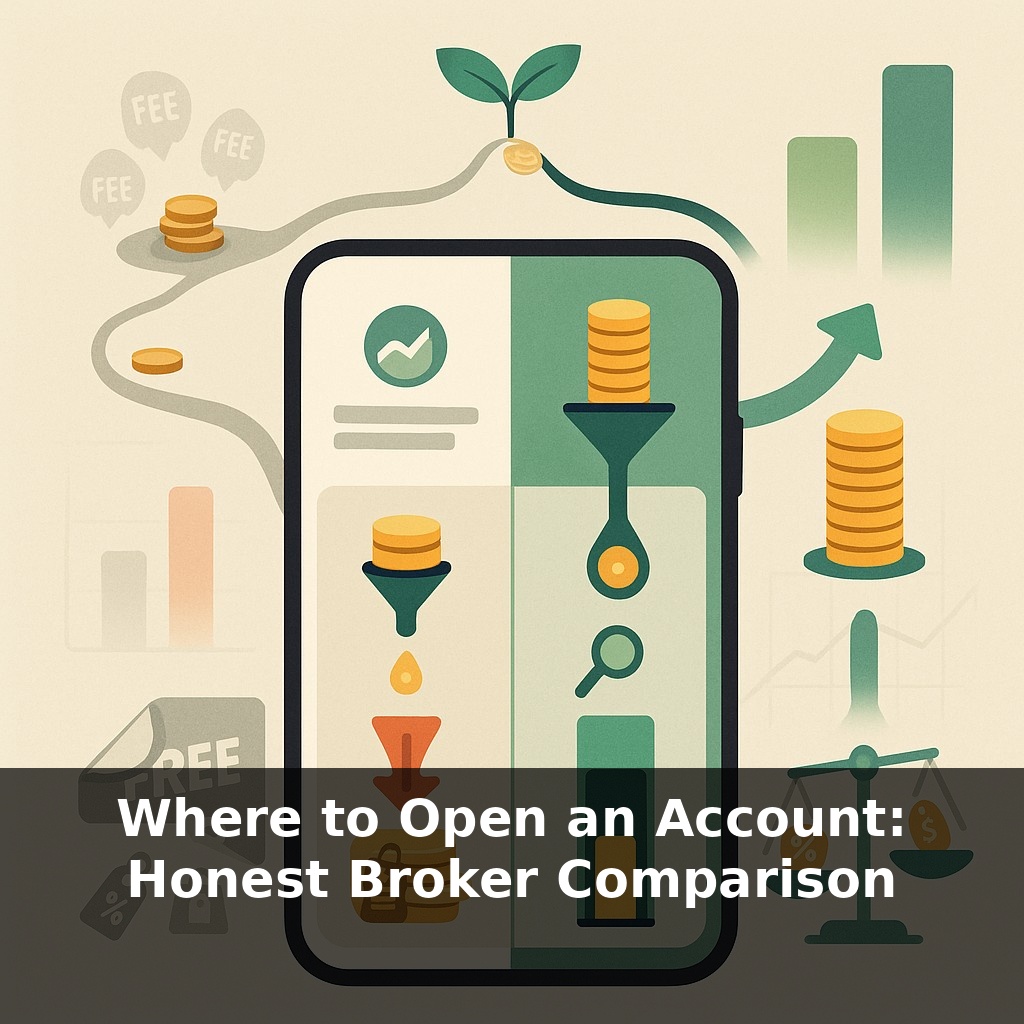
Your first clue often hides in tiny details. One broker shows a bright “$0 commission” badge; another quietly lists a higher yield on cash, a lower margin rate, and no transfer fee. Over a decade, that second one may leave you thousands ahead—even though both *look* cheap on day one.
Think about three real‑world profiles. A nurse who auto‑invests $200 every paycheck mainly needs simple automation, low ongoing friction, and decent yield on small balances. A software engineer who loves options needs robust tools, clear routing info, and fast, responsive support when trades misfire. A grad student studying abroad might care more about access to overseas markets and fair FX conversion than the slickest app.
The only way to see these differences is to read past the marketing page. Fee schedules, cash sweep terms, and product lists are dry, but they reveal how each firm truly makes money from you. Inconsistent or vague disclosures are a red flag; transparent, itemized breakdowns signal a broker that expects scrutiny.
Broker choice today might be a single decision, but it won’t stay that way. As open‑banking tools mature, juggling two or three focused accounts could feel as normal as using multiple cards in your wallet: one for travel perks, one for cashback, one for groceries. That shift nudges you from “Which broker is best?” to “Which job does each account do best?” and rewards investors who treat platforms as modular tools they can swap, stack, and optimize over time.
Treat this like scouting trails before a long hike: you’re checking distance, terrain, and weather, not just the view from the brochure. Brokers will keep evolving—rates shift, features appear, policies tighten. Staying curious enough to revisit your setup every year or two turns a one‑time choice into an ongoing edge you quietly compound over decades.
To go deeper, here are 3 next steps: 1) Open a free account at two contrasting brokers (e.g., Fidelity and Robinhood or Charles Schwab and Webull) and actually walk through their ETF purchase screens using a low-stakes test amount (like $50–$100) to feel the difference in fees, interface, and order types. 2) Use NerdWallet’s “Best Online Brokers” and Morningstar’s broker comparison tools side-by-side to compare your short list on specific criteria you care about (commissions, fractional shares, automatic investing, customer service hours), then screenshot or save the comparison pages so you’re not starting from scratch later. 3) Read the broker sections in The Bogleheads’ Guide to Investing or The Little Book of Common Sense Investing, and then log into your chosen broker and set up one concrete automation that matches that philosophy—like a recurring monthly purchase of a total market index fund (e.g., VTI, VOO, or ITOT).