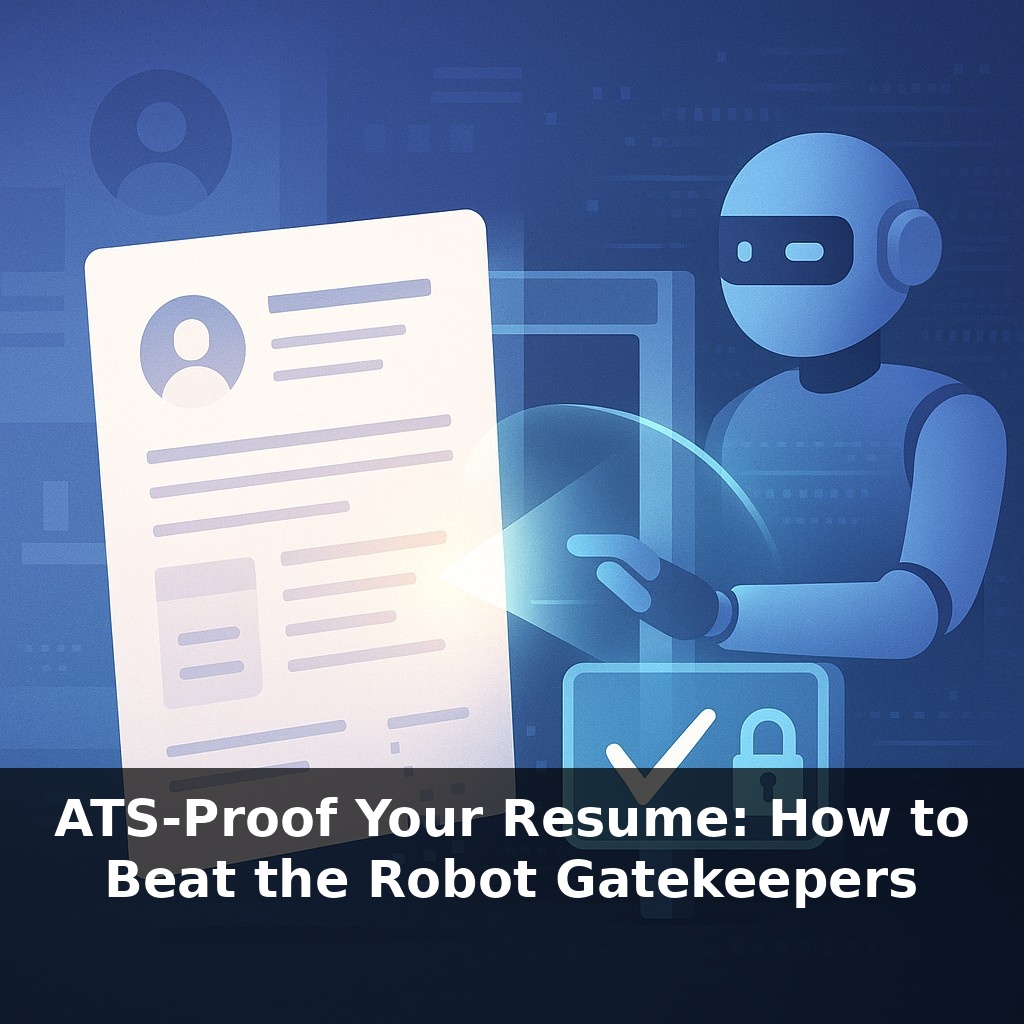
About half of qualified resumes never reach a human—not because the candidates are weak, but because a robot can’t read their document. You think you’re applying to a real person; in reality, your resume is fighting software that rejects you in under ten seconds.
Roughly 99% of Fortune 500 companies now use some form of applicant-tracking software, and it doesn’t care how impressive your resume *looks*—only how it *parses*. Before a recruiter spends their 7.4 seconds on you, their system has already scored, sorted, or silently discarded your application. That’s why two equally strong candidates can get wildly different results: one resume is formatted for humans *and* machines, the other only for humans. In this episode, you’ll learn how to engineer your resume so ATS software can accurately read, categorize, and match it to the role you want. We’ll cover the specific file types that fail most often, the section titles and layouts that boost your match rate, and how to turn a vague job posting into a precise keyword roadmap—without turning your resume into a messy keyword dump.
Many candidates assume that passing the software filter is about stuffing in as many buzzwords as possible—but modern systems are closer to search engines than simple keyword counters. They weigh *where* and *how* terms appear: “Python” buried once in a long paragraph is weaker than “Python” in your title, skills list, and a quantified bullet. Some tools even compare your resume structure and density to top applicants. In this episode, we’ll translate that into tactics: how to place key terms, write impact bullets, and structure your career story so you score highly without sounding robotic.
Here’s the reality check: most “beautiful” resumes lose points the moment they’re uploaded. To make sure yours doesn’t, you need to engineer *inputs* the system can actually consume and *signals* it can easily rank.
Start with structure. Use a single column, flush-left layout. Limit yourself to 3–5 clear sections, for example:
- Summary - Skills - Experience - Education - Certifications (if relevant)
Each section should start with a standard heading word-for-word like this; avoid clever labels such as “My Journey” or “What I Bring.” Those can cut your chances of correct parsing by 20–30% in some systems because the software can’t reliably map them to its fields.
Next, treat your job titles and company lines as prime real estate. A line like:
Senior Data Analyst | Acme Corp | 2019–Present | New York, NY
is far easier for the system to interpret than a stacked, stylized version. Include month and year (e.g., 03/2019 – 11/2024) so your tenure doesn’t get misread—missing dates can reduce your completeness score and push you below the auto-shortlist threshold.
Now layer in keywords with intent. Take the 10–15 highest-priority terms you’ve identified and distribute them where they matter most:
- 3–5 in your Summary - 10–15 in your Skills section - 1–3 per relevant job in your Experience bullets
But every keyword should be attached to evidence. Instead of “Project management, Agile, Jira,” write: “Led 8 concurrent Agile sprints using Jira, delivering a 23% reduction in cycle time and 98% on-time release rate.” That gives the system multiple signals at once: tools, methodology, scale, and measurable outcomes.
Be consistent with how you name things. If a posting says “salesforce” 4 times and “CRM” once, use “Salesforce CRM” in your Skills and in at least one bullet. Tiny alignment moves like that can bump your score above an automated cutoff—sometimes the difference between a 62% and 78% match.
Finally, strip out anything that acts like a wall: tables, text boxes, graphics, columns, logos, icons. Even if they render nicely on-screen, they can slice your content into fragments the parser ranks as incomplete. Your design goal isn’t “pretty”; it’s “frictionless text flow from top-left to bottom-right.”
Think of your resume like a stock prospectus: serious investors only fund what’s clearly documented, quantified, and easy to compare. Hiring teams do the same. Once you’ve got a clean, ATS-readable layout, the next edge comes from how *strongly* you broadcast your value inside that structure.
One powerful tactic: mirror the *shape* of the job, not just its words. If a posting leans 60% on execution (e.g., “implement,” “ship,” “deliver”) and 40% on strategy (e.g., “define roadmap,” “advise leadership”), aim for a similar ratio in your bullets. For a product role at HubSpot, that might mean 6–8 bullets on launches, experiments, and feature ownership, and 3–4 on roadmap influence and stakeholder alignment.
Add scale wherever possible. Replace “Managed campaigns” with “Managed 14 concurrent campaigns across 3 regions, influencing $2.3M ARR.” A resume with 8–10 such quantified bullets often outperforms one with 20 vague ones, both in automated ranking and in those 7.4 seconds of human review.
As resume filters shift toward skill-based matching, generic applications will lose more ground. Expect postings where 70–80% of the “must-haves” are explicit skills or tools, and titles matter less. That favors people who break big achievements into 5–7 discrete, named capabilities—“SQL optimization,” “Figma prototyping,” “pipeline automation”—each backed by 1–2 impact metrics. A profile with 25–40 such tagged skills can surface for roles you’ve never held in title but can actually do.
Treat each application like a tailored campaign: refine one master resume into 3–5 targeted versions aligned to your top role types. Track the numbers—submissions, interviews, offers—in a simple sheet. If a version underperforms after 15–20 sends, adjust keywords, reorder sections, and tighten weak bullets until response rates climb.
Before next week, ask yourself: 1) “If I paste my current resume and a target job description into an online ATS checker today, which 5–7 core skills and keywords from the posting are clearly missing or buried in my resume?” 2) “Looking at one real job I’d love to apply for, how could I rewrite my bullet points so they mirror the job’s language (tools, metrics, and responsibilities) while still being 100% honest about what I’ve done?” 3) “If a recruiter only saw my file name, top 3 bullet points, and ‘Skills’ section in an ATS preview, would they instantly know my target role, my biggest results (with numbers), and the exact tools/technologies I use—and if not, what will I change today to fix that?”