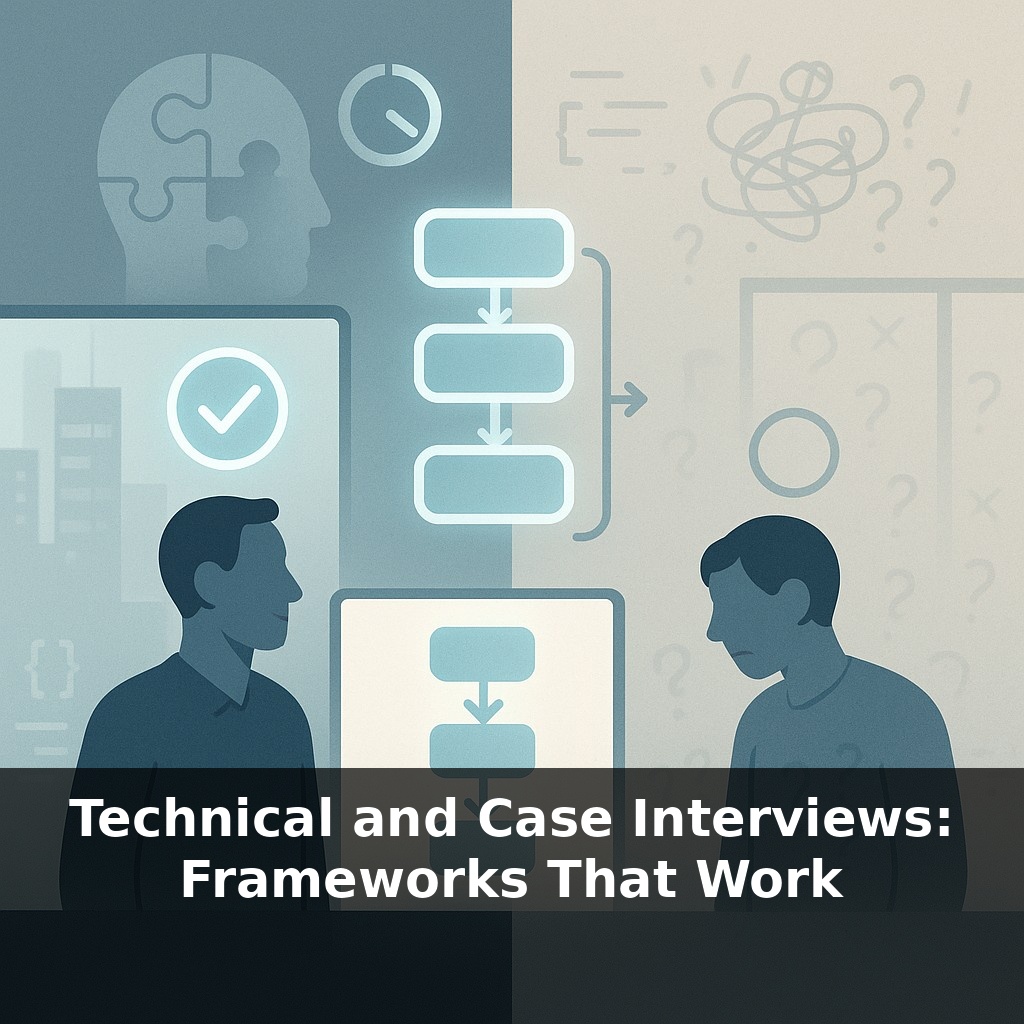
A McKinsey recruiter once said, “We don’t hire the smartest people. We hire the best problem solvers.” You and another candidate get the same coding question. Same skills, same time. One of you reaches for a clear, practiced framework. The other free-styles. Only one gets the offer.
McKinsey screens over 200,000 applicants a year and hires fewer than 1%. Amazon runs Bar Raiser loops with calibrated rubrics. FAANG technical screens are timed to the minute: ~5 minutes clarify, 10 plan, 20 code, 5 test, 5 Q&A. Across all of these, one pattern keeps showing up in the data: candidates who use *explicit* frameworks—out loud—win.
This episode is where we zoom out from individual questions and zoom in on the *systems* behind great answers. In technical rounds, that means how you structure clarifying questions, choose and defend an approach, and narrate trade‑offs. In case interviews, it’s how you build a clean, MECE issue tree, push a testable hypothesis, and crunch numbers without getting lost.
Think of today as upgrading from “answering questions” to “running a repeatable playbook” under pressure.
In earlier episodes, we focused on individual moves: polishing stories, anticipating questions, tightening how you talk about your impact. Now we’re stitching those moves into something you can rely on when the stakes spike: a visible, step‑by‑step way of thinking that interviewers can actually *follow*. Top firms don’t just want the right answer; they want to see *how* you get there, so they can predict how you’ll handle messy, ambiguous work later. The twist: most candidates treat each question as a one‑off. Today is about reusing the same mental scaffolding, whether you’re debugging code, sizing a market, or navigating a tricky “tell me about a time” prompt.
Let’s make this concrete by splitting into two arenas: technical interviews and case-style interviews. The hidden pattern is that both are really testing the same thing: can you *impose structure on chaos* in real time.
### 1. Technical interviews: the visible thinking loop
Strong candidates don’t just “do the problem”; they *run a loop* the interviewer can track:
1. **Restate + nail constraints** You already know to clarify. Here’s the next level: label constraints explicitly as you go—“performance constraints,” “correctness constraints,” “edge-case constraints.” You’re signaling that you see multiple dimensions of quality, not just “pass the tests.”
2. **Name the family of approaches** Before you pick one, briefly map the space: “We could brute-force, use a greedy approach, or apply dynamic programming.” Saying the *categories* lets the interviewer see your mental library, not just the final choice.
3. **Time-box exploration** Use tiny, spoken timers: “Let me spend 60 seconds checking if a greedy invariant exists. If not, I’ll consider DP.” This shows you can manage limited time and avoid rabbit holes.
4. **Code with checkpoints, not monologue** Every few minutes, pause: “Quick check: we still optimizing for readability over micro-performance, right?” That keeps alignment and subtly reminds them you’re tracking trade-offs, which we know correlates with higher rubric scores at places like Amazon.
5. **Post-code autopsy** Instead of “done,” try: “If we had 10x more data, I’d revisit data structures X and Y. If we had 10x less time to build, I’d ship the simpler variant.” You’re already thinking like someone who will own this in production.
### 2. Case / product / strategy interviews: thinking in trees
Many non-consulting companies now sneak in case-like prompts: “How would you grow usage in market X?” or “Should we launch feature Y?” Treat them with the same disciplined structure:
1. **Scope like a product manager** “To keep this focused, I’ll look at consumer users in North America over the next 12 months. If that sounds right, I’ll build a structure around acquisition, activation, and retention.” You reduce ambiguity *before* building your tree.
2. **Turn your tree into a to-do list** Once you lay out the branches, immediately prioritize: “Of these four drivers, I’d start with A and B because they’re both high impact and, based on your context, most uncertain.” That “impact vs. uncertainty” lens sounds simple, but it reads as senior.
3. **Quantify early, not just at the end** Don’t wait for a big final calculation. Sprinkle quick numbers: “If churn drops by just 2 percentage points, with 1M users, that’s ~20k users retained per month. At $Z per user, that’s roughly $__.” Frequent, rough math proves you can tether ideas to reality.
4. **Synthesize *while* moving, not just at the close** After each mini-analysis: “So far, the data suggests most upside is in activation, not acquisition. Unless new information contradicts this, I’d focus experiments there.” You’re updating your hypothesis in public, which mirrors how decisions happen on the job.
Think of two candidates walking into the same on‑site loop. Both know their data structures and market frameworks cold. One treats each question as brand‑new terrain. The other quietly runs the *same* mental checklist again and again, shifting only the content. In practice, that second candidate often feels “lucky,” when they’re really just predictable.
For a technical round, that might look like noticing patterns across questions: graph problems where you always start by sketching a tiny example, or string questions where you instinctively ask about character sets and memory limits. Over time, you’re not just solving; you’re tagging problems into “families” you’ve seen before.
In a case or product scenario, your issue trees start to echo across industries. A pricing question for a SaaS tool, a nonprofit membership drive, and a consumer subscription box each become variations on volume, conversion, and retention levers. The content shifts, but your spine stays familiar. That repeatability under stress is what hiring panels remember hours later, when they’re deciding who to fight for.
Frameworks won’t stay “optional polish” for long. As assessment tools crawl interviews frame by frame, they’ll start flagging how often you loop back to goals, label risks, or shift gears when new data appears. Think of it less as gaming robots and more as leaving a clean audit trail of your thinking. The twist: once that trail is measurable, managers may expect the *same* structured habits in your one‑on‑ones, status mails, even Slack threads.
Treat these habits as a portable toolkit you can unpack in any room: whiteboard, Zoom, board meeting. As you practice, notice how the same structure sharpens emails, project updates, even tough conversations. Like compounding interest in a savings account, small, consistent deposits of structured thinking quietly grow into real career leverage.
Before next week, ask yourself: 1) “If I had a technical interview tomorrow, which 3–5 core data structures or algorithms (e.g., arrays vs. hash maps, BFS vs. DFS, time/space tradeoffs) would I confidently explain out loud, and which ones still feel fuzzy enough that I’d stumble under pressure?” 2) “When I walk through a case or system design prompt, do I have a repeatable framework (e.g., clarify → restate → high-level approach → dive into tradeoffs) that I actually say out loud, and how could I tweak that script so it feels natural in my own words?” 3) “If I recorded myself solving one LeetCode-style problem and one product/case question today, where exactly do I start rambling, skipping edge cases, or failing to quantify impact—and what’s one concrete change I’ll test in my *next* practice run to fix that specific habit?”