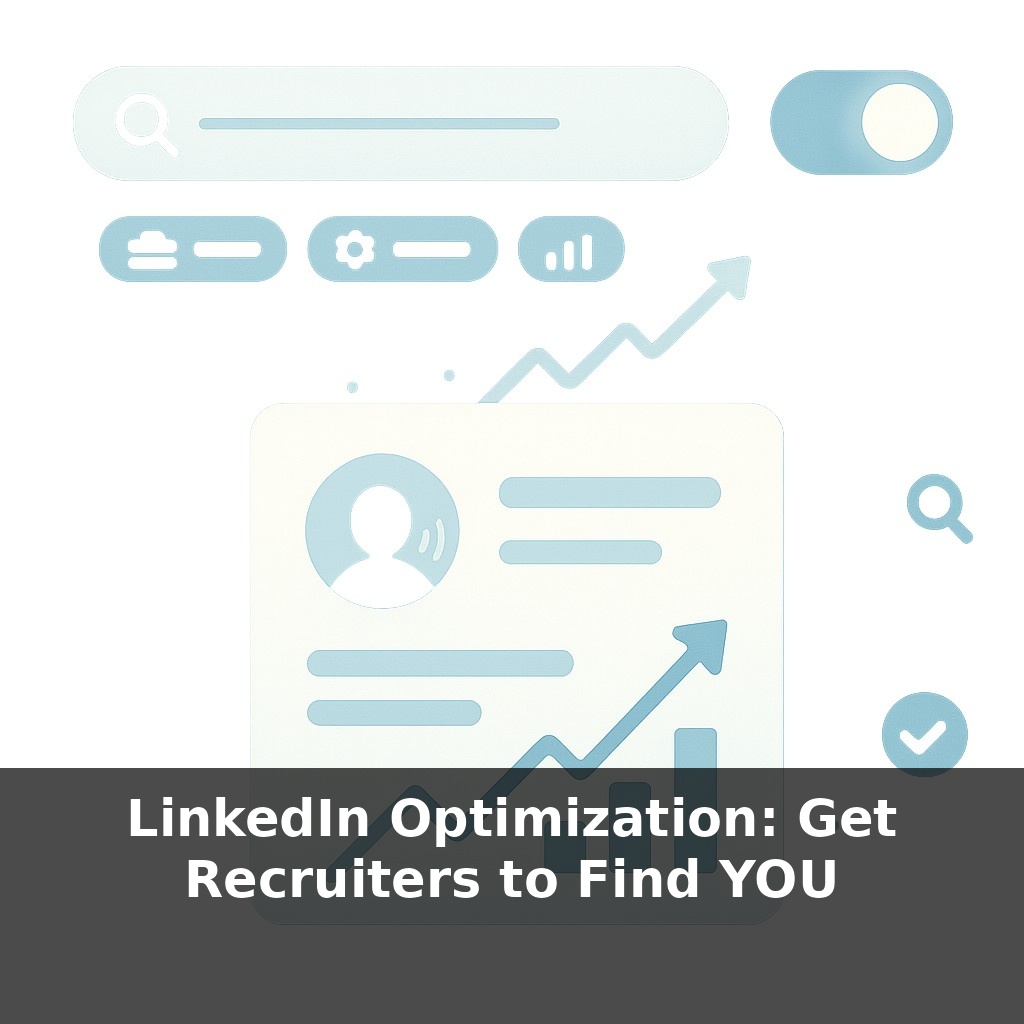
About half of LinkedIn users quietly hunt for jobs—yet many of the roles they land start with a recruiter searching *for them*, not the other way around. In this episode, we’ll explore why some profiles pop to the top of those searches while others stay invisible.
About 50 million people search for jobs on LinkedIn every week—but the people who get the *most* attention often aren’t the ones applying the most. They’re the ones who’ve quietly turned their profile into a magnet.
In the last episodes, we focused on getting past gatekeepers and into the right pipelines. Now we’re flipping the script: instead of you chasing roles, we’ll focus on making the right roles start coming to you.
Here’s the twist: LinkedIn doesn’t just look at what you *say* you do—it weighs how recently you’ve shown signs of doing it, and how clearly your profile lines up with what recruiters type into their searches. That means tiny tweaks in your headline, skills, and activity can move you from page 7 of results to page 1.
In this episode, we’ll break down how to tune those signals so your profile quietly works for you in the background, 24/7.
Most people treat LinkedIn like a static online resume; LinkedIn treats *you* like a constantly updating data point. Behind the scenes, every click, comment, and keyword you add becomes part of a profile “score” that determines where you land in recruiter searches. This isn’t just about stuffing buzzwords—it’s about matching the language, seniority, and focus areas companies are actively hiring for right now. Think of it less as “showing everything you’ve ever done” and more as “curating a portfolio” that clearly signals the next role you want, not just the last one you had.
Think of LinkedIn’s search like a very picky matchmaker: it doesn’t care how “impressive” you are in general—it cares how precisely you match the words and filters a recruiter just typed in *today*. That’s why two people with similar backgrounds can get wildly different levels of inbound interest.
The backbone of this is keywords, but not in the vague “add more buzzwords” way you’ve probably heard. LinkedIn weighs *where* a keyword appears and *how consistently* it shows up across your profile. A role title in your Experience section, repeated (naturally) in your About, then reinforced in your Skills and in the text of a recent post, sends a much stronger signal than a one-off mention buried in a paragraph.
Here’s where most people lose traction: they describe what they did using internal company language instead of market language. A title like “Customer Champion” might sound fun, but recruiters are searching for “Customer Success Manager” or “Account Manager.” If your profile doesn’t echo the phrasing in live job posts, you’re leaving relevance points on the table.
The same applies to skills. LinkedIn’s data shows a sharp jump in search appearances once you pass a modest threshold of well-chosen skills. The trick isn’t quantity for its own sake; it’s coverage. You want a cluster of skills that triangulate the role you want: core craft (e.g., “Python,” “Financial Modeling”), must-have tools (“Salesforce,” “Figma”), and contextual strengths (“Stakeholder Management,” “Cross-functional Collaboration”).
Recency then acts like a time-weighting factor. When you publish, comment, or get endorsed for a skill, you’re essentially telling LinkedIn, “This isn’t just in my past; it’s live.” A dormant profile with great history can lose to a slightly less experienced profile that’s clearly active in the right topics.
Finally, your network quietly shapes what you’re “allowed” to be discovered for. More 1st- and 2nd-degree connections in your target function and industry create additional pathways for you to surface in filtered searches—especially when those people share overlapping skills and titles.
Think of your LinkedIn presence as a garden you’re actively cultivating, not a lawn you mowed once and forgot. Instead of obsessing over one “perfect” profile update, zoom out and look at how each section supports a single, specific role target—almost like arranging complementary plants so the whole bed looks intentional.
For example, if you’re aiming for “Product Marketing Manager,” your Featured section can highlight one launch breakdown, one customer story, and one metrics win—three different angles on the same story. Your activity can echo that focus: comment thoughtfully on posts about positioning, go-to-market, and user research instead of chiming in on every trending topic.
Small structural choices matter too. Use short, skimmable bullets in Experience so a recruiter can grasp your scope in five seconds. In About, write in the first person with a clear “I’m best at…” line that anchors your niche. And don’t forget your banner image and Featured links; they’re prime visual real estate to reinforce your domain—case studies, portfolios, talks, or press.
The same forces quietly shaping how you show up today will only intensify. As AI starts proposing phrasing, skills, even auto-drafting sections, the gap will widen between people who click “accept” on every suggestion and those who treat it like a draft to be edited. Think of it like using an index fund vs. hand-picking a few conviction stocks: the baseline matters, but your human judgment on where to double down will separate you from a million near-identical profiles.
Your LinkedIn presence will always be a work in progress—and that’s a good thing. Instead of waiting for “ready,” treat it like adjusting a sailboat mid-journey: small course corrections based on where you want to land next. As your interests shift, let your projects, Featured section, and interactions drift toward that new shoreline and see who starts reaching out.
Before next week, ask yourself: “If a recruiter skimmed only my LinkedIn headline and About section for 10 seconds, would they instantly know my target role, core skills, and industry—and what exact words would they repeat back to me?” “Looking at 3–5 job descriptions I’d love to be contacted for, which exact keywords (tools, job titles, skills, industries) are missing from my headline, About, and Experience sections right now?” “If a recruiter landed on my profile today, which 3 recent projects, wins, or metrics could I add to my Featured and Experience sections to immediately prove I can do the roles I say I want?”