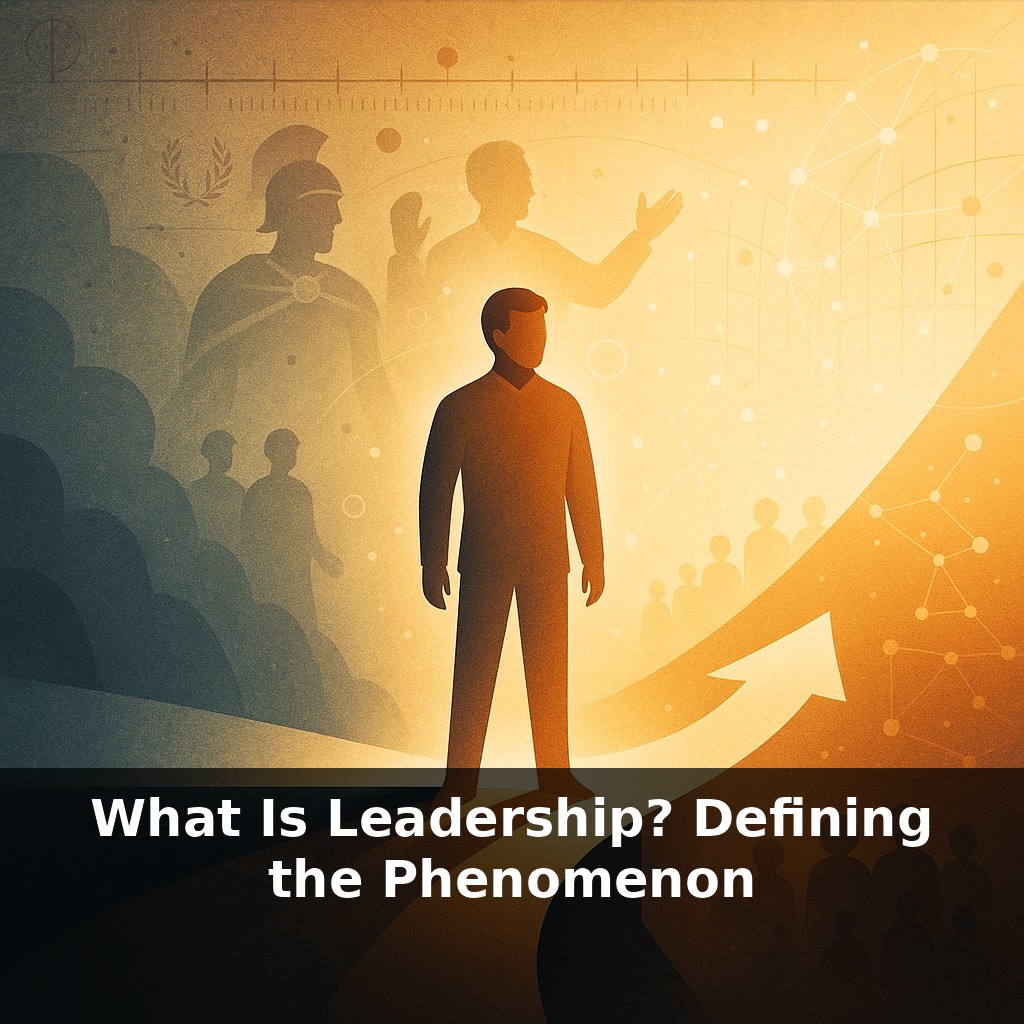
What Is Leadership? Defining the Phenomenon
📝 Transcript
Leadership isn't just a management buzzword—it's a critical factor that shapes the fortunes of a team. A Gallup study found that highly engaged teams, those carved out by effective leaders, can earn markedly more profit than others. So what is this elusive concept that turns potential into performance?
So if titles, perks, and org charts aren’t the whole story, where does leadership actually begin? Often, it starts in the smallest possible space: the gap between “what is” and “what could be” that only a few people are willing to name out loud. Think about the colleague who speaks up in a messy project and says, “Here’s what we’re really trying to do”—and suddenly the room exhales. No promotion. No memo. But the energy shifts.
Researchers call this a socially constructed process: people collectively agree, often unconsciously, to let someone’s voice carry more weight. That agreement can be revoked just as quickly. One misaligned decision, one signal that “we” actually means “me,” and the spell breaks. In fast-moving, networked teams, this rise-and-fall can happen in days, not decades. That’s why modern leadership is less about a crown you wear and more about a credit score you earn—transaction by transaction, in real time.
To see this “credit score” idea in action, watch how we respond to two different people in a meeting. One person pushes a flashy idea that doesn’t match the team’s real constraints; another quietly asks sharp questions, links the discussion to core priorities, and offers a next step. Over time, we lean toward the second voice—not because of rank, but because they repeatedly help the group make sense of chaos and move forward. Leadership capital accumulates in those moments: who clarifies the fog, who protects shared values, who makes hard things feel doable for everyone else.
If that “credit score” rises and falls in real time, what exactly are people *rating* when they decide to follow someone’s lead? Researchers tend to cluster it into three big buckets: how you think, how you relate, and how you enable.
First, how you think: sensemaking and direction. Effective leaders take messy, partial information and turn it into a coherent “here’s where we are, here’s where we’re going.” They connect dots across functions, time horizons, and stakeholders. This is where values quietly enter the room: what you choose to prioritize signals what “good” looks like. Over time, people don’t just borrow your plan; they borrow your way of deciding.
Second, how you relate: trust and psychological safety. Authority can force silence; it cannot force honesty. Leadership shows up in the micro-moments that tell people whether it’s safe to speak truth, admit risk, or share bad news early. Consistency matters more than drama here. Satya Nadella’s signature move at Microsoft wasn’t a single speech—it was years of asking questions like “What did we learn?” instead of “Who’s to blame?” That pattern teaches people how to show up.
Third, how you enable: turning intent into collective action. This is the operational side of leadership that often gets ignored in inspirational quotes. It includes clearing obstacles, aligning incentives, pairing the right people, and making sure decisions stick. Tim Cook is a striking example: less showy than Steve Jobs, but exceptional at orchestrating complex supply chains and execution rhythms that allow creativity to scale.
Notice what’s missing from these buckets: a requirement to be the smartest person in the room, the official boss, or the loudest voice. You can practice all three dimensions from almost any seat—project lead, senior IC, volunteer organizer.
A leader is a bit like a cloud computing platform: they don’t do all the “processing” themselves; they provide shared infrastructure—clarity, trust, and coordination—that lets everyone else run their best “applications” on top. When that infrastructure is strong, individual talent compounds instead of colliding.
Think about your last group project where things *actually* worked. Chances are, someone quietly did more than their job description. Maybe a designer noticed engineers were stuck and sketched three simpler options, unblocking the sprint without asking for credit. Or a junior analyst, seeing tension between sales and finance, translated the numbers into a one-page view both sides could act on. No promotion. Just a choice to tilt the system toward progress.
You see the same pattern in history. During the Apollo program, NASA didn’t just have heroic astronauts; it had mid-level leaders who coordinated thousands of specialists, turning rivalries into collaboration under absurd time pressure. Or look at community organizers who rally volunteers around a local crisis—they map who knows whom, who has which resources, and who needs what by tomorrow morning.
In each case, the “leader” is often the person redesigning the flow of information, energy, and opportunity so that other people can do their best work.
Leadership’s next frontier may feel less like steering a ship and more like running a live beta test. As AI handles routine oversight, your value shifts to asking better questions, not having all the answers. You’ll be expected to toggle between local and global impact—like a zoom lens flicking from team dynamics to supply‑chain emissions. The leaders who thrive will treat every project as a prototype for fairer, smarter systems, not just faster results.
Leadership, then, isn't a fixed endpoint but an evolving craft. Each choice is like a line of code, shaping the system of your team. This week, focus on team communication: identify a recurring misunderstanding and propose a change in your meeting format or communication tool that could clarify the message for your team.
From this course
Leaders Who Shaped History: What Made Them Different
7 episodesUnlock all episodes
Full access to 7 episodes and everything on OwlUp.
Subscribe — $1.99/monthLess than a coffee ☕ · Cancel anytime