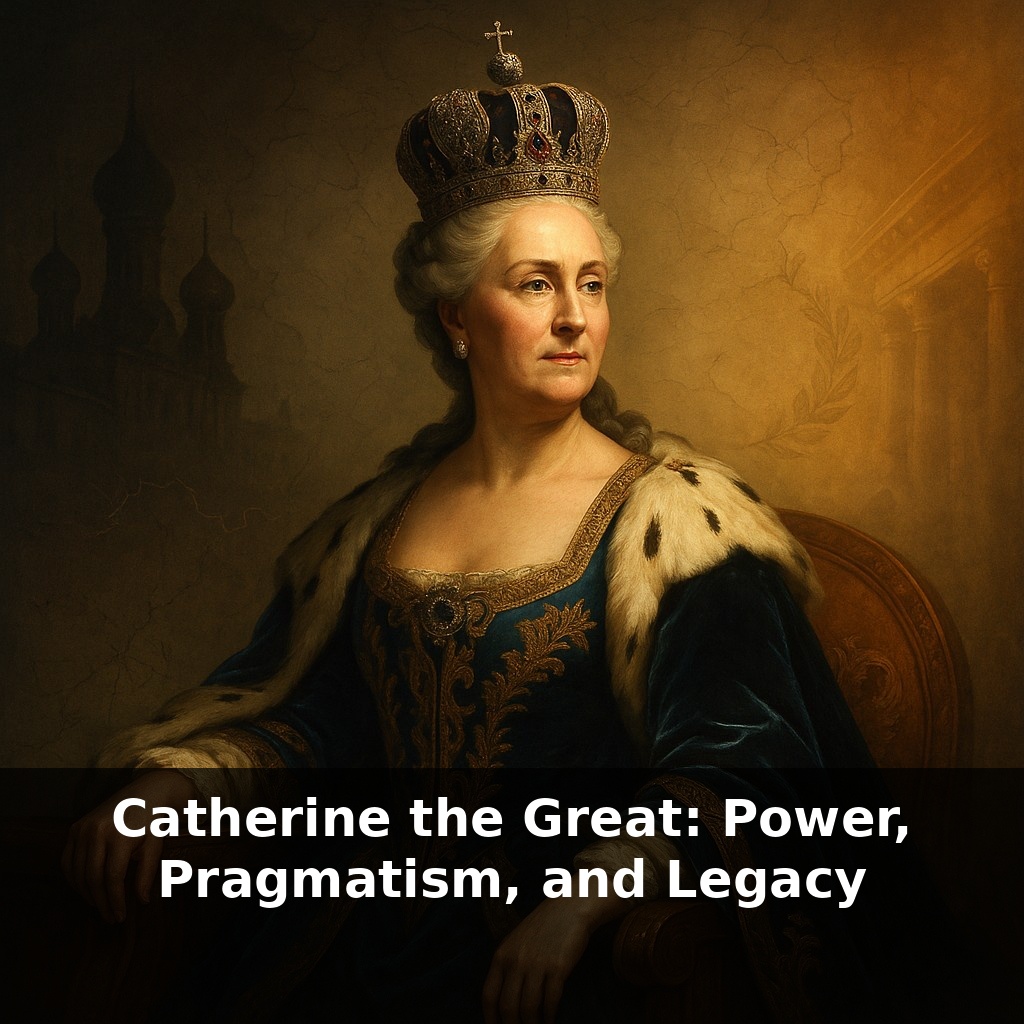
A German princess stages a bloodless coup, topples her own husband, and becomes “the most absolute sovereign in Europe”—all while praising liberty and reason. How does someone speak like a philosopher, rule like an autocrat, and still be called “the Great”?
Catherine didn’t just seize a crown; she inherited a problem: how do you modernize a sprawling, fragile empire without loosening your own grip? Russia in the mid‑18th century was a patchwork of languages, loyalties, and local powers, closer to a chaotic group chat than a unified state. Elites wanted status, officers wanted pay, peasants wanted protection, and Europe’s great powers circled like creditors eyeing a risky investment. Into this mess walked a ruler fluent in French philosophy and Russian court intrigue, determined to make her empire look “Enlightened” enough to impress Paris, yet strong enough to scare Prussia and the Ottomans. She would redraw borders, rewrite laws on paper, and rebrand Russia as a civilized great power—while quietly making sure that every new reform still pointed back to her.
To do that, she first had to secure the basics: loyalty at the top and obedience at the bottom. Catherine showered nobles with privileges, turning service to the crown into something closer to owning stock in the regime—your fortune rose as hers did. At the same time, she tightened the screws on millions of peasants, whose labor underwrote every grand project. Abroad, she watched rivals like a cautious investor tracking volatile markets, buying influence in Poland, pressing south toward warm‑water ports, and only gambling on war when the odds looked tilted in her favor. For Catherine, ideals were useful; survival was non‑negotiable.
Catherine’s favorite tools weren’t armies or palaces, but paper and performance. Early in her reign she drafted the *Nakaz*, a grand instruction manual for how Russia ought to be governed, stuffed with quotes and paraphrases from Montesquieu and Beccaria. She sent it to a huge Legislative Commission, hundreds of delegates summoned to advise on a new law code. On the surface, it looked like she was inviting the country into a conversation about justice. In practice, it let her survey opinions, flatter elites with a sense of importance, and broadcast to Europe that Russia now spoke the language of sophistication. When the meetings grew unruly and the delegates began drifting toward topics she didn’t like—especially anything hinting at limits on her authority—the whole experiment quietly fizzled. The law code never materialized, but the image of a thoughtful reformer stuck.
She applied the same blend of theater and calculation to society. Catherine poured money into academies, salons, and translations, helping Russian nobles read and debate like their French counterparts. She stocked her growing Hermitage with thousands of imported paintings, turning Western culture into a kind of soft power she could host, curate, and control. Yet the dazzling conversations and galleries were mostly for a sliver of society at the top. Below them, she expanded the rights of landowners over serfs, especially in newly acquired regions, binding more people to estates just as she preached “humanity” in public.
War and diplomacy followed this double track too. Victories against the Ottoman Empire opened access to the Black Sea and brought Crimea under Russian control, while the partitions of Poland pushed her borders deep into central Europe. Each gain was dressed up as restoring order or protecting co‑religionists, but the real payoff was leverage: more subjects to tax, more land to grant loyal followers, more buffers against rivals. Her reign became a long exercise in turning lofty language into cover for very grounded goals—security, prestige, and a throne that looked immovable.
Catherine’s real genius shows when you zoom in on how she handled crises. Take the Pugachev Rebellion (1773–1775): a former officer claimed to be her murdered husband and rallied tens of thousands of desperate peasants and Cossacks. Catherine didn’t respond with philosophy; she responded with logistics—troop movements, supply lines, and ruthless reprisals—then used the shock to justify tightening noble control over the countryside. Or look at her response to the French Revolution. The same woman who once quoted French writers now banned their works, cracked down on Russian radicals, and recast herself as guardian of order against “contagious” ideas. In modern terms, she treated political ideals like a seasoned investor treats tech trends: exciting when they boost value, disposable when they threaten the core business. Even in city planning—laying out grids in new southern towns, awarding land to favored officers—she fused image and utility, making each new settlement both a billboard of progress and a fortress of control.
Your challenge this week: pick one tough decision you’re facing where ideals and self‑interest pull in different directions. For seven days, keep a short “Catherine log.” Each time you lean toward the pragmatic choice, jot down: 1) what value you’re bending, 2) what risk you’re avoiding, and 3) how you’d publicly justify that choice if you had to explain it to a skeptical audience. At week’s end, read your seven entries as if you’re an outside historian writing about you. Are you comfortable with the pattern you see—or are there places where you’re using “big ideas” mainly to defend what benefits you?
Today, leaders still copy Catherine’s playbook: advertise progress, keep control. Think of “smart cities” packed with sensors—sold as efficient, yet quietly expanding surveillance. Or central banks pushing digital currencies that promise inclusion while tightening oversight. Her story suggests we should always ask: who holds the off‑switch? As debates over data rights, platform power, and national memory heat up, Catherine’s ghost lingers in every “upgrade” that quietly narrows our room to say no.
Catherine’s legacy sits in that uneasy space between admiration and suspicion. She proved you can widen roads, fund theaters, and sponsor “improvements” while quietly tightening the locks. When you see new policies, platforms, or “innovations” today, it’s worth asking: are these doors being opened for everyone—or just windows being polished on the same old fortress?
Try this leadership exercise daily: Identify a complex situation in your work that needs stabilizing, akin to Catherine’s reforms. Spend a few moments prioritizing one aspect you can improve slightly, such as enhancing team communication with a clear update or streamlining a process for efficiency. This should be your ‘enlightened action’—a small yet impactful move that drives positive change incrementally.