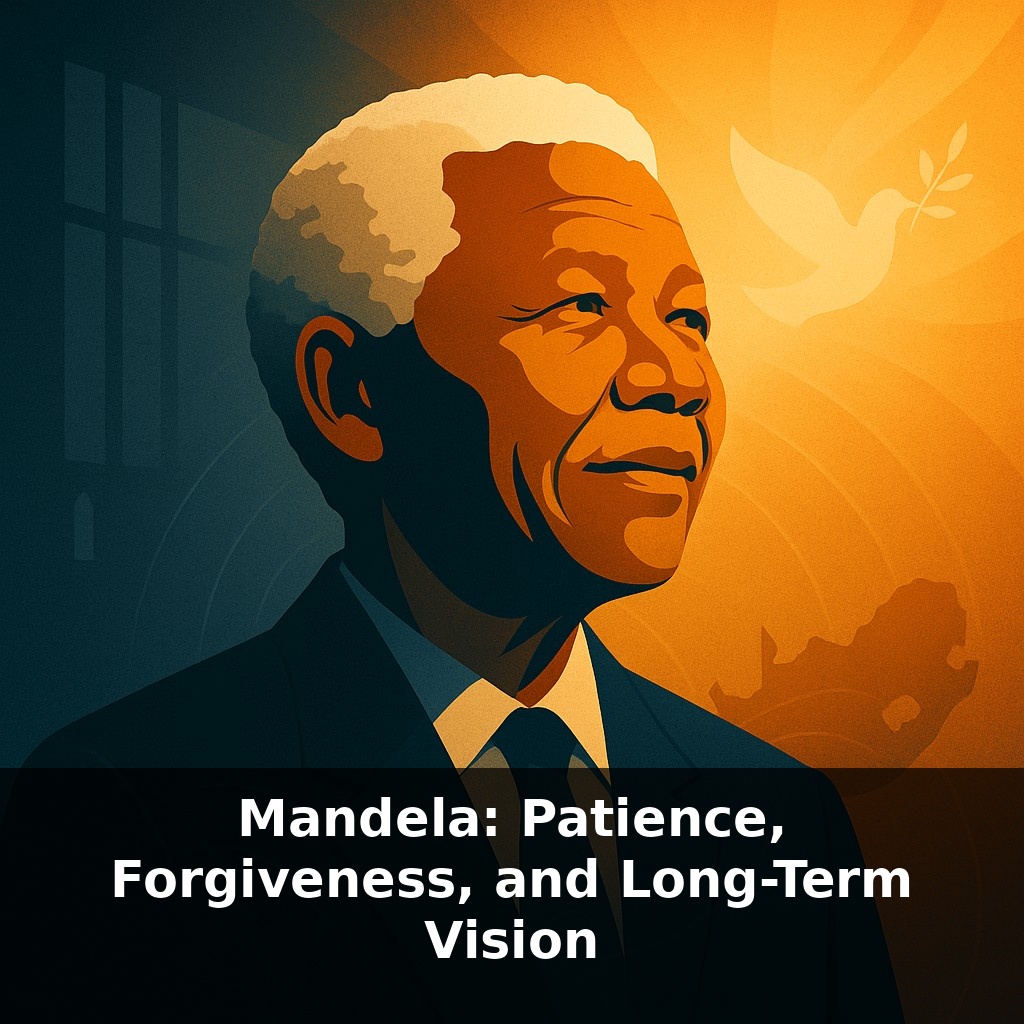
Twenty-seven years in prison, and Nelson Mandela walks out with a smile, not a clenched fist. A leader who loses decades of his life, yet chooses patience over rage, forgiveness over revenge. How does someone turn that kind of suffering into a long-term strategy for peace?
Mandela didn’t just endure prison; he used it as a lab. On Robben Island, he studied his opponents’ language, history, and fears the way a coder studies legacy systems before rewriting them. He learned Afrikaans, debated warders about politics, and quietly mapped out how a future South Africa could include the very people guarding his cell. This wasn’t naïveté; it was design. By the time the regime finally met him at the negotiating table, he knew their internal splits, their red lines, and their deepest anxieties about “losing” the country. He also understood his own movement’s hunger for justice—and its capacity for chaos if left unmanaged. Mandela’s genius was to turn these opposing pressures into a single, shared project: a country no side would win outright, yet none would be doomed to lose forever.
Mandela also understood timing. By the late 1980s, apartheid was wobbling: global sanctions bit hard, the Cold War was thawing, and business leaders quietly feared permanent isolation. Instead of pushing for total victory, he framed talks as a way to rescue everyone from a dead-end system. Inside the ANC, he argued not just for what they were fighting against, but what living together would actually look like—schools, policing, even sports teams. Like a software architect refactoring a live system, he accepted messy, incremental changes now to avoid catastrophic crashes later.
Mandela’s real leverage wasn’t just moral; it was structural. He saw that if apartheid collapsed in a civil war, the new state would inherit rubble: no economy to fund schools, no trust to staff institutions, no credit to borrow for rebuilding. So he treated each negotiation not as a showdown, but as a way to pre‑build the foundations of the future state while the old one was still standing. Constitutional talks weren’t side quests; they were the main arena where tomorrow’s rules were written by yesterday’s enemies.
Look at how specific he was about power. He didn’t push for a simple “winner-takes-all” handover. Instead, he backed a phased transition: a Government of National Unity, power-sharing cabinets, and a constitution that locked in minority protections alongside majority rule. That architecture gave nervous white voters and business elites something concrete: guarantees about property, language rights, and an independent judiciary. In return, the ANC secured irreversible control over the big levers—universal suffrage, a bill of rights, and a roadmap to phase out temporary power‑sharing.
He was equally granular with his own movement. Instead of romanticizing “the people,” he worried about undisciplined anger turning liberation into factional score‑settling. He spent enormous political capital insisting on centralized command of armed units, codes of conduct for cadres, and later, acceptance of compromises that felt emotionally unsatisfying but strategically necessary. When radicals accused him of selling out, he didn’t flinch from confronting them publicly, precisely because he knew the old regime was watching for any excuse to walk away from the table.
His stance on justice showed the same pattern. The Truth and Reconciliation Commission wasn’t a soft option; it was a hard bet that truth plus conditional amnesty would stabilize a fragile democracy more effectively than mass trials or blanket impunity. By tying amnesty to full disclosure, the TRC surfaced hidden atrocities while signaling that the new South Africa would not mirror the old regime’s vengeance. That choice protected the security forces from existential panic, yet honored victims with voice, record, and recognition.
In all this, Mandela kept returning to one test: will this decision make it easier or harder for future leaders—people not yet born—to govern a shared country? That question, more than any single speech or symbol, is what turned a negotiated truce into a durable, if imperfect, democracy.
Mandela’s discipline shows up in tiny, concrete choices. During negotiations, he insisted on wearing carefully tailored suits, not as vanity, but to signal to white officials and Black township leaders alike: “I’m already behaving like a head of state; treat this process as state‑craft, not a skirmish.” He also kept meeting with hardline Afrikaner leaders at their farms and clubs—spaces where they felt strong—precisely to lower the emotional temperature enough to discuss real concessions.
His approach resembles a careful software rollout: you don’t hit “deploy to all users” on day one; you ship to a small, skeptical beta group first, learn their fears, then roll out more widely with safeguards built in. Mandela’s “beta tests” were quiet meetings with generals, business leaders, and church figures—each conversation a way to debug the transition before the public “launch” of democracy.
Modern parallels? Think of Satya Nadella reshaping Microsoft’s culture, or Rwanda’s post‑genocide *gacaca* courts—different contexts, but the same principle: design process so former rivals can risk cooperating without feeling defenseless.
Polarized democracies today face a quieter version of South Africa’s crossroads. Deepfakes, rage‑bait politics, and economic shocks act like constant micro‑fractures in the social fabric. Mandela’s model hints that we may need “civic TRCs” in digital form: independent forums that surface manipulated narratives, require public clarification, and let rival groups correct the record together—less a courtroom, more a shared debugging session for a society’s operating system.
Mandela’s real provocation to us isn’t moral perfection; it’s operational curiosity: how do you redesign a future with people you don’t trust yet? Your challenge this week: pick one ongoing conflict—at work, in your community, or online—and ask, “What rule or habit, if we changed it today, would make cooperation slightly less risky for both sides?”