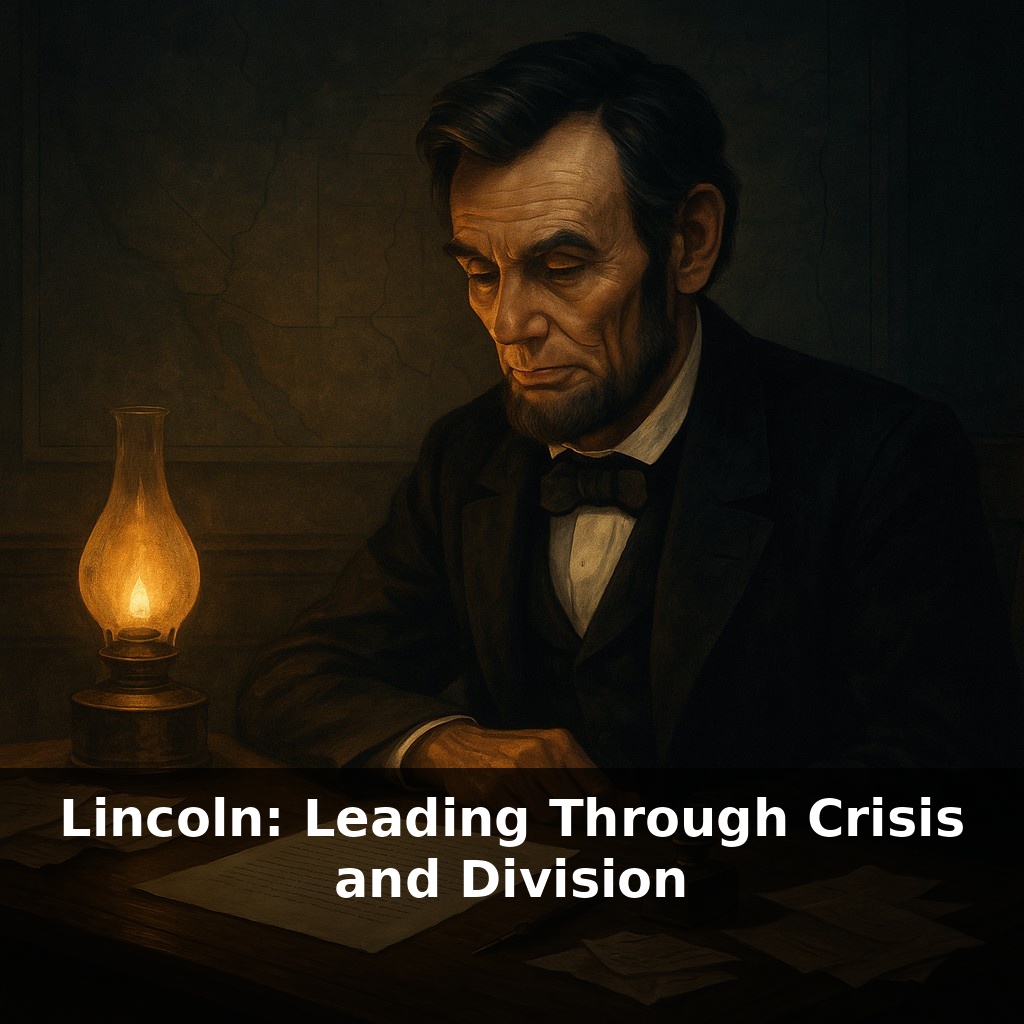
A president once wrote over a thousand public letters, yet many of his most powerful decisions began as notes he never sent. In this episode, we step into war rooms, late-night writing sessions, and bitter cabinet feuds to uncover how Lincoln led a country tearing itself apart.
Lincoln’s leadership looked calm from a distance, but up close it was a blur of drafts, reversals, and careful timing. While the country split along battle lines, he was tracking a different front line: public opinion, border states, foreign governments, even factions inside his own party. Think of a cook watching several pots at once—turning down the heat on one issue, turning it up on another—so the whole meal would be ready at the same moment.
In this episode, we’ll explore how Lincoln: - Tested ideas privately before announcing them - Turned defeats into arguments for deeper reform - Used short, plainspoken messages to shift the country’s moral center
We’ll follow him not just as commander-in-chief, but as strategist-in-chief of a fragile democracy under stress.
Lincoln was also doing quiet math. He knew the Union’s larger population meant more soldiers and factories—but also more grieving families, more newspapers to win over, more local elections that could turn against the war. As casualty lists grew, he had to keep support alive without promising quick victories he couldn’t deliver. That’s where his moral aims came in. By tying the conflict to slavery and equality, he shifted it from a fight over “policy” to a test of the nation’s character, like changing a software update into a full system reboot of American ideals.
Lincoln’s next move was to assemble people who would, on paper, never choose to work for him. He brought former rivals like William Seward and Salmon Chase into his cabinet, not as window dressing, but as daily sparring partners. They disagreed with him in front of others, challenged his assumptions, and leaked to the press. Instead of shutting that down, he treated it as a live test environment: if an idea survived their criticism, it might survive the country’s.
But he drew a sharp line between internal chaos and external clarity. Inside, arguments could rage for hours; outside, the message had to be crisp and steady. That’s where his skill with short speeches and carefully staged announcements came in. He didn’t leap straight to sweeping moral declarations. He moved stepwise: first framing the war as a fight to save self-government, then gradually tying victory to a new birth of freedom.
The Emancipation Proclamation is a case study in this pacing. Lincoln waited for a military turning point, then issued a preliminary warning months before the final order took effect. That delay wasn’t hesitation alone; it was time for soldiers, voters, and nervous border states to absorb what freedom for millions would mean. He matched legal language to battlefield reality, so the policy wouldn’t float in the air, disconnected from events.
At the same time, Lincoln spent huge amounts of energy on individual cases—especially death sentences for deserters. He read petitions, asked for background, and often granted pardons. This wasn’t softness; it was calibration. He wanted discipline without turning the war into a machine that chewed up poor farmers and frightened teenagers with no second chances.
His most famous words in places like Gettysburg were astonishingly brief, but they rested on this dense web of political tradeoffs, human stories, and incremental moves. The speech didn’t introduce a new goal so much as distill months of painful evolution into a few sentences the country could carry into its next, bloodier chapters.
Lincoln’s habit of granting dozens of pardons a month wasn’t random mercy; it was targeted course correction. Think of how a modern tech company handles a massive platform: the core rules stay firm, but engineers constantly push small patches to prevent the system from failing real users in edge cases. Lincoln treated military justice that way—upholding discipline while “patching” verdicts that didn’t fit the larger purpose of the war.
You can see the same pattern in how he refined his message. The Gettysburg Address wasn’t just short; it was the product of countless earlier attempts to speak to grief-stricken families, skeptical editors, and party leaders pulling in different directions. Each audience gave him data. He noticed which phrases cooled tempers in one region but sparked hope in another, which moral arguments united farmers, abolitionists, and soldiers long enough to keep them pulling in roughly the same direction.
Leaders now face algorithm-driven outrage, climate shocks, and culture wars that move faster than any 19th‑century crisis. Lincoln’s mix of moral direction and tactical patience hints at a playbook: treat social data like a weather report, not a script; use it to time moves, not choose values. Coalition‑building becomes less about perfect agreement and more about shared “red lines,” like a neighborhood deciding which houses must be protected first when a wildfire jumps the ridge.
Lincoln’s real legacy for today’s leaders sits in the gap between conviction and control: you can’t script outcomes, only raise the odds. Like a careful investor, he spread “bets” across people, timing, and language, knowing some would fail. The lesson isn’t to copy his moves, but to ask: where can I hold my direction and still loosen my grip?
To delve deeper into Lincoln's leadership, try these steps: (1) Examine a recent decision-making process within your team and apply Lincoln's method of incorporating diverse opinions by adding a 'devil's advocate' role for balanced perspective. (2) Host a discussion based on Lincoln’s Second Inaugural Address to practice how moral clarity and humility can enhance your leadership communication. (3) Craft your 'crisis communication strategy' by referencing Lincoln’s Annual Message to Congress, focusing on transparent updates and resilient team cohesion during challenging times.