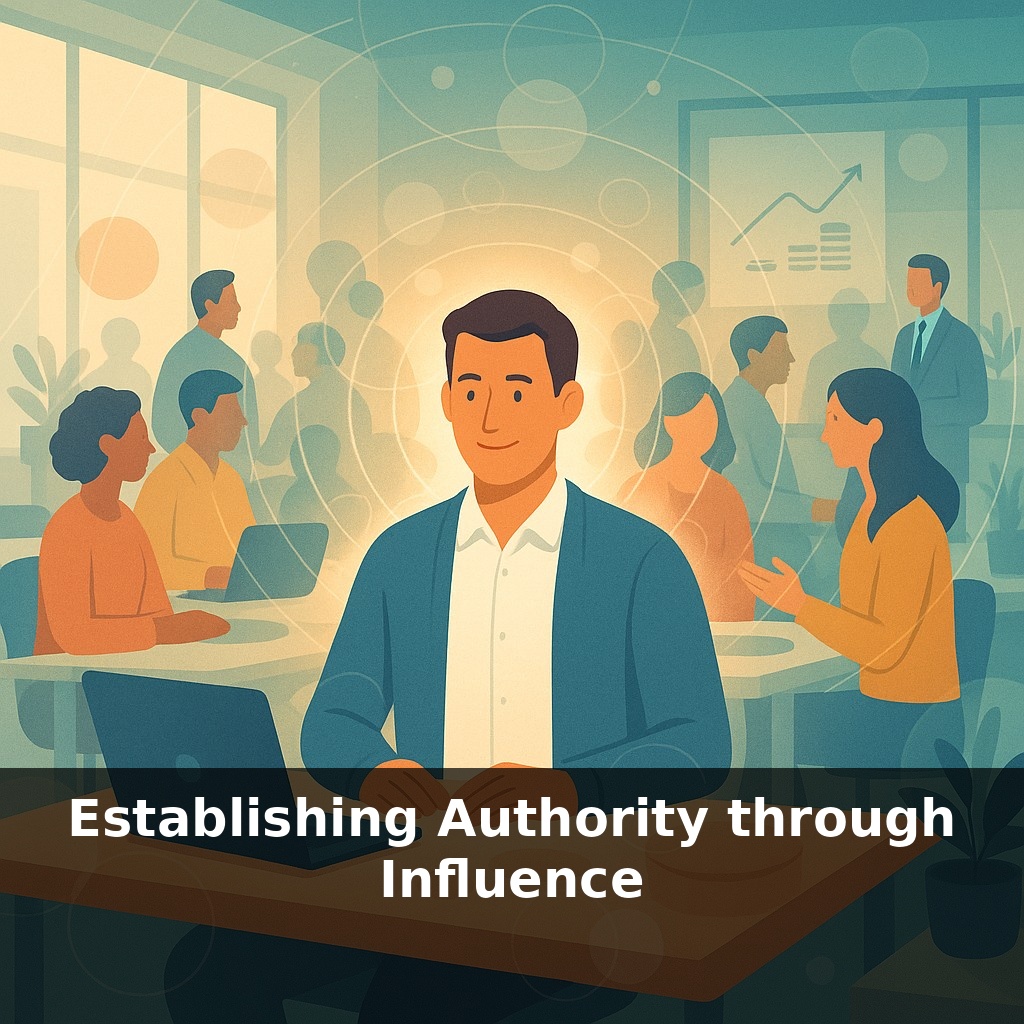
In a hectic office, everyone seems to follow one peer’s lead rather than the manager. The surprising factor? It's the perception of reliability. Today, we’re stepping into that invisible space where real authority is earned.
Think of influence-based authority as the compound interest of leadership: small, consistent deposits of behavior that quietly grow into something powerful over time. In flatter, cross-functional environments, people don’t “have to” follow you just because your name sits higher on an org chart. They choose to follow the people whose competence, character, and clarity make work easier, safer, and more meaningful.
This is where three forces quietly shape your impact: how clearly others see your expertise, how deeply they trust your intent, and how strongly they believe you’re committed to a shared purpose—not just your own agenda. When those elements align, your words carry more weight in the room, your ideas get oxygen, and your feedback stops feeling like criticism and starts feeling like a resource others seek out.
Authority built on influence shows up in tiny, practical moments: who people turn to when a project is stuck, whose opinion quiets the room, whose feedback teammates actually request. It’s less about big speeches and more about hundreds of small “micro-votes” others cast in your direction each day. Those votes tend to follow three signals: clear competence in something that matters to the team’s goals, consistent behavior that matches your words, and a visible concern for others’ success. Like a well-designed app, when you remove friction, reduce confusion, and make others’ work smoother, your influence quietly escalates.
Influence-based authority grows fastest when people can answer three quiet questions about you with “yes”:
1. **“Do they actually know what they’re talking about?”** 2. **“Do they follow through when it matters?”** 3. **“Do they care about something bigger than themselves—and about me?”**
Most leaders focus almost entirely on the first question—stacking credentials, frameworks, and tools. But in practice, “perceived competence” is less about how much you know and more about how quickly and clearly you reduce uncertainty for others.
Notice who gains influence in tense meetings. It’s often the person who can do three things in sequence: name the real problem without blame, propose a next step that feels doable, and explain the trade-offs honestly. They might not be the most senior or the loudest, but they convert chaos into clarity. That’s the kind of expertise people remember and return to.
Credibility signals help here. A visible track record of solving specific types of problems—launch risks, stakeholder conflict, messy data—makes it easier for others to route decisions to you. That doesn’t require a big stage. It can be as simple as: you always send a short, sharp summary after complex discussions; your estimates are usually close to reality; when you say “I’ll find out,” you actually do. Over time, people start thinking, “Loop them in; this will go faster.”
Relational behaviors answer the second and third questions. Listening without rushing to your own solution, asking one clarifying question before you give an opinion, or acknowledging someone’s concern before you counter it—these are tiny moves that signal, “I’m not here just to win; I’m here to understand.” In cross-functional work, that often matters more than whose idea is best on paper, because people are gauging whether partnering with you will cost them social capital.
A useful analogy: influence is like a well-designed API in software. Other “systems” (people, teams) plug into you when inputs and outputs are predictable, documentation is clear, and calls rarely fail. When interacting with you reduces friction instead of adding it, integration—and with it, authority—spreads through the network almost automatically.
That’s the shift: from trying to convince people to follow you, to becoming the most reliable interface for getting meaningful work done.
Think of two project leads in the same company. Both are smart. One hoards information, jumps into solutions, and treats every meeting as a stage. The other does something quieter: when a crisis hits, they start by asking, “What decision actually needs to be made now?” Then they sort what’s known from what’s guesswork and pull in the right people to fill gaps. Over time, stakeholders start informally routing hairy problems to the second lead—not because of title, but because tough conversations feel clearer and safer around them.
You see the same pattern outside work. In a friend group, there’s usually someone people call when they’re making a big life decision. That person isn’t always the oldest or most “successful”; they’re the one who remembers details, doesn’t weaponize your vulnerability later, and offers perspective without pressure. Their influence grows quietly, meeting by meeting, choice by choice, until their opinion carries disproportionate weight—without ever being demanded.
As AI tools quietly take over status reports and deadline reminders, what’s left on your side of the equation is the human work: interpreting grey areas, holding ethical lines, and turning fragmented input into a story people can act on. Influence shifts from “nice to have” to survival skill. Think of it like learning to navigate by landmarks instead of GPS; when systems fail, people will default to the person who can still orient the group and move them forward.
Think of every interaction this week as seasoning a dish: a pinch more curiosity here, a dash of follow-through there, and the overall flavor of how people experience you shifts. Your challenge this week: notice one moment per day where you could slow down, ask a better question, or clarify a next step—and actually do it. Watch whose posture toward you subtly changes.