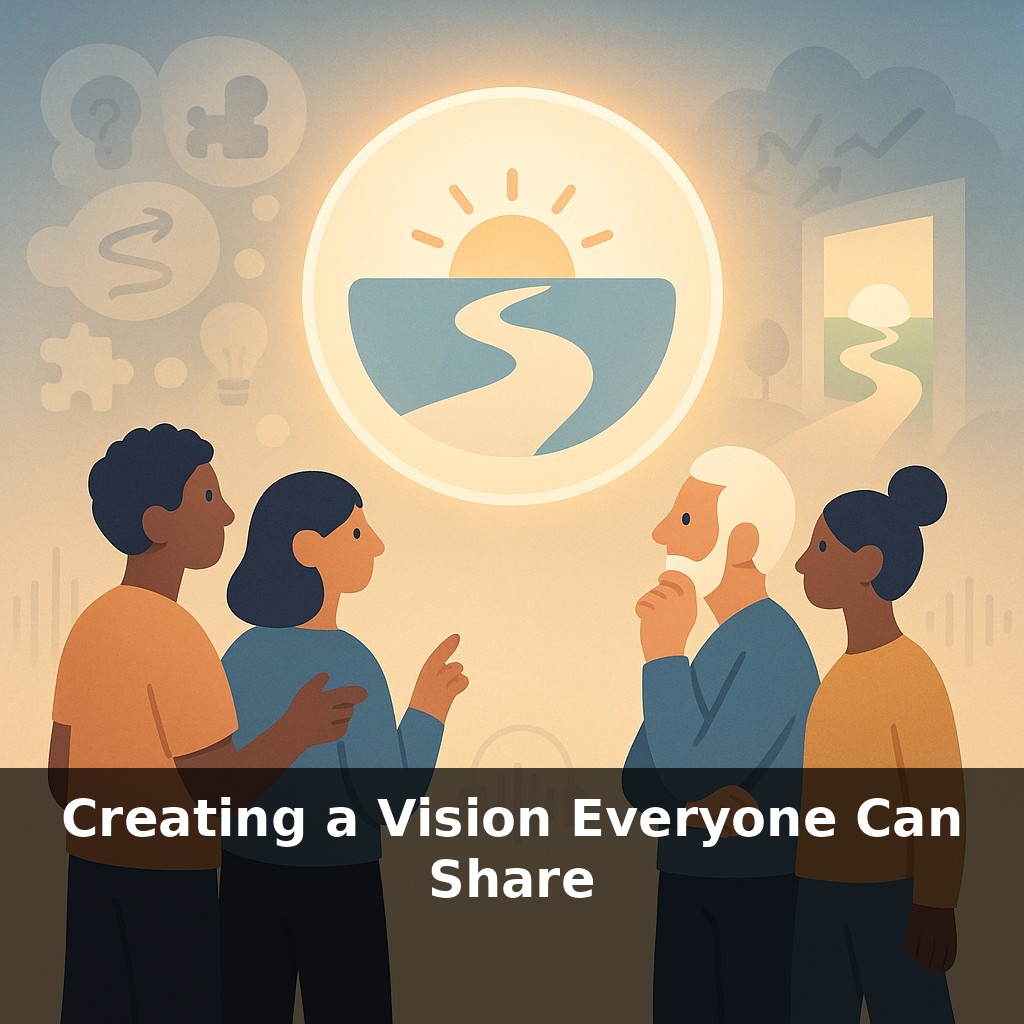
Research shows only about one in five people can repeat their company’s mission word for word—yet leaders still act shocked when no one follows it. In this episode, we’re diving into why your vision isn’t sticky, and how to turn vague slogans into something people can feel.
Most teams don’t lack intelligence or effort—they lack a picture they can actually see themselves in. When people hear lofty words with no concrete meaning, they quietly create their own mental version of “where we’re going.” That’s how you end up with five departments marching in slightly different directions, all convinced they’re aligned.
In this episode, we’re going to move from clever wordsmithing to building something people can almost touch. We’ll look at how to translate a distant future into scenes from an ordinary Tuesday at work: what customers are saying, what decisions people are making, what “a win” really looks like.
We’ll also explore why the way you *tell* the vision—your voice, your face, your consistency—often matters more than the exact phrasing, and how to involve others so the vision feels like *theirs*, not just *yours*.
Think of this next step less as “polishing words” and more as adjusting the lighting in a room so everyone can finally see the same details. The research is blunt: people remember what is concrete, emotional, and repeated in different forms—not what is abstract and clever. That means your offhand comments in meetings, the examples you highlight in Slack, even how you react in tense moments, all either sharpen or blur the shared picture. We’ll explore how to use small, everyday cues—like which metrics you praise or which stories you retell—to quietly pull everyone’s attention toward the same horizon.
Most leaders start vision work by staring at a blank page. High‑impact leaders start by staring at their people.
Before you wordsmith anything, ask: “In their world, what would ‘we’ve truly arrived’ *look like*?” Not for you, for them. A frontline engineer, a customer success manager, a regional director—each has a different daily reality. Your job is to find the overlap and turn it into a shared scene.
One practical way to do this is to collect “future snapshots.” In small groups, ask people to answer three prompts, but all in the present tense, as if it’s three years from now: - “What are customers thanking us for now that they don’t today?” - “What decisions feel easy that are hard right now?” - “What are you proud to tell friends you work on?”
Capture phrases, not paragraphs. You’re mining for recurring images and feelings: “we respond same‑day,” “we ship ideas faster,” “our tools just work,” “we’re the team others copy.” These become raw material for a vision people recognize as their own.
Next, run your draft through three filters:
1. **Concrete test** Circle every abstract word (e.g., “innovation,” “excellence,” “world‑class”). For each, ask, “How would we know?” Translate into behaviors or outcomes: “launching features weekly,” “90 % of support tickets solved in one interaction.”
2. **Emotional test** Read it aloud and notice your own body. Do you feel anything? If not, it’s probably safe but dead. Add a word or phrase that hints at stakes: who benefits, what changes, what is at risk if you don’t get there.
3. **Memory test** Say it once to someone, then, five minutes later, ask them to repeat *just the gist*. If they need more than about 20 words, you’re overcomplicating it. Remember: research shows shorter phrasing dramatically boosts recall.
Now comes the part most leaders skip: mapping the vision to micro‑moments. Take each key phrase and ask, “Where will this show up on a normal day?” If your vision says “decisions close to the customer,” decide: - Which approvals will you remove? - Which metrics will you stop asking for? - Which meetings will you redesign?
Think in terms of “if–then” cues: *If* we’re serious about X, *then* this is what changes in hiring, promotions, budgets, and recognition. Quiet misalignment here will kill belief faster than any speech.
A helpful way to stress‑test your draft is to show it to a skeptic, not a fan. Ask them, “Where does this feel like a poster, not a plan?” Anywhere they point is a place to add specificity: numbers, timeframes, or clear trade‑offs. If your vision never forces you to say “no” to something that sounds attractive, it’s not sharp enough yet.
Finally, remember that clarity doesn’t mean certainty. You can be vivid about direction while honest about unknowns: “Here’s what won’t change, here’s what might, here’s what we’ll learn together.” Paradoxically, naming the fog makes the path feel more trustworthy.
A tech startup I worked with had a beautifully phrased direction, but nobody could describe what “success” meant for their own role. Instead of another all‑hands speech, the CEO ran a “future shift” workshop. Each cross‑functional group got a simple prompt: “Walk me through your first 90 minutes at work two years from now, on a really good day.” People drew storyboards: a support rep sketched a live dashboard showing real‑time customer wins; an engineer drew a “red tape meter” set almost to zero; a salesperson drew a customer texting, “You made us look brilliant in front of our board.”
Patterns emerged without anyone debating slogans: faster learning cycles, fewer handoffs, customers bragging about them unprompted. Those images became the backbone of one short, memorable statement the team could actually *use* to make trade‑offs. Marketing shifted spend toward word‑of‑mouth triggers; product trimmed a feature that didn’t advance “customers bragging about us.” Sharing the pen made the direction harder to ignore, because ignoring it meant ignoring their *own* drawings.
Only 22 % of employees can recite their company’s mission, but AI can already summarize it in seconds. The real advantage isn’t having cleaner words—it’s having a *living* vision that keeps upgrading as your context shifts. Expect leaders to pull in data like customer sentiment, internal chat themes, even exit‑interview transcripts, then “compile” that input into shared direction, the way a developer ships new software builds without rewriting the whole codebase each time.
Your challenge this week: **Run a 5‑day “micro‑vision experiment” with your team.**
Day 1: Ask three people (different levels/functions), “If we were wildly successful in 3 years, what would you *see* that’s different from today?”
Day 2: Turn what you heard into one draft sentence (max 20 words). Don’t polish; just capture the core image.
Day 3: Share it with the same three people. Ask, “What feels true? What feels like a poster on the wall?”
Day 4: Edit using their feedback. Tighten verbs, add one concrete outcome, cut buzzwords.
Day 5: In a regular meeting, test it: connect one real decision to that sentence and make a visible trade‑off because of it.
Notice: Where did people lean in? Where did they look confused? That’s data for your next iteration, not a verdict on your leadership.
Treat your vision like a living prototype, not a finished sculpture. Keep shipping “version updates” as you learn: tweak a phrase after a tough quarter, refine examples after customer feedback, upgrade stories when new people join. The more you treat it as something you cook together and keep tasting, the more people will trust it enough to follow it.
Try this experiment: In your next team meeting, bring two versions of your vision for the next 12 months—one written as a dry, bullet-point plan, and one as a vivid story that starts with “It’s February 2027, and here’s what a great day at work looks like for us…” including specifics like how customers feel, what meetings look like, and how decisions get made. Read both out loud and ask each person to rate, on a sticky note from 1–10, how excited they feel about each version and which parts feel “most like us.” Then, spend 10 minutes having them rewrite one paragraph of the story in their own words to make it feel more shared and real, and notice what themes show up across their versions.